
What's inside: 10 resources. You get every file, and any updates the creator makes later.
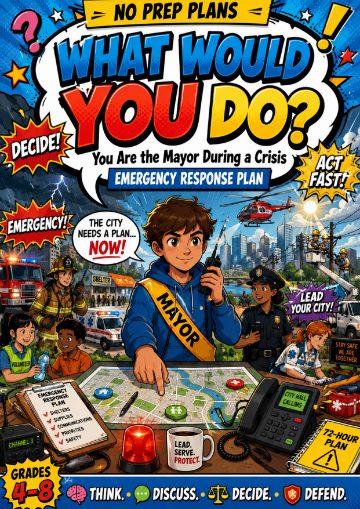 Emergency Preparedness Activity | Critical Thinking & Decision Making | 4th-8thPDF, 16 pages
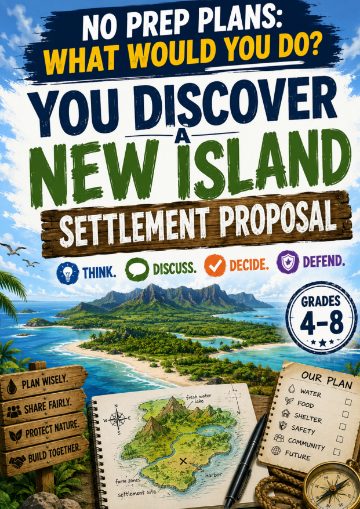 Build a Sustainable Community | Settlement Planning Project |Geography ActivityPDF, 16 pages
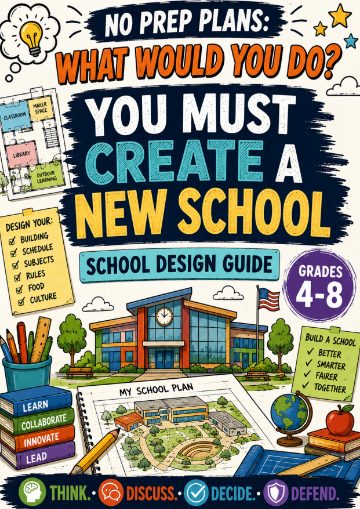 School Design Project | Critical Thinking & School Planning Activity Grades 4-8PDF, 16 pages
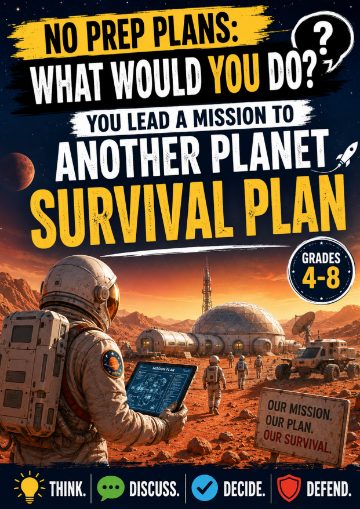 Mars Mission Project | Space Exploration STEM Activity | Grades 4-8PDF, 16 pages
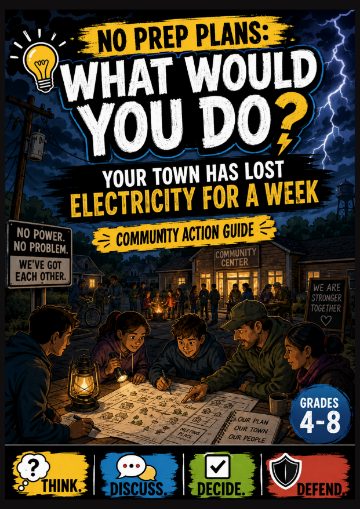 Power Outage Survival Project | Blackout Critical Thinking Lesson | Grades 4–8PDF, 16 pages
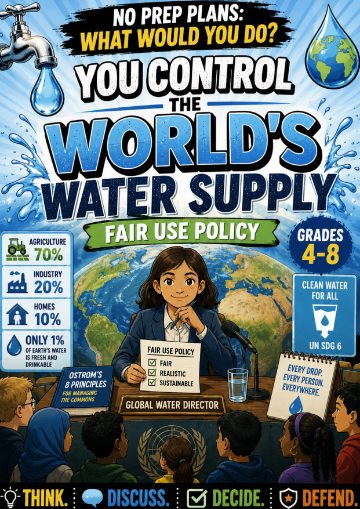 Global Water Crisis Activity | Water Scarcity & Sustainability Project | 4th-8thPDF, 16 pages
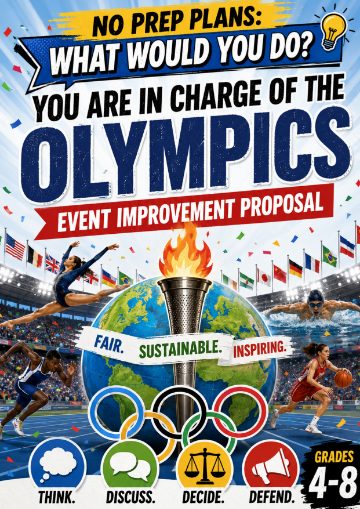 Olympic Games Redesign Project | Sports Leadership & Critical Thinking |4th-8thPDF, 16 pages
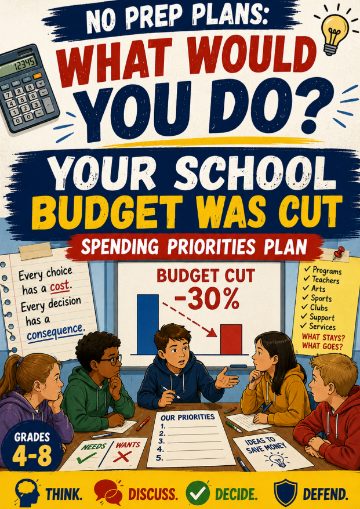 School Budget Cuts Project | Critical Thinking & Decision Making |Grades 4-8PDF, 16 pages
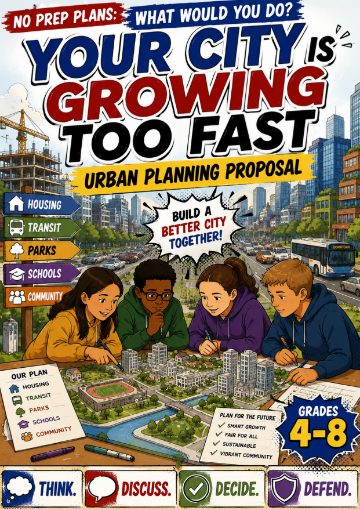 Urban Planning Activity | City Growth Project | Critical Thinking-Grades 4-8PDF, 16 pages
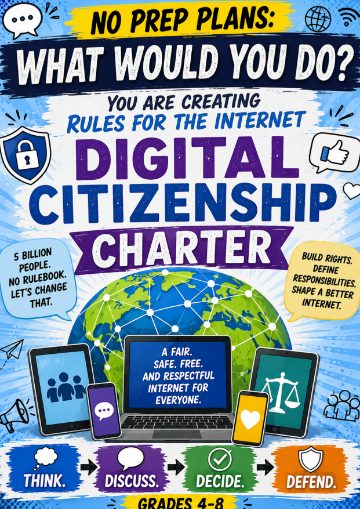 Internet Safety & Online Responsibility | Critical Thinking |Digital CitizenshipPDF, 16 pages
$27.00
Bought separately: $30.00
In your cart. View cart
No account needed. You get a download link.
| Grade | 4th Grade to 8th Grade |
|---|---|
| Resource type | Projects |
| Subject | Geography |
| Format | Bundle of 10 resources |
| How was this made? | Created by hand, with images from generation tools |
| Updated | 2026-10-26 |
Real World Scenarios | Debate, Discussion & Decision Making | Grades 4–8
No Prep Plans: What Would You Do?
10 Real World Decision-Making Lessons Grades 4–8
Think. Discuss. Decide. Defend.
What would you do if the decision was yours to make?
This engaging bundle places students in the role of real-world leaders facing authentic dilemmas with no single correct answer. Instead of memorizing facts, students analyze evidence, consider multiple perspectives, weigh competing priorities, and defend their decisions using reasoned arguments.
Every lesson is built around an authentic scenario inspired by real challenges faced by governments, communities, businesses, scientists, and international organizations. Students quickly discover that leadership is rarely about finding perfect solutions—it is about making thoughtful choices, balancing trade-offs, and explaining decisions with confidence.
Using the consistent Think. Discuss. Decide. Defend. framework, every lesson encourages collaboration, critical thinking, respectful discussion, and evidence-based decision making.
What's Included
- Teacher Directions (1–3 class periods)
- Overview & Mini Research Page
- Collaborative Group Activity
- Student Page 1 – Think
- Student Page 2 – Discuss
- Student Page 3 – Decide & Defend
- Final Project Page
- Full-Color Version
- Black-and-White Version
- Print-ready PDF
Lessons Included
- You Must Create a New School — School Design Proposal
- You Discover a New Island — Island Development Plan
- Your Town Has Lost Electricity for a Week — Emergency Response Plan
- You are the Mayor During a Crisis — Community Crisis Action Plan
- You Control the World's Water Supply — Fair Use Policy
- Your City Is Growing Too Fast — Urban Planning Proposal
- You Are Creating Rules for the Internet — Digital Citizenship Charter
- You Are in Charge of the Olympics — Event Improvement Proposal
- Your School Budget Was Cut — Spending Priorities Plan
- You Lead a Mission to Another Planet — Planet Settlement Proposal
Students Will Learn About
- Critical thinking
- Decision making
- Leadership
- Stakeholder analysis
- Trade-offs
- Ethical reasoning
- Civic responsibility
- Collaboration
- Discussion skills
- Evidence-based argument
- Global citizenship
- Sustainable development
- Urban planning
- Digital citizenship
- Resource management
- Emergency preparedness
- Economics
- Public policy
- Problem solving
- Communication
Perfect For
- Social Studies
- Civics
- Geography
- STEM
- Advisory
- Character Education
- Leadership
- Gifted & Talented
- Project-Based Learning (PBL)
- Inquiry-Based Learning
- Critical Thinking units
- Debate and Discussion
- Fast Finishers
- Enrichment
- Substitute Plans
- Middle School Humanities
Why Teachers Love It
- Students tackle authentic, high-interest problems that mirror real decisions made by leaders around the world.
- Every lesson promotes higher-order thinking through analysis, discussion, evaluation, and justification.
- The consistent lesson structure makes implementation simple while giving students confidence with the routine.
- Encourages respectful debate and evidence-based discussion rather than searching for one "right" answer.
- Naturally integrates geography, civics, economics, environmental studies, digital citizenship, engineering, leadership, and communication.
- Large writing spaces and thoughtfully designed project pages encourage meaningful responses instead of one-word answers.
- Flexible for individual work, partners, or collaborative groups.
- Minimal teacher preparation required.
- Easily adapted for one class period or extended over multiple lessons.
- Includes both full-color and black-and-white versions for flexible printing.
The Think. Discuss. Decide. Defend. Framework
Every lesson follows the same engaging learning process:
- Think – Understand the challenge, identify stakeholders, gather information, and recognize competing priorities.
- Discuss – Explore different viewpoints, debate possible solutions, and analyze the trade-offs.
- Decide – Develop a well-reasoned solution or proposal based on evidence.
- Defend – Justify decisions, reflect on the process, and communicate recommendations with confidence.
Rather than asking "What's the right answer?", this series challenges students to ask "What's the fairest, wisest, and most defensible decision?" Through realistic scenarios, students build the habits of thoughtful leaders while developing the communication, collaboration, and critical thinking skills they'll use for life.
·
Questions
No questions yet.
Ask a question
Your question goes to No Prep Plans. Answers show on this page, without your name or email.
Sent. The answer will show on this page.
Reviews
No reviews yet. Buyers can review a resource from their order page.
More from No Prep Plans
Campus Happiness Index
 No Prep Plans
$3.00
Book Labels
No Prep PlansFree

Big Band & Jazz Musicians Poster Set (1930s–1950s)
No Prep Plans$3.50
FREE Geography Learning Stations Signs & Choice Cards--Reusable
No Prep PlansFree
Refugee: Author's Craft, Themes & Evidence Bundle 10 Literary Analysis Lessons
No Prep Plans$29.25
Ancient World Turning Points Bundle | 10 Research + Group Project Lessons | 6-10
No Prep Plans$29.25
Request a quote or purchase order
For schools and districts. Your request goes to No Prep Plans, who will reply to your email with a quote or invoice.
Sent. The seller will reply to your email.
Report this listing
What your notice must include
The address of the listing on Classroom Clearinghouse (for example, the /p/ link).
https://classroomclearinghouse.com/p/xhu4wgjvtu
Your name, mailing address, phone number, and email.
How to report
Your name, company, mailing address, phone number, and email.
The address of each listing or store you are reporting.
https://classroomclearinghouse.com/p/xhu4wgjvtu
Copyright owners can also use the DMCA notice page.
Thanks. The report is in the review queue.