
Preview: 3 of 16 pages. Scroll sideways to see more.
$3.00
In your cart. View cart
No account needed. You get a download link.
| Grade | 4th Grade to 8th Grade |
|---|---|
| Resource type | Projects |
| Subject | Geography |
| Format | PDF, 16 pages |
| How was this made? | Created by hand, with images from generation tools |
| Updated | 2026-10-26 |
Global Water Crisis Activity | Water Scarcity & Sustainability Project | 4th-8th
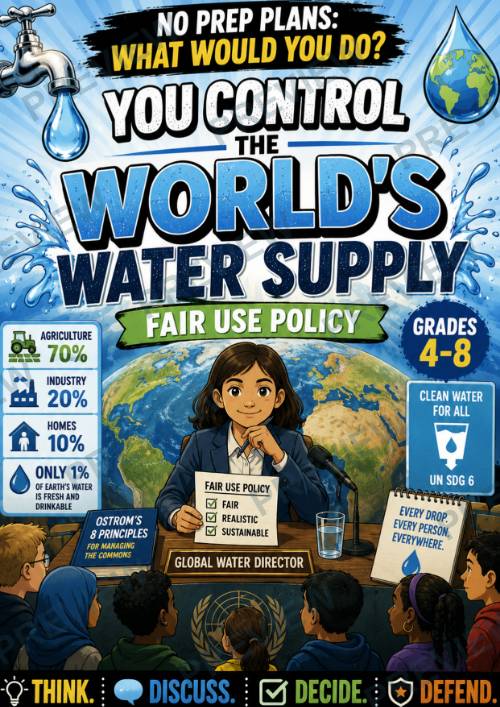
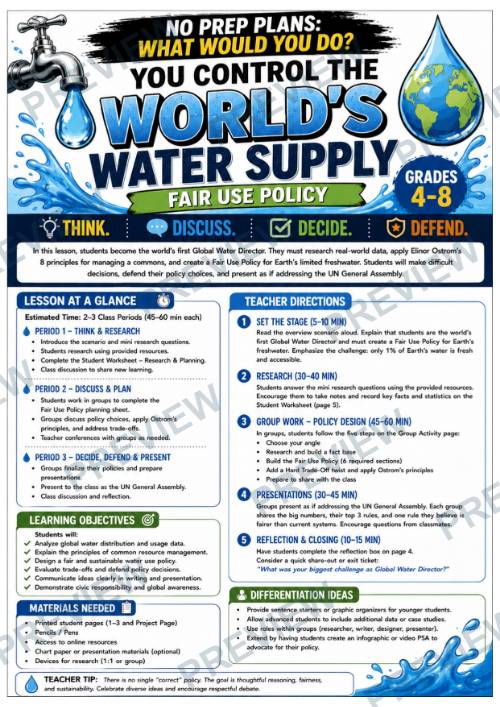
No Prep Plans: What Would You Do?
You Control the World's Water Supply--Fair Use Policy
Grades 4–8
Think. Discuss. Decide. Defend.
What if you had to decide how to share the world's freshwater fairly?
In this engaging, real-world decision-making lesson, students become the world's first Global Water Director. Their challenge is to create a fair and sustainable policy for sharing Earth's limited freshwater among more than 8 billion people. Students must balance the needs of agriculture, industry, cities, ecosystems, and countries experiencing severe water shortages while making difficult ethical decisions with no perfect solution.
Inspired by the research of Nobel Prize-winning economist Elinor Ostrom and connected to United Nations Sustainable Development Goal 6: Clean Water and Sanitation, this lesson challenges students to think like global leaders while developing practical solutions to one of humanity's greatest challenges.
There is no single correct answer. Students must evaluate trade-offs, analyze competing priorities, justify policy decisions, and defend their reasoning using evidence and critical thinking.
What's Included
- Teacher directions (1–3 class periods)
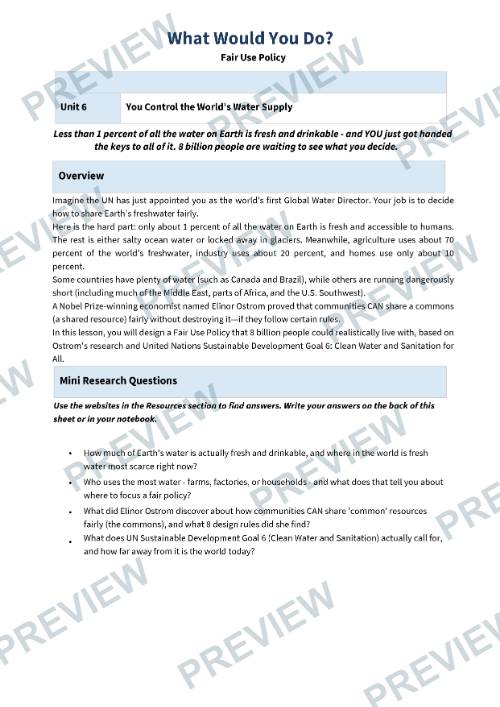
- Student Page 1: Think – Investigate freshwater scarcity, identify competing water needs, distinguish facts from opinions, evaluate priorities, and determine what information is needed before creating a policy.
- Student Page 2: Discuss – Compare different water-sharing systems, debate leadership decisions, evaluate difficult trade-offs, challenge opposing viewpoints, and consider how climate change may affect future water security.
- Student Page 3: Decide & Defend – Develop a complete global water policy, justify key decisions, reflect on leadership, evaluate long-term sustainability, and defend the fairness of the final proposal.
- Fair Use Policy Project Page – Design a comprehensive global water policy including freshwater data, world water map, fair-use rules, decision-making system, conservation strategies, international cooperation, future planning, and an "Impossible Problem" challenge.
- Full-color version
- Black-and-white version
- Print-ready PDF
Students Will Practice
- Critical thinking
- Ethical decision-making
- Global citizenship
- Sustainability planning
- Environmental literacy
- Systems thinking
- Leadership
- Evidence-based reasoning
- Collaboration
- Communication
- Civic responsibility
- Problem solving
- Geographic thinking
- Policy development
Perfect For
- Geography
- Environmental Science
- Earth Science
- Social Studies
- Civics
- Sustainability units
- United Nations SDG lessons
- STEM activities
- Project-Based Learning (PBL)
- Leadership lessons
- Gifted & Talented
- Debate and Discussion
- Advisory / Homeroom
- Fast-finisher activities
- Substitute plans
Why Teachers Love It
- Explores one of today's most important global issues through meaningful decision-making.
- Encourages deep discussion without a single "correct" answer.
- Develops empathy by asking students to balance the needs of different countries, industries, and communities.
- Naturally integrates geography, environmental science, economics, ethics, and civics.
- Promotes higher-order thinking through authentic policy design and evidence-based argument.
- Flexible for individual, partner, or small-group work.
- Requires minimal teacher preparation.
- Easily adapts to 1–3 class periods.
- Includes a polished Fair Use Policy project that students can present, defend, compare, and revise.
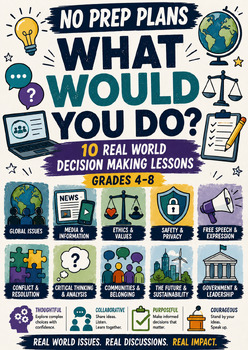
This resource is part of the No Prep Plans: What Would You Do? series—a collection of highly engaging, scenario-based lessons where students tackle authentic real-world challenges, analyze competing priorities, and learn to Think. Discuss. Decide. Defend. Each lesson builds critical thinking, leadership, communication, and problem-solving skills through realistic scenarios that encourage students to consider multiple perspectives before making and defending their decisions.
·
This resource is also part of a bundle with 9 other resources
Questions
No questions yet.
Ask a question
Your question goes to No Prep Plans. Answers show on this page, without your name or email.
Sent. The answer will show on this page.
Reviews
No reviews yet. Buyers can review a resource from their order page.
More from No Prep Plans
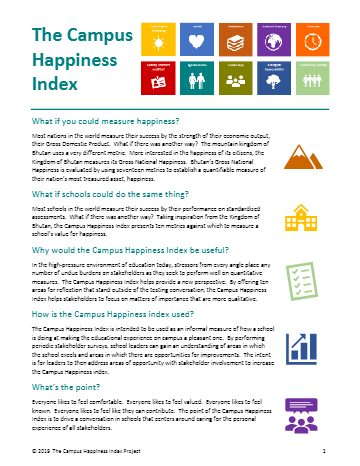
Campus Happiness Index
 No Prep Plans
$3.00
Book Labels
No Prep PlansFree

Big Band & Jazz Musicians Poster Set (1930s–1950s)
No Prep Plans$3.50
FREE Geography Learning Stations Signs & Choice Cards--Reusable
No Prep PlansFree
Refugee: Author's Craft, Themes & Evidence Bundle 10 Literary Analysis Lessons
No Prep Plans$29.25
Ancient World Turning Points Bundle | 10 Research + Group Project Lessons | 6-10
No Prep Plans$29.25
Request a quote or purchase order
For schools and districts. Your request goes to No Prep Plans, who will reply to your email with a quote or invoice.
Sent. The seller will reply to your email.
Report this listing
What your notice must include
The address of the listing on Classroom Clearinghouse (for example, the /p/ link).
https://classroomclearinghouse.com/p/r9zh4d2sr7
Your name, mailing address, phone number, and email.
How to report
Your name, company, mailing address, phone number, and email.
The address of each listing or store you are reporting.
https://classroomclearinghouse.com/p/r9zh4d2sr7
Copyright owners can also use the DMCA notice page.
Thanks. The report is in the review queue.