
Preview: 3 of 16 pages. Scroll sideways to see more.
$3.00
In your cart. View cart
No account needed. You get a download link.
| Grade | 4th Grade to 8th Grade |
|---|---|
| Resource type | Projects |
| Subject | Science |
| Format | PDF, 16 pages |
| How was this made? | Created by hand, with images from generation tools |
| Updated | 2026-10-26 |
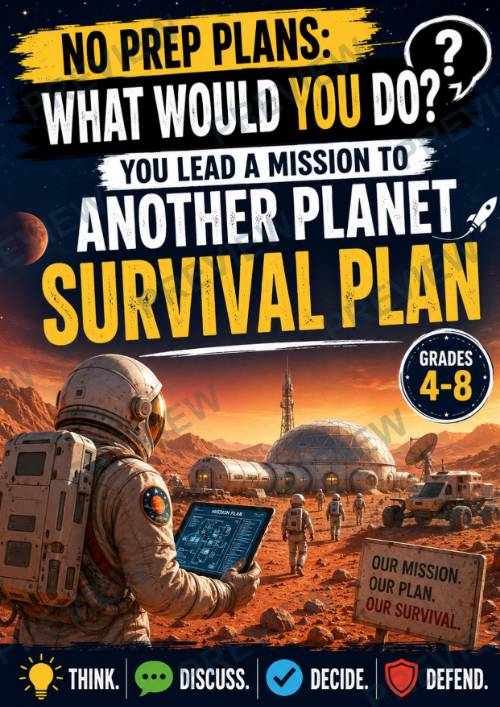
Mars Mission Project | Space Exploration STEM Activity | Grades 4-8
No Prep Plans: What Would You Do?
You Lead a Mission to Another Planet--Survival Plan
Grades 4–8
Think. Discuss. Decide. Defend.
What would it really take to keep six astronauts alive on Mars?
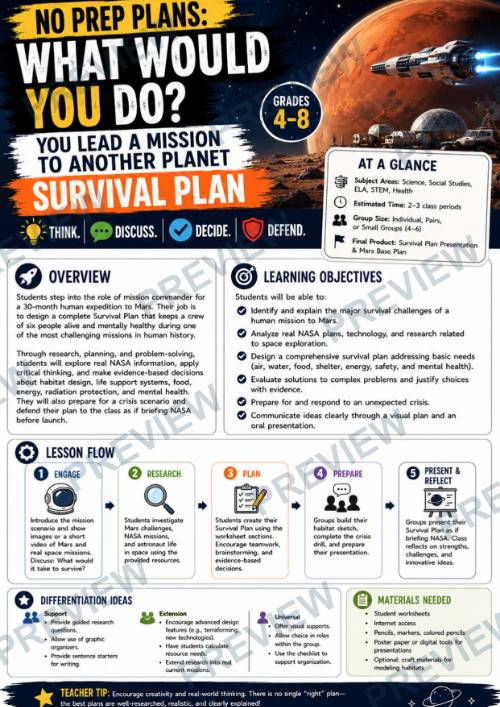
In this engaging, real-world decision-making lesson, students become the commander of humanity's first mission to another planet. With no possibility of a quick rescue, they must make difficult decisions about life support, food production, habitat design, energy, scientific research, emergency planning, and crew well-being.
There is no single correct answer. Students must evaluate competing priorities, analyze risks, anticipate system failures, consider multiple perspectives, and defend every major decision with logical reasoning and evidence—just like real mission planners at NASA and other space agencies.
Perfect for developing critical thinking, STEM problem solving, systems thinking, leadership, collaboration, and evidence-based discussion.
What's Included
- Teacher directions (1–3 class periods)
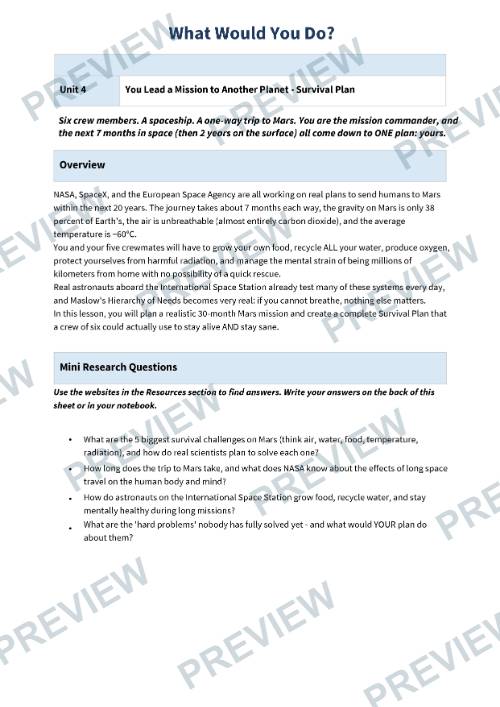
- Student Page 1: Think – Analyze the challenges of living on Mars, identify mission priorities, separate facts from assumptions, rank survival needs, and determine additional research requirements.
- Student Page 2: Discuss – Compare habitat options, evaluate mission decisions, analyze how interconnected systems affect survival, consider opposing viewpoints, and debate long-term mission goals.
- Student Page 3: Decide & Defend – Develop a complete mission strategy, justify key decisions, evaluate risks, reflect on leadership, and defend the overall survival plan.
- Survival Plan Project Page – Design a realistic Mars mission including mission timeline, habitat, life-support systems, energy, technology, crew organization, emergency procedures, scientific research, and a final survival challenge.
- Full-color version
- Black-and-white version
- Print-ready PDF
Students Will Practice
- Critical thinking
- Systems thinking
- STEM problem solving
- Risk assessment
- Decision-making
- Leadership
- Collaboration
- Scientific reasoning
- Evidence-based argument
- Planning and organization
- Communication skills
- Written reflection
- Creative problem solving
- Future-ready thinking
Perfect For
- STEM lessons
- Space Exploration units
- Earth & Space Science
- Engineering Design Challenges
- Leadership activities
- Gifted & Talented
- Project-Based Learning (PBL)
- Advisory / Homeroom
- Critical Thinking lessons
- Debate and Discussion
- Fast-finisher activities
- Substitute plans
Why Teachers Love It
- Engages students with an exciting real-world space mission scenario.
- Encourages authentic discussion with no single "correct" solution.
- Promotes higher-order thinking through systems planning and risk analysis.
- Connects science, engineering, leadership, and teamwork in one lesson.
- Flexible for individual, partner, or small-group work.
- Requires minimal teacher preparation.
- Easily adapts to 1–3 class periods.
- Includes a polished Survival Plan project that students can present, defend, and compare.
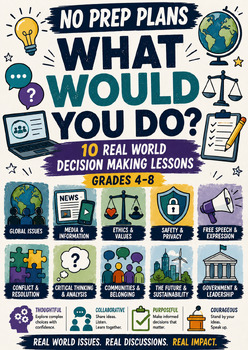
This resource is part of the No Prep Plans: What Would You Do? series—a collection of highly engaging, scenario-based lessons where students tackle authentic challenges, evaluate complex decisions, and learn to Think. Discuss. Decide. Defend. Each lesson builds critical thinking, communication, leadership, and problem-solving skills through meaningful discussion and real-world decision-making.
·
This resource is also part of a bundle with 9 other resources
Questions
No questions yet.
Ask a question
Your question goes to No Prep Plans. Answers show on this page, without your name or email.
Sent. The answer will show on this page.
Reviews
No reviews yet. Buyers can review a resource from their order page.
More from No Prep Plans
Campus Happiness Index
 No Prep Plans
$3.00
Book Labels
No Prep PlansFree

Big Band & Jazz Musicians Poster Set (1930s–1950s)
No Prep Plans$3.50
FREE Geography Learning Stations Signs & Choice Cards--Reusable
No Prep PlansFree
Refugee: Author's Craft, Themes & Evidence Bundle 10 Literary Analysis Lessons
No Prep Plans$29.25
Ancient World Turning Points Bundle | 10 Research + Group Project Lessons | 6-10
No Prep Plans$29.25
Request a quote or purchase order
For schools and districts. Your request goes to No Prep Plans, who will reply to your email with a quote or invoice.
Sent. The seller will reply to your email.
Report this listing
What your notice must include
The address of the listing on Classroom Clearinghouse (for example, the /p/ link).
https://classroomclearinghouse.com/p/pm255p99ps
Your name, mailing address, phone number, and email.
How to report
Your name, company, mailing address, phone number, and email.
The address of each listing or store you are reporting.
https://classroomclearinghouse.com/p/pm255p99ps
Copyright owners can also use the DMCA notice page.
Thanks. The report is in the review queue.