
What's inside: 10 resources. You get every file, and any updates the creator makes later.
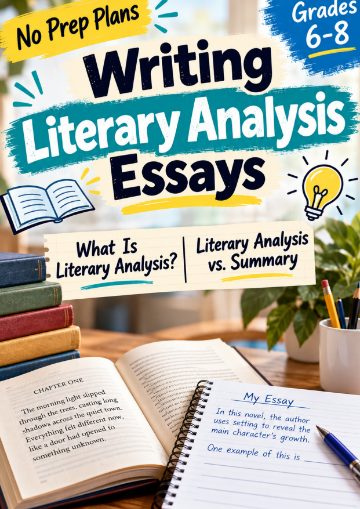 Writing Literary Analysis Essays:What Is Literary Analysis? Summary vs. AnalysisPDF, 14 pages
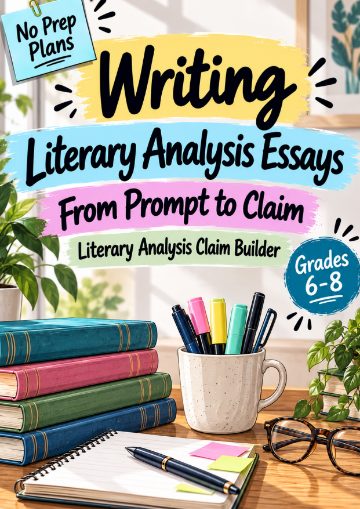 Writing Literary Analysis Essays: From Prompt to Claim Claim Builder |Grades 6-8PDF, 14 pages
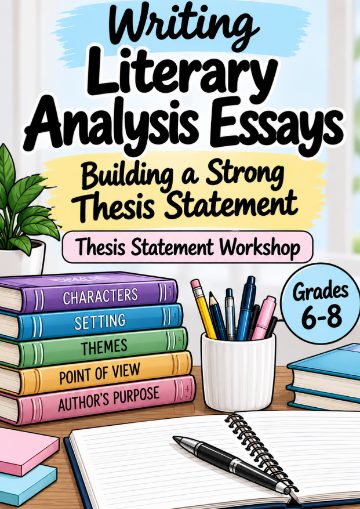 Writing Literary Analysis Essays: Building a Strong Thesis Statement |Grades 6–8PDF, 16 pages
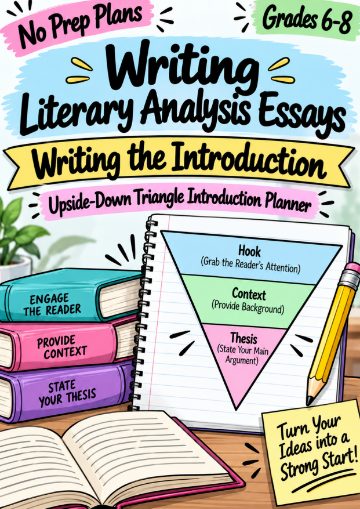 Writing Literary Analysis Essays: Writing the Introduction | Grades 6–8PDF, 16 pages
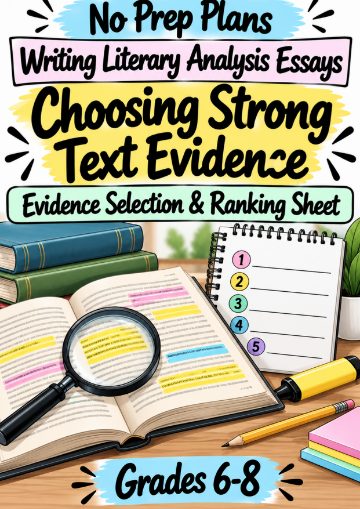 Writing Literary Analysis Essays: Choosing Strong Text Evidence | Grades 6–8PDF, 14 pages
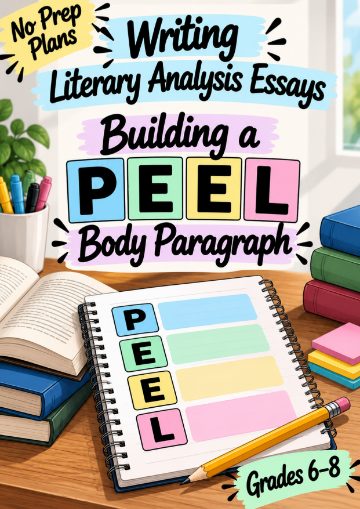 Writing Literary Analysis Essays: Building a PEEL Body Paragraph | Grades 6–8PDF, 14 pages
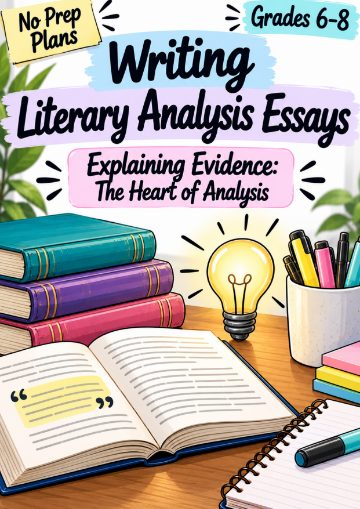 Writing Literary Analysis Essays: Explaining Evidence | Grades 6–8PDF, 14 pages
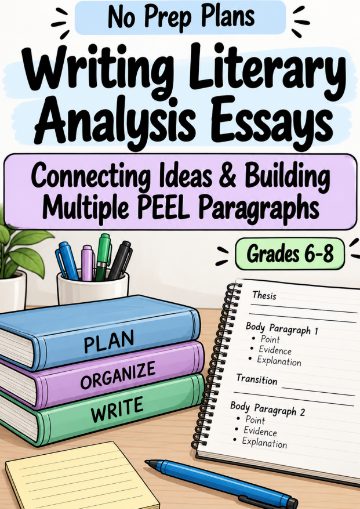 Literary Analysis Essays: Connecting Ideas & Building Multiple PEEL ParagraphsPDF, 14 pages
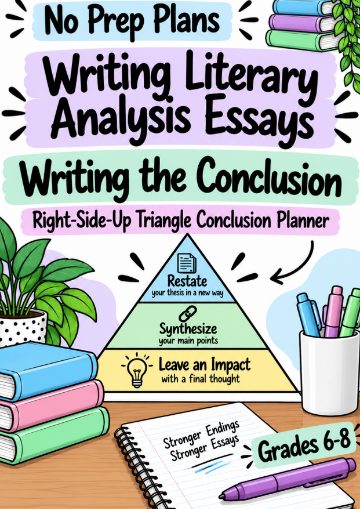 Writing Literary Analysis Essays: Writing the Conclusion | Grades 6–8PDF, 14 pages
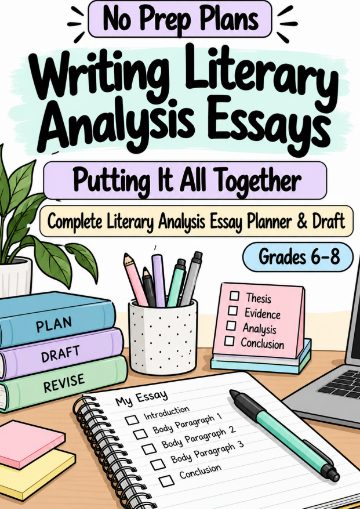 Writing Literary Analysis Essays: Putting It All Together | Grades 6–8PDF, 14 pages
$27.90
Bought separately: $31.00
In your cart. View cart
No account needed. You get a download link.
| Grade | 6th Grade to 8th Grade |
|---|---|
| Subject | Writing |
| Format | Bundle of 10 resources |
| How was this made? | Created by hand, with images from generation tools |
| Updated | 2026-10-26 |
Writing Literary Analysis Essays Bundle | From Prompt to Complete Essay | 6-8th
Writing Literary Analysis Essays Bundle | From Prompt to Complete Essay | Grades 6–8
Take students through the entire literary analysis essay process—from understanding what literary analysis actually is to planning and organizing a complete essay. This 10-lesson No Prep Plans bundle breaks literary analysis writing into manageable skills so students can build confidence with each piece before putting everything together.
Rather than asking students to “write a literary analysis essay” all at once, the lessons explicitly teach the thinking and writing skills behind successful analysis. Students learn to move beyond summary, develop claims and thesis statements, organize introductions, build PEEL paragraphs, select and explain evidence, connect multiple body paragraphs, write meaningful conclusions, and finally bring all of those skills together in a complete literary analysis essay.
Designed for Grades 6–8, these lessons can be used with novels, short stories, excerpts, or other literary texts, making the bundle easy to incorporate into your existing ELA curriculum.
10 Lessons Included
1. What Is Literary Analysis? — Summary vs. Analysis
Students learn the difference between simply telling what happened in a text and analyzing how and why an author creates meaning. This foundational lesson prepares students to move from retelling into deeper literary thinking.
2. From Prompt to Claim — Claim Builder
Students break down a literary analysis prompt, identify what it is really asking, and develop a focused, arguable claim that can guide an essay.
3. Building a Strong Thesis Statement
Students transform their ideas and claims into a clear thesis statement that establishes the central argument of the essay and provides direction for their analysis.
4. Writing the Introduction
Students learn how to move from broader context to a focused thesis and plan an introduction that includes an effective opening, necessary background information, and a clear thesis statement.
5. Building a PEEL Body Paragraph
Students use the Point, Evidence, Explanation, Link structure to construct organized body paragraphs in which evidence and analysis work together to prove a specific part of the thesis.
6. Choosing Strong Text Evidence — Evidence Selection & Ranking Sheet
Students evaluate multiple pieces of textual evidence and determine which quotations or details most directly and convincingly support a specific claim.
7. Explaining Evidence — The Heart of Analysis
Students move beyond dropping quotations into a paragraph or simply restating evidence. They practice explaining how and why evidence proves a point and what specific details reveal about the text.
8. Connecting Ideas & Building Multiple PEEL Paragraphs
Students move from one body paragraph to a complete line of reasoning by organizing multiple PEEL paragraphs logically and using transitions to connect ideas back to the thesis.
9. Writing the Conclusion — Right-Side-Up Triangle Conclusion Planner
Students learn to move from narrow to wide as they restate the thesis, synthesize their main points, and end with a broader final thought that gives the essay a meaningful sense of closure.
10. Putting It All Together — Complete Literary Analysis Essay Planner & Draft
Students bring the entire process together. They gather their claim, thesis, evidence, PEEL paragraphs, transitions, introduction, and conclusion; organize the pieces into one coherent argument; and plan, evaluate, draft, and revise a complete literary analysis essay.
What Students Practice Throughout the Bundle
Students progressively work on:
- Understanding the difference between summary and analysis
- Breaking down literary analysis prompts
- Developing focused, arguable claims
- Writing strong thesis statements
- Planning effective introductions
- Organizing body paragraphs with PEEL
- Selecting relevant and convincing textual evidence
- Explaining evidence instead of simply restating it
- Developing deeper literary analysis
- Connecting multiple ideas and body paragraphs
- Using logical transitions
- Writing meaningful conclusions
- Maintaining a consistent argument throughout an essay
- Planning and revising a complete literary analysis essay
Built for Student Independence
Each lesson focuses on one manageable piece of the larger writing process. Students first learn and investigate the skill, apply it through structured practice, and then use planning and analysis pages to develop their own thinking.
The final lesson asks students to bring those individual skills together so that the complete essay is no longer one overwhelming assignment—it is a combination of processes they have already practiced.
Great for:
- Grades 6–8 ELA
- Literary Analysis Units
- Novel Studies
- Short Story Units
- Essay Writing
- Text-Based Writing
- Writing Workshop
- Middle School Writing Intervention
- Independent Practice
- Small Groups
- Review & Reinforcement
- Sub Plans
- IB MYP Language & Literature
- Beginning or Developing Literary Analysis Writers
Flexible for the Texts You Already Teach
This bundle is not tied to one particular novel or short story. Students can apply the strategies to the literary texts already being studied in your classroom. That makes the lessons useful throughout the year rather than for only one unit or book.
Use the complete sequence as a literary analysis writing unit, or pull individual lessons when students need targeted practice with a particular skill such as thesis writing, selecting evidence, PEEL paragraphs, analysis, transitions, or conclusions.
Why Teachers Will Love This Bundle
The progression does the instructional heavy lifting by breaking a complex writing task into clear, teachable steps. Instead of repeatedly telling students to “add more analysis” or “use stronger evidence,” teachers have focused lessons and student practice for the individual skills students need to improve.
10 focused lessons. One complete literary analysis writing process. Grades 6–8.
·
Questions
No questions yet.
Ask a question
Your question goes to No Prep Plans. Answers show on this page, without your name or email.
Sent. The answer will show on this page.
Reviews
No reviews yet. Buyers can review a resource from their order page.
More from No Prep Plans
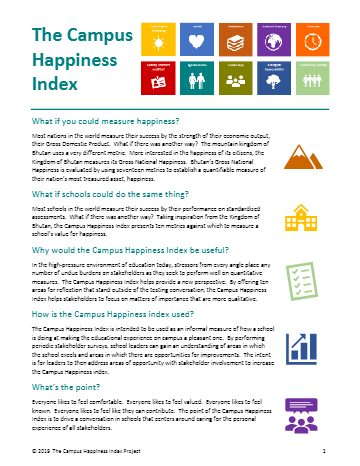
Campus Happiness Index
 No Prep Plans
$3.00
Book Labels
No Prep PlansFree

Big Band & Jazz Musicians Poster Set (1930s–1950s)
No Prep Plans$3.50
FREE Geography Learning Stations Signs & Choice Cards--Reusable
No Prep PlansFree
Refugee: Author's Craft, Themes & Evidence Bundle 10 Literary Analysis Lessons
No Prep Plans$29.25
Ancient World Turning Points Bundle | 10 Research + Group Project Lessons | 6-10
No Prep Plans$29.25
Request a quote or purchase order
For schools and districts. Your request goes to No Prep Plans, who will reply to your email with a quote or invoice.
Sent. The seller will reply to your email.
Report this listing
What your notice must include
The address of the listing on Classroom Clearinghouse (for example, the /p/ link).
https://classroomclearinghouse.com/p/397rcg42fm
Your name, mailing address, phone number, and email.
How to report
Your name, company, mailing address, phone number, and email.
The address of each listing or store you are reporting.
https://classroomclearinghouse.com/p/397rcg42fm
Copyright owners can also use the DMCA notice page.
Thanks. The report is in the review queue.