
Preview: 3 of 14 pages. Scroll sideways to see more.
$3.00
In your cart. View cart
No account needed. You get a download link.
| Grade | 6th Grade to 8th Grade |
|---|---|
| Resource type | Lesson Plans |
| Subject | Geography |
| Format | PDF, 14 pages |
| How was this made? | Created by hand, with images from generation tools |
| Updated | 2026-10-26 |
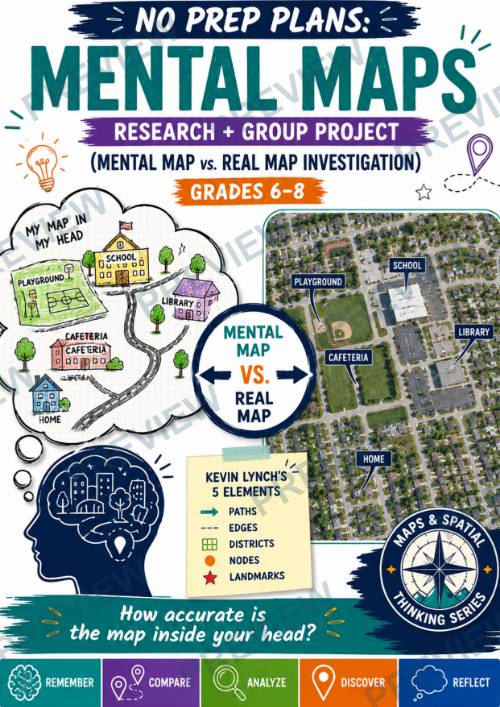
No Prep Plans: Mental Maps (Mental Map vs. Real Map Investigation)
No Prep Plans: Mental Maps
Research + Group Project: Mental Map vs. Real Map Investigation
How accurate is the map inside your head?
In this engaging geography investigation, students explore the fascinating concept of mental maps—the internal maps people create in their minds based on memory, experience, and daily routines. Students discover that the places they know best are often remembered in surprising and distorted ways. Familiar routes may seem shorter, important landmarks may appear larger, and entire locations may be forgotten altogether.
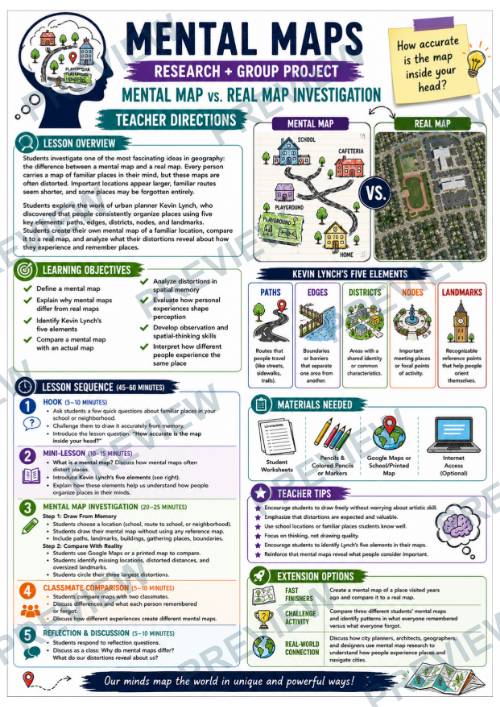
Students investigate the work of urban planner Kevin Lynch, who identified five key elements that people use to organize places in their minds: paths, edges, districts, nodes, and landmarks. Students then create their own mental map of a familiar location, compare it to a real map, identify distortions, and analyze what those differences reveal about perception, memory, and personal experience.
Perfect for Geography, Humanities, Social Studies, Spatial Thinking, Human Geography, and Maps & Spatial Thinking units.
What's Included
✔ Teacher Directions (1 lesson; 45–60 minutes)
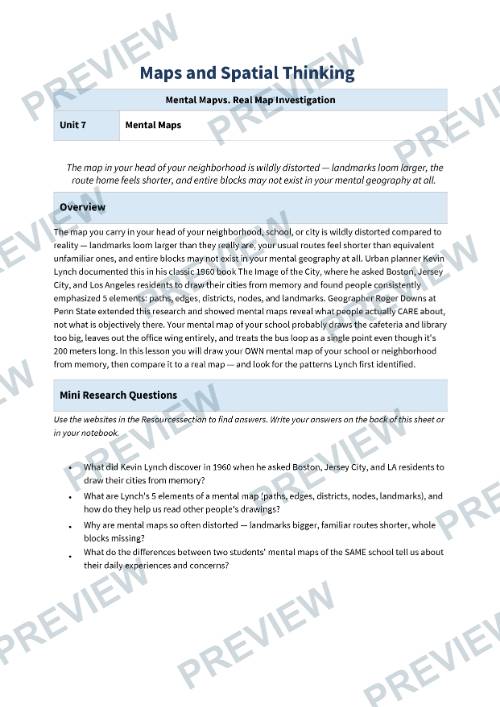
✔ Mental Map Research & Planning Page
✔ Mental Map vs. Real Map Analysis Page
✔ Mental Map Sketch & Reflection Page
✔ Color & Black and White Versions
✔ Online Research Resources Included
Students Will
- Define and explain mental maps
- Explore why mental maps differ from real maps
- Learn Kevin Lynch's five elements of spatial perception
- Compare memory-based maps to actual maps
- Identify distortions in spatial memory
- Analyze how personal experiences shape perception
- Evaluate similarities and differences between classmates' maps
- Develop observation and spatial-thinking skills
- Reflect on how people experience places differently
Why Teachers Love This Resource
⭐ Requires minimal preparation
⭐ Introduces students to an engaging and memorable geography concept
⭐ Encourages critical thinking and self-reflection
⭐ Connects geography, psychology, and human behavior
⭐ Promotes discussion and collaborative learning
⭐ Builds observation and spatial-awareness skills
⭐ Provides meaningful real-world applications of geography
⭐ Encourages creativity without requiring artistic ability
⭐ Works well with school, neighborhood, or community investigations
⭐ Creates highly engaging classroom discussions
Perfect For
- Geography Units
- Maps & Spatial Thinking
- Human Geography
- Spatial Awareness Activities
- Social Studies
- Humanities
- Inquiry-Based Learning
- Project-Based Learning (PBL)
Through this investigation, students discover that maps are not only tools for navigation—they are also reflections of memory, experience, and perspective. By comparing what they remember with what actually exists, students gain a deeper understanding of how people perceive and interact with the places around them.
·
This resource is also part of a bundle with 9 other resources
Questions
No questions yet.
Ask a question
Your question goes to No Prep Plans. Answers show on this page, without your name or email.
Sent. The answer will show on this page.
Reviews
No reviews yet. Buyers can review a resource from their order page.
More from No Prep Plans
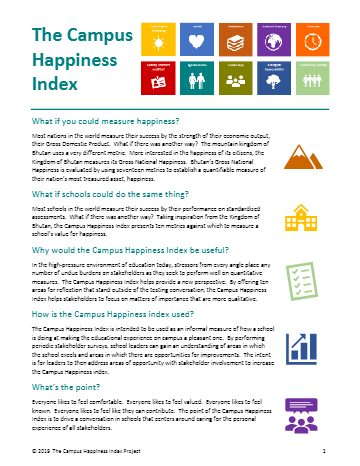
Campus Happiness Index
 No Prep Plans
$3.00
Book Labels
No Prep PlansFree
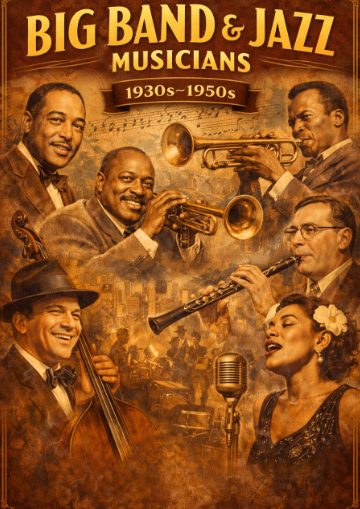
Big Band & Jazz Musicians Poster Set (1930s–1950s)
No Prep Plans$3.50
FREE Geography Learning Stations Signs & Choice Cards--Reusable
No Prep PlansFree
Refugee: Author's Craft, Themes & Evidence Bundle 10 Literary Analysis Lessons
No Prep Plans$29.25
Ancient World Turning Points Bundle | 10 Research + Group Project Lessons | 6-10
No Prep Plans$29.25
Request a quote or purchase order
For schools and districts. Your request goes to No Prep Plans, who will reply to your email with a quote or invoice.
Sent. The seller will reply to your email.
Report this listing
What your notice must include
The address of the listing on Classroom Clearinghouse (for example, the /p/ link).
https://classroomclearinghouse.com/p/zzb2dz5xdq
Your name, mailing address, phone number, and email.
How to report
Your name, company, mailing address, phone number, and email.
The address of each listing or store you are reporting.
https://classroomclearinghouse.com/p/zzb2dz5xdq
Copyright owners can also use the DMCA notice page.
Thanks. The report is in the review queue.