
Preview: 3 of 14 pages. Scroll sideways to see more.
$3.00
In your cart. View cart
No account needed. You get a download link.
| Grade | 5th Grade to 10th Grade |
|---|---|
| Resource type | Lesson Plans |
| Subject | Reading |
| Format | PDF, 14 pages |
| How was this made? | Created by hand, with images from generation tools |
| Updated | 2026-10-26 |
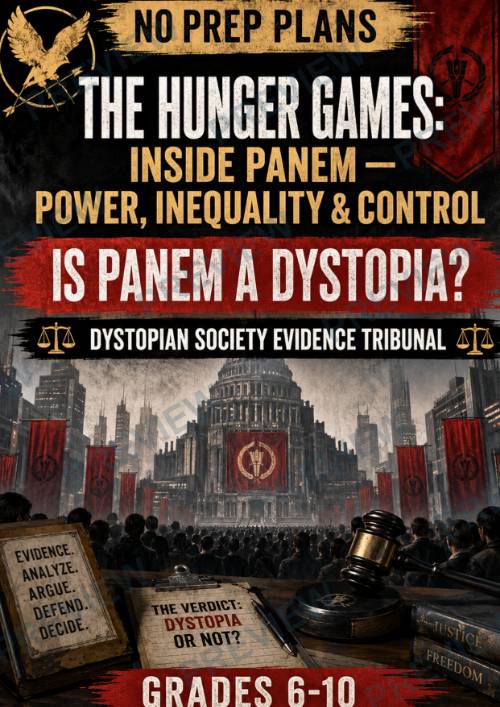
No Prep Plans: Hunger Games Inside Panem — Is Panem a Dystopia?
No Prep Plans: Hunger Games Inside Panem — Is Panem a Dystopia?
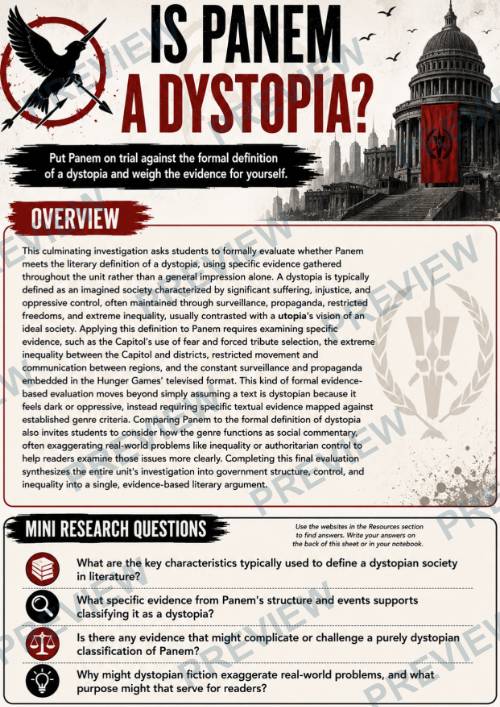
Is Panem automatically a dystopia because it is cruel and oppressive—or can students prove that classification using established literary criteria and evidence?
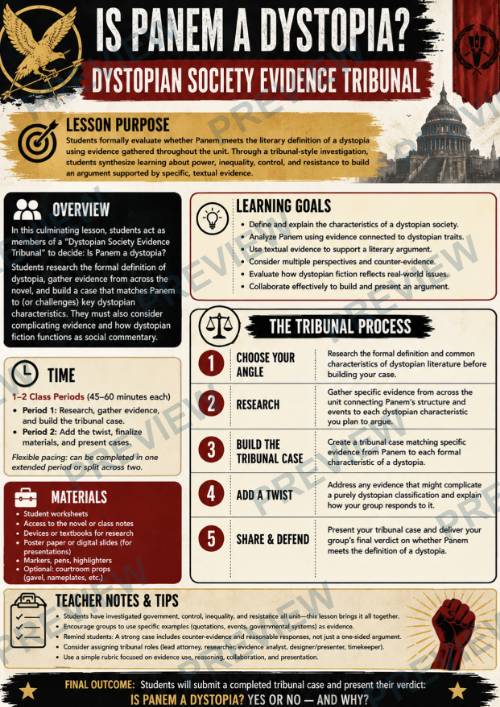
In this no-prep Hunger Games novel study lesson, students put Panem on trial in a Dystopian Society Evidence Tribunal. Rather than simply labeling the society dystopian, students research the characteristics of dystopian literature, gather specific evidence from the novel, evaluate how strongly that evidence fits established criteria, consider evidence that complicates their argument, and ultimately defend their own verdict.
This makes an excellent culminating lesson for a study of Panem because students synthesize their understanding of government, inequality, propaganda, surveillance, restricted freedoms, suffering, and control into one evidence-based literary argument.
Grades: 6–10
Time: 1–2 class periods (45–60 minutes each)
What's Included
- Teacher directions
- Student-friendly overview
- Mini research questions
- 5-step Dystopian Society Evidence Tribunal
- Build the Dystopia Evidence File student activity
- Test the Dystopian Classification deeper analysis
- Build the Dystopian Society Tribunal Case planning activity
- Color student pages
- Printer-friendly black-and-white student pages
Students Will
- Define and apply characteristics of dystopian literature
- Identify evidence of oppressive control, restricted freedoms, surveillance, inequality, suffering, propaganda, and manipulation
- Connect specific evidence from Panem to formal dystopian criteria
- Distinguish between isolated events, repeated patterns, government systems, and society-wide conditions
- Evaluate the relative strength of different pieces of evidence
- Consider evidence that challenges or complicates their initial position
- Analyze how dystopian fiction can exaggerate real-world concerns as a form of social commentary
- Revise conclusions as new evidence is considered
- Construct a clear literary claim
- Organize evidence into a formal tribunal case
- Address counterarguments rather than ignoring opposing evidence
- Defend a final verdict using evidence and reasoning
Great For
- The Hunger Games novel studies
- Dystopian literature units
- Culminating novel activities
- Literary genre analysis
- Theme analysis
- Textual evidence
- Argument writing
- Claims & counterclaims
- Propaganda and surveillance
- Critical thinking
Original Work & Novel Disclaimer
This resource is an independently created, original educational work designed to support classroom study of The Hunger Games by Suzanne Collins.
This product is not affiliated with, authorized by, sponsored by, or endorsed by Suzanne Collins, Scholastic, the publisher, or any other rights holder associated with The Hunger Games. The novel title, characters, fictional locations, and other intellectual property associated with the novel remain the property of their respective rights holders.
No portion of the novel is reproduced or included. All instructional materials, research prompts, analysis activities, worksheets, and project materials are original educational content intended for supplemental classroom use alongside legally obtained copies of the novel.
Please Note
- Novel is not included
- Designed for classroom educational use
- Students should have access to The Hunger Games
- Some research activities may require internet access
·
This resource is also part of a bundle with 9 other resources
Questions
No questions yet.
Ask a question
Your question goes to No Prep Plans. Answers show on this page, without your name or email.
Sent. The answer will show on this page.
Reviews
No reviews yet. Buyers can review a resource from their order page.
More from No Prep Plans
Campus Happiness Index
 No Prep Plans
$3.00
Book Labels
No Prep PlansFree
Big Band & Jazz Musicians Poster Set (1930s–1950s)
No Prep Plans$3.50
FREE Geography Learning Stations Signs & Choice Cards--Reusable
No Prep PlansFree
Refugee: Author's Craft, Themes & Evidence Bundle 10 Literary Analysis Lessons
No Prep Plans$29.25
Ancient World Turning Points Bundle | 10 Research + Group Project Lessons | 6-10
No Prep Plans$29.25
Request a quote or purchase order
For schools and districts. Your request goes to No Prep Plans, who will reply to your email with a quote or invoice.
Sent. The seller will reply to your email.
Report this listing
What your notice must include
The address of the listing on Classroom Clearinghouse (for example, the /p/ link).
https://classroomclearinghouse.com/p/qnwg8cr64m
Your name, mailing address, phone number, and email.
How to report
Your name, company, mailing address, phone number, and email.
The address of each listing or store you are reporting.
https://classroomclearinghouse.com/p/qnwg8cr64m
Copyright owners can also use the DMCA notice page.
Thanks. The report is in the review queue.