
What's inside: 10 resources. You get every file, and any updates the creator makes later.
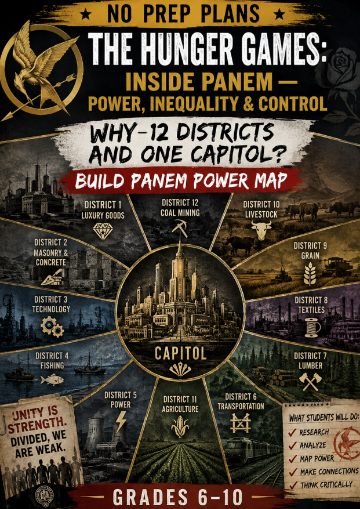 No Prep Plans | The Hunger Games: Inside Panem Why 12 Districts and One Capitol?PDF, 14 pages
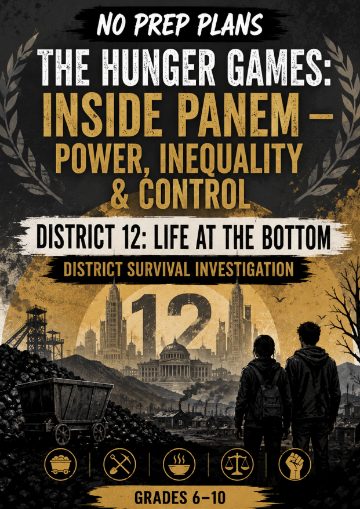 No Prep Plans | The Hunger Games: Inside Panem — Life at the BottomPDF, 14 pages
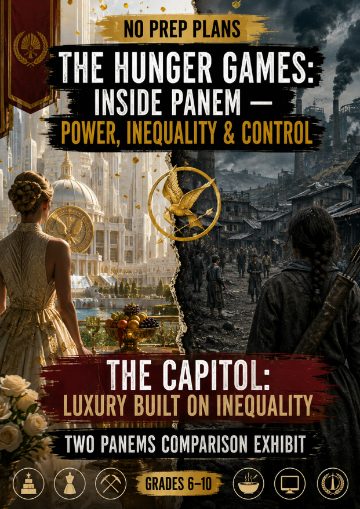 The Hunger Games: Inside Panem The Capitol: Luxury Built on InequalityPDF, 14 pages
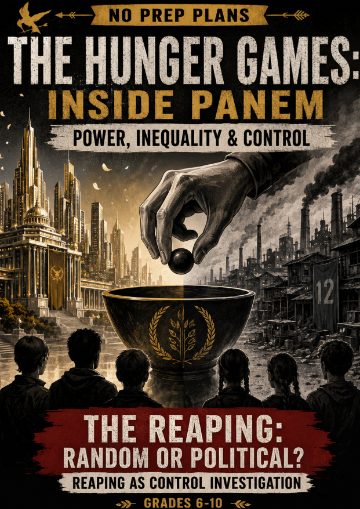 No Prep Plans: The Hunger Games Inside Panem-The Reaping:Random or Political?PDF, 14 pages
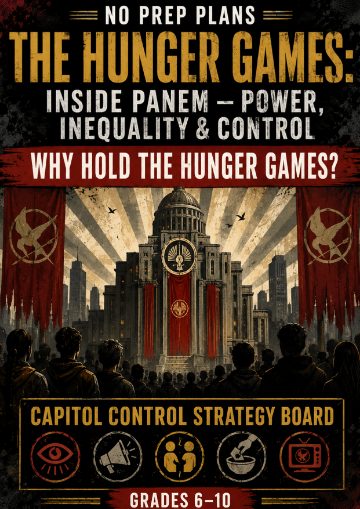 No Prep Plans: Hunger Games Inside Panem — Why Hold the Hunger Games?PDF, 14 pages
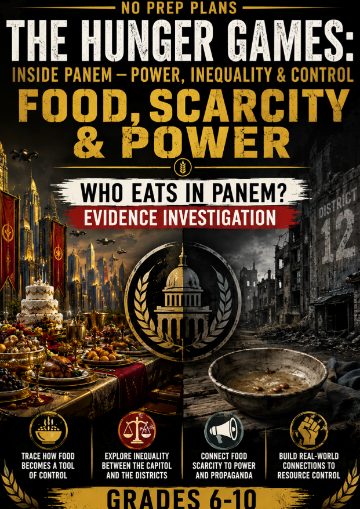 No Prep Plans: Hunger Games Inside Panem — Food, Scarcity & PowerPDF, 14 pages
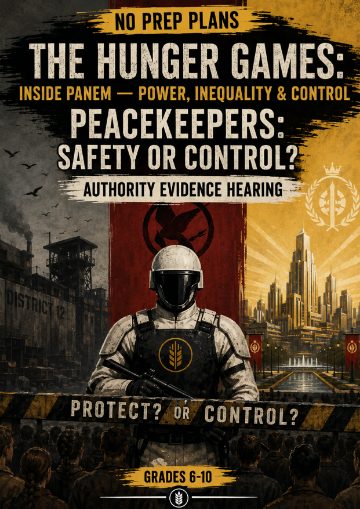 No Prep Plans: Hunger Games Inside Panem — Peacekeepers: Safety or Control?PDF, 14 pages
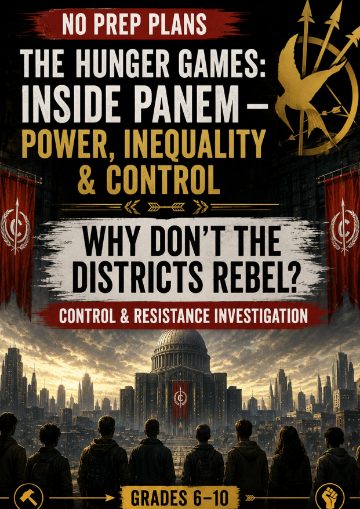 No Prep Plans: Hunger Games Inside Panem — Why Don’t the Districts Rebel?PDF, 14 pages
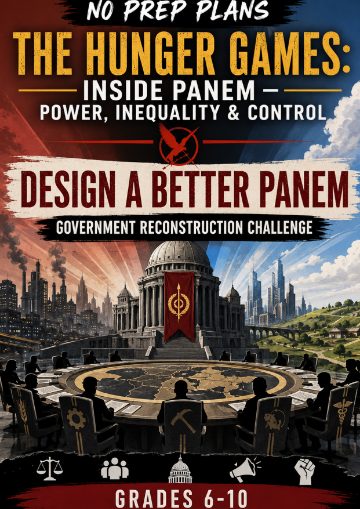 No Prep Plans: Hunger Games Inside Panem — Design a Better PanemPDF, 14 pages
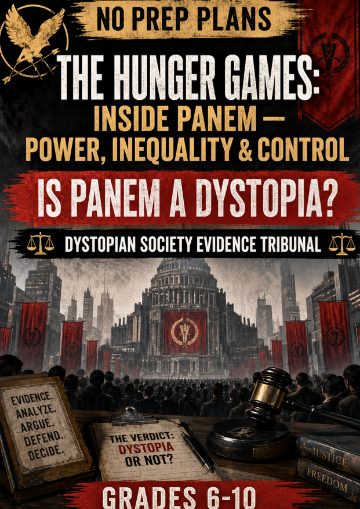 No Prep Plans: Hunger Games Inside Panem — Is Panem a Dystopia?PDF, 14 pages
$27.00
Bought separately: $30.00
In your cart. View cart
No account needed. You get a download link.
| Grade | 6th Grade to 10th Grade |
|---|---|
| Resource type | Lesson Plans |
| Subject | Reading |
| Format | Bundle of 10 resources |
| How was this made? | Created by hand, with images from generation tools |
| Updated | 2026-10-26 |
No Prep Plans: The Hunger Games Inside Panem: Power, Inequality & Control Bundle
No Prep Plans: The Hunger Games — Inside Panem: Power, Inequality & Control Bundle
Take students inside Panem with 10 inquiry-based lessons that move beyond basic comprehension and ask students to investigate the systems of power, inequality, government, scarcity, propaganda, authority, and control operating beneath the events of The Hunger Games.
Designed for Grades 6–10, this complete bundle turns Panem into a case study students can investigate. Each lesson combines analysis and research with a collaborative inquiry-based group project, giving students opportunities to gather evidence, make connections, evaluate competing explanations, and defend their conclusions.
Rather than simply asking what happened?, these lessons ask students to investigate why Panem works the way it does—and how the Capitol maintains its power.
10 Complete Lessons | Grades 6–10 | No Prep | Inquiry + Analysis + Group Projects
Lessons Included:
1. Why 12 Districts and One Capitol?
Students investigate Panem's unusual political geography and consider why a powerful central government might divide the rest of the nation into separate districts.
2. Life at the Bottom
Students examine life in District 12 and investigate how poverty, limited opportunity, dangerous work, and unequal access to resources shape everyday life at the bottom of Panem's social structure.
3. The Capitol: Luxury Built on Inequality
Students contrast the Capitol's extraordinary wealth with conditions in the districts and investigate how extreme inequality can reinforce political and social power.
4. The Reaping: Random or Political?
Students examine the Reaping as more than a selection process, investigating whether its structure is truly fair and random or whether inequality is built into the system.
5. Why Hold the Hunger Games?
Students look beyond the Capitol's official justification for the Games to investigate their larger political purposes, including punishment, intimidation, propaganda, division, and psychological control.
6. Food, Scarcity & Power
Students trace who has access to food and resources across Panem and investigate how hunger, scarcity, excess, and resource distribution can become tools of political power.
7. Peacekeepers: Safety or Control?
Students evaluate the role of the Peacekeepers and determine whether their primary function is protecting Panem's population or enforcing Capitol authority and obedience.
8. Why Don't the Districts Rebel?
Students investigate the overlapping barriers to resistance, including fear, isolation, lack of resources, restricted communication, normalization of oppression, and division among the districts.
9. Design a Better Panem
Students shift from analyzing Panem's problems to solving them. They become constitutional designers tasked with creating a fairer government that addresses representation, concentrated power, inequality, accountability, and resource distribution.
10. Is Panem a Dystopia?
Students bring their learning together in a Dystopian Society Evidence Tribunal, formally evaluating Panem against established characteristics of dystopian literature and defending a final evidence-based verdict.
What's Included
Each lesson is designed as a complete classroom investigation and includes:
- Teacher directions
- Student-friendly lesson overview
- Focused mini research questions
- 5-step inquiry-based group activity
- Student analysis and research activities
- Planning and evidence-organizing materials
- Deeper-thinking and synthesis tasks
- Collaborative project or investigation
- Color student pages
- Printer-friendly black-and-white student pages
Students Will
Across the bundle, students will investigate how government structure, geography, economic inequality, food scarcity, propaganda, policing, fear, and institutional systems interact to maintain Capitol power.
Students practice identifying and evaluating textual evidence, distinguishing individual events from larger systems, tracing cause-and-effect relationships, analyzing multiple perspectives, developing claims and counterclaims, recognizing tradeoffs, making real-world connections, collaborating with peers, and defending evidence-based conclusions.
The sequence also creates a natural progression from analysis to synthesis. Students begin by examining individual pieces of Panem's structure before eventually asking larger questions about resistance, government reconstruction, and whether Panem actually satisfies the literary definition of a dystopia.
Perfect For
- The Hunger Games novel study
- Dystopian literature units
- Middle & high school ELA
- ELA + Social Studies integration
- Government and civics connections
- Inquiry-based learning
- Project-based learning
- Literary analysis
- Textual evidence
- Critical thinking
- Power & inequality
- Propaganda & media literacy
- Government & authority
- Collaborative learning
- End-of-novel synthesis
- Grades 6–10
Why Teachers Will Love This Bundle
These aren't traditional chapter questions or recall worksheets. The activities are designed to help students think with the novel.
Students investigate questions such as why Panem is divided the way it is, how inequality benefits those in power, why people tolerate oppressive systems, how governments use scarcity and spectacle as tools of control, and what would actually have to change to create a fairer society.
The result is a novel study that combines literary analysis, inquiry, research, discussion, collaboration, and real-world thinking while giving teachers structured, ready-to-use materials.
Original Work & Novel Disclaimer
This bundle is an independently created collection of original educational resources designed to support classroom study of The Hunger Games by Suzanne Collins.
This product is not affiliated with, authorized by, sponsored by, or endorsed by Suzanne Collins, Scholastic, the publisher, or any other rights holder associated with The Hunger Games. The novel title, characters, fictional locations, and other intellectual property associated with the novel remain the property of their respective rights holders.
No portion of the novel is reproduced or included. All instructional materials, research prompts, analysis activities, worksheets, investigations, and project materials are original educational content intended for supplemental classroom use alongside legally obtained copies of the novel.
Please Note: The novel is not included. Students should have access to The Hunger Games. Some research activities may require internet access.
·
Questions
No questions yet.
Ask a question
Your question goes to No Prep Plans. Answers show on this page, without your name or email.
Sent. The answer will show on this page.
Reviews
No reviews yet. Buyers can review a resource from their order page.
More from No Prep Plans
Campus Happiness Index
 No Prep Plans
$3.00
Book Labels
No Prep PlansFree
Big Band & Jazz Musicians Poster Set (1930s–1950s)
No Prep Plans$3.50
FREE Geography Learning Stations Signs & Choice Cards--Reusable
No Prep PlansFree
Refugee: Author's Craft, Themes & Evidence Bundle 10 Literary Analysis Lessons
No Prep Plans$29.25
Ancient World Turning Points Bundle | 10 Research + Group Project Lessons | 6-10
No Prep Plans$29.25
Request a quote or purchase order
For schools and districts. Your request goes to No Prep Plans, who will reply to your email with a quote or invoice.
Sent. The seller will reply to your email.
Report this listing
What your notice must include
The address of the listing on Classroom Clearinghouse (for example, the /p/ link).
https://classroomclearinghouse.com/p/q8ejuwxpwv
Your name, mailing address, phone number, and email.
How to report
Your name, company, mailing address, phone number, and email.
The address of each listing or store you are reporting.
https://classroomclearinghouse.com/p/q8ejuwxpwv
Copyright owners can also use the DMCA notice page.
Thanks. The report is in the review queue.