
Preview: 3 of 14 pages. Scroll sideways to see more.
$3.00
In your cart. View cart
No account needed. You get a download link.
| Grade | 6th Grade to 8th Grade |
|---|---|
| Resource type | Projects |
| Subject | Reading |
| Format | PDF, 14 pages |
| How was this made? | Created by hand, with images from generation tools |
| Updated | 2026-10-26 |
A Long Walk to Water Novel Study | Two Opening Worlds Comparison | Grades 6–8
A Long Walk to Water Novel Study | Two Opening Worlds Comparison
| Grades 6–8
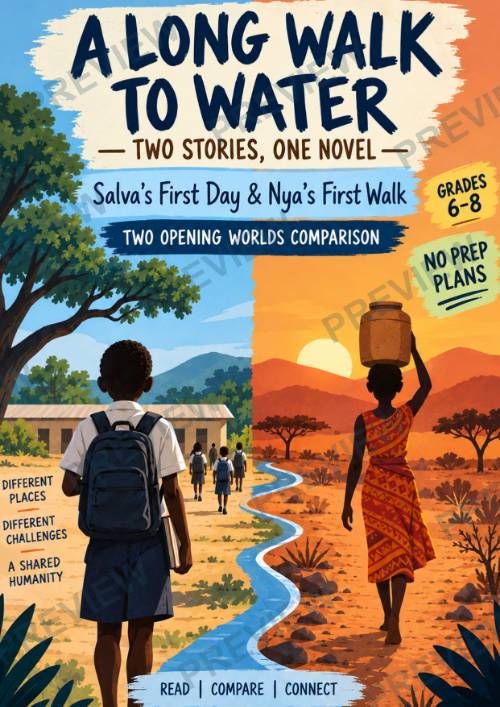
Introduce A Long Walk to Water by Linda Sue Park with an engaging, no-prep literary analysis lesson that helps students examine the novel’s two opening storylines: Salva’s first day in 1985 and Nya’s first walk in 2008.
Students explore how Park introduces two very different ordinary lives before revealing the challenges each character faces. Through close reading, comparison, discussion, textual evidence, and prediction, students analyze the difference between Salva’s sudden dramatic disruption and Nya’s ongoing, normalized hardship while considering why the author begins the novel with these contrasting experiences.
Students Will
- Examine Salva’s and Nya’s opening worlds
- Compare setting, daily routines, family, and community
- Identify and use textual evidence
- Analyze dramatic disruption vs. ongoing hardship
- Explore the author’s choices and dual narrative structure
- Look for connections between the two storylines
- Make evidence-based predictions
- Dig deeper into emerging ideas of hardship, survival, community, and resilience
What’s Included
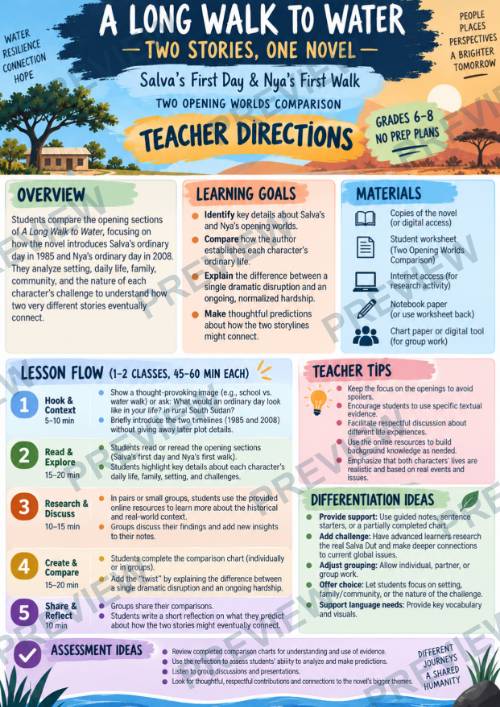
- Teacher Directions
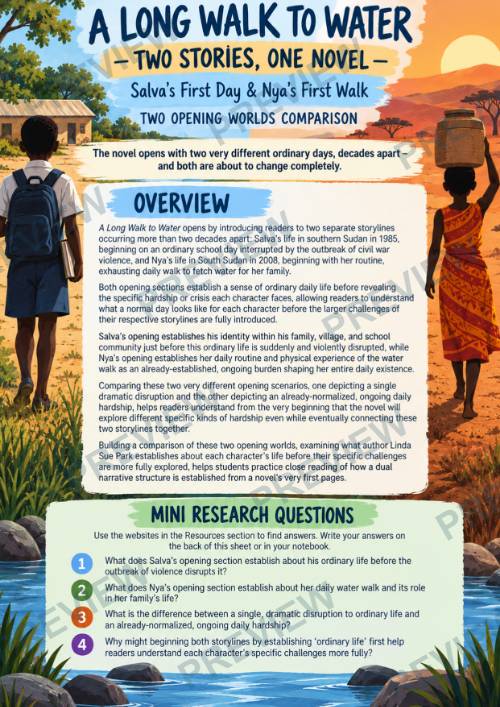
- Lesson Overview
- Mini Research Questions
- Two Opening Worlds Comparison Group Activity
- Student Research & Planning Pages
- Compare & Analyze Organizer
- Dramatic Disruption vs. Ongoing Hardship Analysis
- Dig Deeper: Why Begin This Way? Activity
- Timeline Analysis
- Evidence & Prediction Activities
- Final Thinking Reflection
- Color student pages
- Ink-friendly black-and-white student pages
Group Activity
Students work as literary analysts to build a Two Opening Worlds Comparison. Groups choose a focus, reread and research, build a comparison using textual evidence, analyze the different nature of each character’s challenge, and predict how the two seemingly separate stories might eventually connect.
Perfect For
- A Long Walk to Water Novel Studies
- Middle School ELA
- Grades 6–8
- Close Reading
- Literary Analysis
- Compare & Contrast
- Collaborative Learning
- Small Groups
- Sub Plans
- Extension Activities
- Independent Work
- Pre-Reading & Early-Novel Activities
Why Teachers Love It
- No prep — print and teach
- Designed for 1–2 class periods
- Moves beyond basic comprehension into analysis
- Encourages students to support ideas with textual evidence
- Combines individual thinking with meaningful collaboration
- Includes built-in differentiation opportunities
- Color and printer-friendly versions included
- Helps students understand the novel’s dual narrative structure from the beginning
Important Novel Disclaimer
This is an independently created educational resource designed to support teaching and learning about A Long Walk to Water by Linda Sue Park. It is not affiliated with, authorized by, endorsed by, or sponsored by Linda Sue Park, her publisher, or any related rights holder.
A Long Walk to Water and its characters, storylines, settings, and other elements originating from the novel remain the intellectual property of their respective rights holders. The novel itself is not included with this resource, and no part of the novel is reproduced as a substitute for the book. Students will need access to a legally obtained copy of A Long Walk to Water to complete activities requiring them to read or reference the text.
Purchase of this resource does not include a copy of the novel or permission to reproduce, distribute, scan, upload, or otherwise share the novel.
·
This resource is also part of a bundle with 9 other resources

Questions
No questions yet.
Ask a question
Your question goes to No Prep Plans. Answers show on this page, without your name or email.
Sent. The answer will show on this page.
Reviews
No reviews yet. Buyers can review a resource from their order page.
More from No Prep Plans
Campus Happiness Index
 No Prep Plans
$3.00
Book Labels
No Prep PlansFree

Big Band & Jazz Musicians Poster Set (1930s–1950s)
No Prep Plans$3.50
FREE Geography Learning Stations Signs & Choice Cards--Reusable
No Prep PlansFree
Refugee: Author's Craft, Themes & Evidence Bundle 10 Literary Analysis Lessons
No Prep Plans$29.25
Ancient World Turning Points Bundle | 10 Research + Group Project Lessons | 6-10
No Prep Plans$29.25
Request a quote or purchase order
For schools and districts. Your request goes to No Prep Plans, who will reply to your email with a quote or invoice.
Sent. The seller will reply to your email.
Report this listing
What your notice must include
The address of the listing on Classroom Clearinghouse (for example, the /p/ link).
https://classroomclearinghouse.com/p/5fxzgqb7dt
Your name, mailing address, phone number, and email.
How to report
Your name, company, mailing address, phone number, and email.
The address of each listing or store you are reporting.
https://classroomclearinghouse.com/p/5fxzgqb7dt
Copyright owners can also use the DMCA notice page.
Thanks. The report is in the review queue.