
Preview: 3 of 14 pages. Scroll sideways to see more.
$3.00
In your cart. View cart
No account needed. You get a download link.
| Grade | 6th Grade to 8th Grade |
|---|---|
| Resource type | Lesson Plans |
| Subject | Geography |
| Format | PDF, 14 pages |
| How was this made? | Created by hand, with images from generation tools |
| Updated | 2026-10-26 |
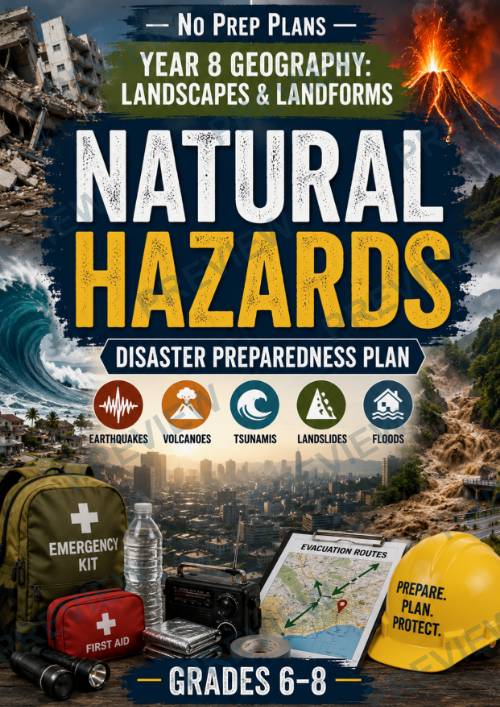
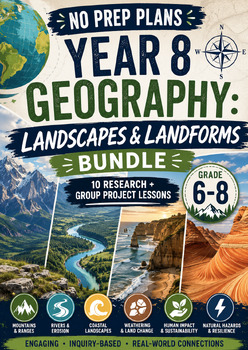
No Prep Plans: Year 8 Geography – Landscapes & Landforms Natural Hazards
No Prep Plans: Year 8 Geography – Landscapes & Landforms Natural Hazards – Disaster Preparedness Plan
Prepare students to think like emergency planners as they investigate natural hazards and develop practical strategies to protect people and communities. In this authentic, inquiry-based lesson, students research real-world hazard risks, analyse vulnerable locations, design a comprehensive emergency operations plan, and evaluate its effectiveness through realistic disaster scenarios.
Using a modern editorial layout inspired by professional emergency management resources, this lesson encourages students to apply geographical knowledge to real-world decision making while developing critical thinking, problem-solving, and communication skills.
Perfect for Year 8 Geography, Grades 6–8 Earth Science, Natural Hazards units, or Disaster Risk Reduction studies.
What's Included
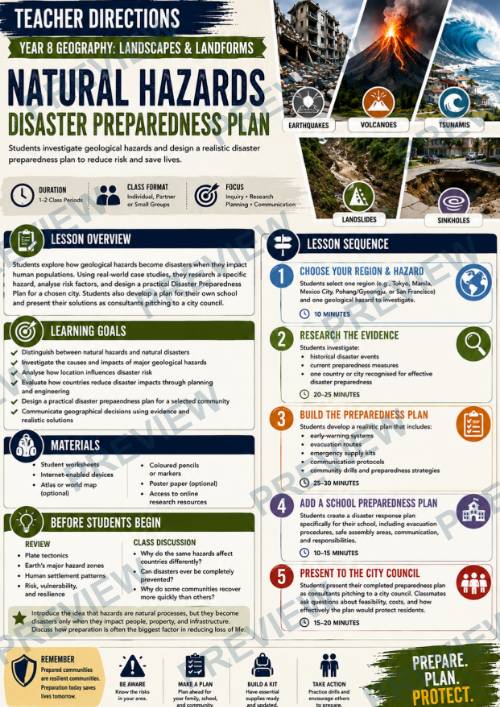
- Teacher Directions (1–2 class periods)
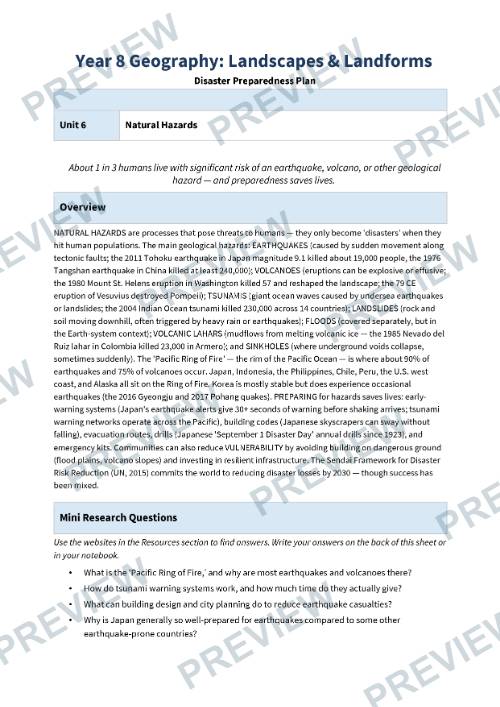
- Student Page 1: Disaster Risk Assessment
- Student Page 2: City Emergency Operations Plan
- Student Page 3: Disaster Readiness Review
- Black-and-White Versions of All Student Pages
Students Will Learn
- The difference between natural hazards and natural disasters
- How earthquakes, volcanoes, tsunamis, landslides, and other hazards affect communities
- How geography influences disaster risk and vulnerability
- How to analyse historical events and geographical evidence
- How emergency warning systems and evacuation plans reduce risk
- How communities prepare for, respond to, and recover from disasters
- How to evaluate disaster preparedness using realistic planning scenarios
- How to communicate geographical recommendations using evidence-based reasoning
Perfect For
- Year 8 Geography
- Grades 6–8 Geography
- Middle School Earth Science
- Landscapes & Landforms Units
- Natural Hazards
- Disaster Risk Reduction
- Emergency Management
- Environmental Science
- Inquiry-Based Learning
- Project-Based Learning (PBL)
- Cross-Curricular Geography & STEM
- Homeschool Geography
- Substitute Teacher Plans
Why Teachers Love It
- No-prep, print-and-go lesson
- Professional, magazine-style layouts designed for middle school learners
- Authentic disaster planning tasks that mirror real emergency management processes
- Encourages critical thinking, collaboration, and evidence-based decision making
- Students create practical, realistic solutions rather than simply answering questions
- Promotes geographical inquiry through research, planning, evaluation, and communication
- Flexible for individual, partner, or small-group learning
- Includes both full-colour and printer-friendly black-and-white student pages
- Builds resilience, civic awareness, and problem-solving skills while reinforcing key geography concepts
This resource is part of the No Prep Plans: Year 8 Geography – Landscapes & Landforms series, where students investigate the natural processes and human activities that shape Earth's surface through engaging, inquiry-based lessons and authentic geographical challenges.
Note: This resource is an independent educational product and is not affiliated with or endorsed by any curriculum authority or examination board. It is designed to supplement classroom instruction and can be adapted to suit your local curriculum.
·
This resource is also part of 2 bundles
Questions
No questions yet.
Ask a question
Your question goes to No Prep Plans. Answers show on this page, without your name or email.
Sent. The answer will show on this page.
Reviews
No reviews yet. Buyers can review a resource from their order page.
More from No Prep Plans
Campus Happiness Index
 No Prep Plans
$3.00
Book Labels
No Prep PlansFree

Big Band & Jazz Musicians Poster Set (1930s–1950s)
No Prep Plans$3.50
FREE Geography Learning Stations Signs & Choice Cards--Reusable
No Prep PlansFree
Refugee: Author's Craft, Themes & Evidence Bundle 10 Literary Analysis Lessons
No Prep Plans$29.25
Ancient World Turning Points Bundle | 10 Research + Group Project Lessons | 6-10
No Prep Plans$29.25
Request a quote or purchase order
For schools and districts. Your request goes to No Prep Plans, who will reply to your email with a quote or invoice.
Sent. The seller will reply to your email.
Report this listing
What your notice must include
The address of the listing on Classroom Clearinghouse (for example, the /p/ link).
https://classroomclearinghouse.com/p/zya9h8p52t
Your name, mailing address, phone number, and email.
How to report
Your name, company, mailing address, phone number, and email.
The address of each listing or store you are reporting.
https://classroomclearinghouse.com/p/zya9h8p52t
Copyright owners can also use the DMCA notice page.
Thanks. The report is in the review queue.