
Preview: 3 of 16 pages. Scroll sideways to see more.
$3.50
In your cart. View cart
No account needed. You get a download link.
| Grade | 6th Grade to 8th Grade |
|---|---|
| Resource type | Lesson Plans |
| Subject | Science |
| Format | PDF, 16 pages |
| How was this made? | Created by hand, with images from generation tools |
| Updated | 2026-10-26 |
No Prep Plans: Year 8 Chemistry Separation Techniques
No Prep Plans: Year 8 Chemistry Separation Techniques
Test Filtration & Evaporation Methods & Create a Separation Methods Guide
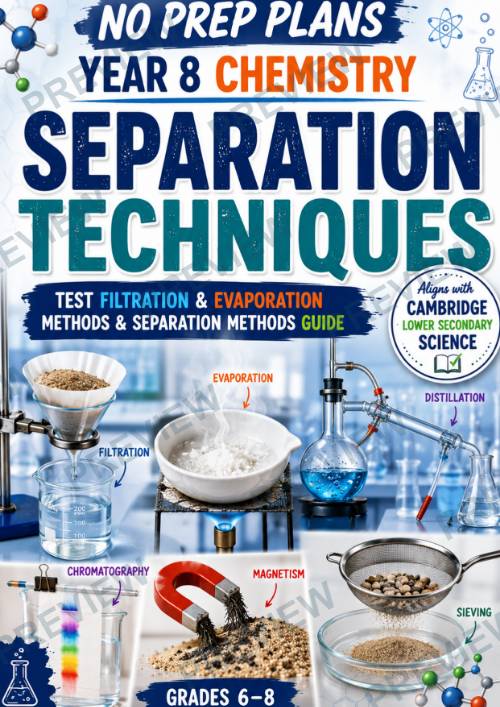
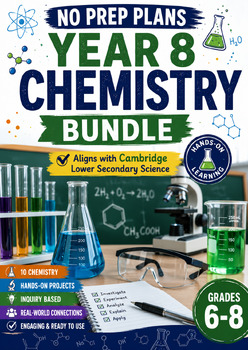
Help students discover how chemists separate mixtures using physical properties through engaging, hands-on investigations! In this inquiry-based lesson, students explore a variety of separation techniques, test filtration and evaporation using real mixtures, compare other common methods, and create their own Separation Methods Guide to explain which technique works best in different situations.
Designed to align with Cambridge Lower Secondary Science and suitable for Grades 6–8, this ready-to-use lesson combines laboratory investigation, scientific reasoning, and practical problem-solving while helping students understand how separation techniques are used in everyday life and industry.
What's Included
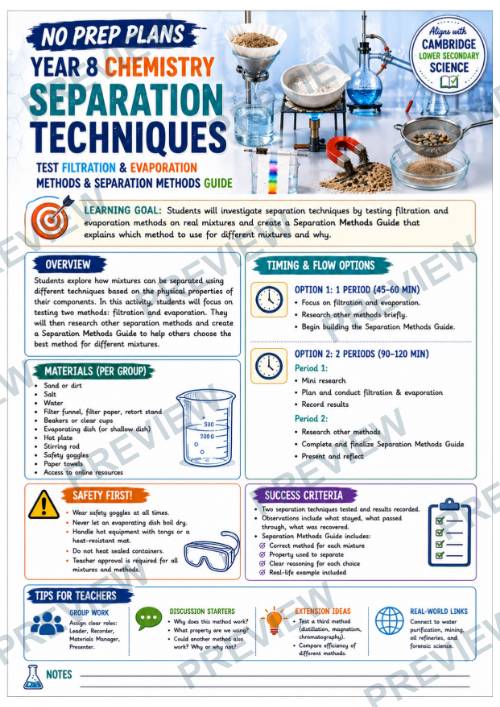
- Teacher directions (1–2 class periods)
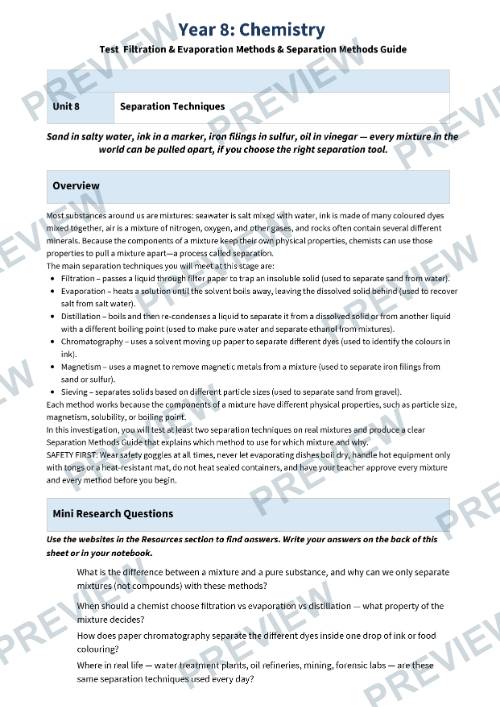
- Student research and concept-building page
- Hands-on separation investigation page
- Separation Methods Guide planning and reflection page
- Early Finisher / Extend Your Learning Choice Board
- Full-colour version
- Black-and-white printer-friendly version
Students Will Learn About
- The difference between mixtures and pure substances
- Why mixtures can be separated using physical methods
- The physical properties used in separation techniques
- Filtration and evaporation investigations
- Distillation, chromatography, magnetism, and sieving
- Choosing the correct separation method for different mixtures
- Recording scientific observations and evidence
- Analysing investigation results
- Real-world applications of separation techniques
- Communicating scientific understanding through a Separation Methods Guide
Perfect For
- Cambridge Lower Secondary Science Stage 8
- US Grade 7 Chemistry
- Middle School Chemistry
- STEM classrooms
- Laboratory investigations
- Inquiry-based science learning
- Science centres
- Independent or partner work
- Extension and enrichment activities
Why Teachers Love It
- Ready-to-use with minimal preparation
- Combines hands-on laboratory work with real-world applications
- Reinforces scientific observation and evidence-based reasoning
- Develops critical thinking and problem-solving skills
- Encourages students to justify why a particular separation method is appropriate
- Connects chemistry concepts to water treatment, mining, food production, and forensic science
- Includes engaging extension activities for early finishers
- Colour and black-and-white versions included for flexible classroom use
- Culminates in a practical reference guide students can use throughout future chemistry units
Students finish this lesson thinking like real chemists—selecting the most effective separation technique based on evidence, explaining the science behind each method, and confidently applying their understanding to everyday mixtures.
Part of the Year 8 Chemistry Series
This lesson is part of the growing No Prep Plans: Year 8 Chemistry series, featuring hands-on investigations and project-based learning experiences covering key chemistry concepts aligned with Cambridge Lower Secondary Science.
Important Disclaimer
This resource is an independently created educational supplement and is not affiliated with, endorsed by, or produced by Cambridge or Cambridge University Press & Assessment.
References to Cambridge Lower Secondary Science are provided only to indicate the curriculum this resource is designed to support.
Teachers should use their professional judgment when determining whether this resource is appropriate for their students and curriculum. This resource is intended to supplement—not replace—official curriculum materials, teacher instruction, or approved course resources. All trademarks and curriculum names remain the property of their respective owners.
·
This resource is also part of 2 bundles
Questions
No questions yet.
Ask a question
Your question goes to No Prep Plans. Answers show on this page, without your name or email.
Sent. The answer will show on this page.
Reviews
No reviews yet. Buyers can review a resource from their order page.
More from No Prep Plans
Campus Happiness Index
 No Prep Plans
$3.00
Book Labels
No Prep PlansFree

Big Band & Jazz Musicians Poster Set (1930s–1950s)
No Prep Plans$3.50
FREE Geography Learning Stations Signs & Choice Cards--Reusable
No Prep PlansFree
Refugee: Author's Craft, Themes & Evidence Bundle 10 Literary Analysis Lessons
No Prep Plans$29.25
Ancient World Turning Points Bundle | 10 Research + Group Project Lessons | 6-10
No Prep Plans$29.25
Request a quote or purchase order
For schools and districts. Your request goes to No Prep Plans, who will reply to your email with a quote or invoice.
Sent. The seller will reply to your email.
Report this listing
What your notice must include
The address of the listing on Classroom Clearinghouse (for example, the /p/ link).
https://classroomclearinghouse.com/p/y6bhkwc6mf
Your name, mailing address, phone number, and email.
How to report
Your name, company, mailing address, phone number, and email.
The address of each listing or store you are reporting.
https://classroomclearinghouse.com/p/y6bhkwc6mf
Copyright owners can also use the DMCA notice page.
Thanks. The report is in the review queue.