
Preview: 3 of 14 pages. Scroll sideways to see more.
$3.50
In your cart. View cart
No account needed. You get a download link.
| Grade | 9th Grade to 12th Grade |
|---|---|
| Resource type | Lesson Plans |
| Subject | Science |
| Format | PDF, 14 pages |
| How was this made? | Created by hand, with images from generation tools |
| Updated | 2026-10-26 |
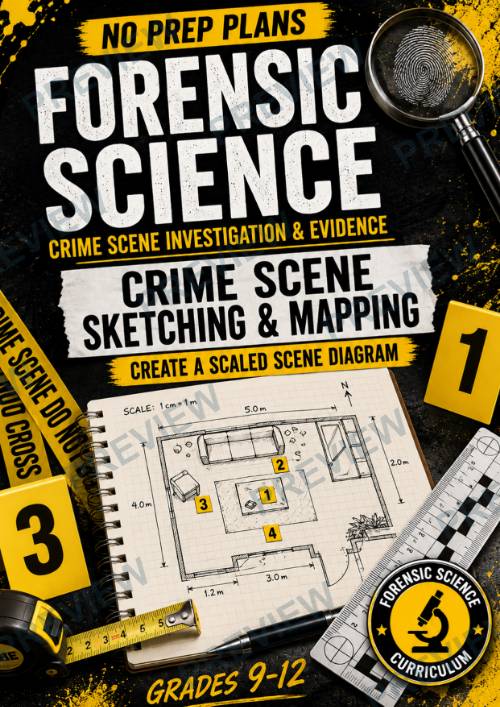
No Prep Plans Forensic Science: Crime Scene Sketching & Mapping
No Prep Plans Forensic Science: Crime Scene Sketching & Mapping | Scaled Scene Diagram
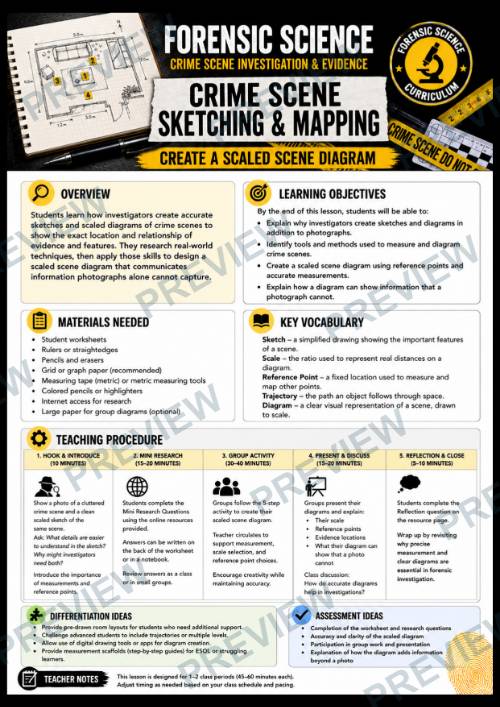
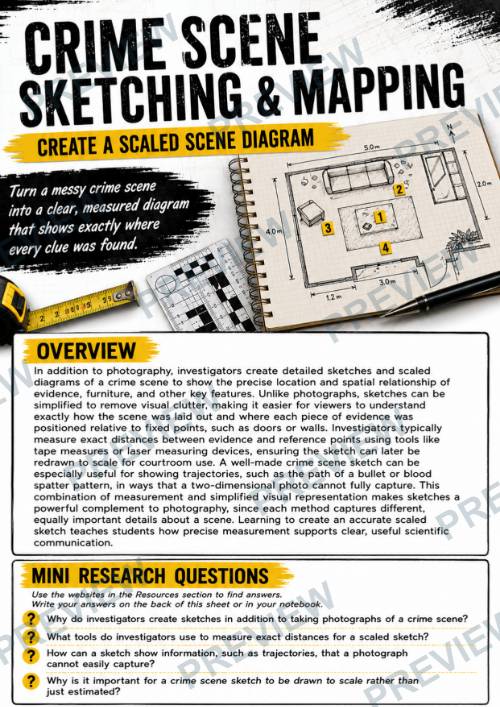
Teach students how investigators turn a complex crime scene into a clear, precise, measured diagram with this No Prep Forensic Science lesson for Grades 9–12. Students explore how crime scene sketches complement photography by documenting the exact locations and spatial relationships of evidence, furniture, and other important scene features.
Students investigate reference points, measurement tools, scale, evidence placement, and spatial relationships before applying their learning in the culminating Create a Scaled Scene Diagram investigation. Working as forensic diagram specialists, students create a measured scene sketch showing the exact locations of evidence and explain what their diagram can reveal that photographs alone may not communicate.
What's Included
- Teacher Directions
- Crime Scene Sketching & Mapping Overview + Mini Research
- Create a Scaled Scene Diagram Group Activity
- 3 Student Activity Pages
- Online Research Resources
- Color + Black-and-White Student Pages
Students Will Explore
- Why investigators sketch crime scenes in addition to photographing them
- How sketches simplify complex scenes and reduce visual clutter
- Fixed reference points and why investigators use them
- Measuring exact evidence locations
- Spatial relationships between evidence and scene features
- Tape measures, rulers, and other measurement tools
- Choosing an appropriate scale
- Converting real-world measurements into diagram measurements
- Creating and labeling a scaled crime scene diagram
- Documenting doors, windows, furniture, evidence, and other fixed features
- How diagrams can communicate trajectories and distances
- How inaccurate measurements can affect interpretation of a scene
- Why precise measurement supports clear forensic communication
Why Teachers Love This Lesson
- No prep and ready to use
- Designed for 1–2 class periods
- Combines forensic science with measurement and spatial reasoning
- Moves students from research into authentic application
- Builds observation, problem-solving, and critical-thinking skills
- Gives students practice working with scale and reference points
- Includes a collaborative forensic investigation
- Works independently or within a larger Crime Scene Investigation & Evidence unit
- Includes full-color and printer-friendly black-and-white student pages
Great For
- Forensic Science
- CSI
- Crime Scene Mapping
- Crime Scene Sketching
- Evidence Documentation
- Criminal Justice
- Grades 9–12
·
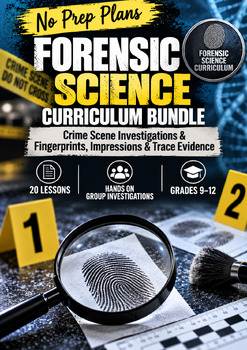
This resource is also part of 2 bundles
Questions
No questions yet.
Ask a question
Your question goes to No Prep Plans. Answers show on this page, without your name or email.
Sent. The answer will show on this page.
Reviews
No reviews yet. Buyers can review a resource from their order page.
More from No Prep Plans
Campus Happiness Index
 No Prep Plans
$3.00
Book Labels
No Prep PlansFree

Big Band & Jazz Musicians Poster Set (1930s–1950s)
No Prep Plans$3.50
FREE Geography Learning Stations Signs & Choice Cards--Reusable
No Prep PlansFree

Refugee: Author's Craft, Themes & Evidence Bundle 10 Literary Analysis Lessons
No Prep Plans$29.25

Ancient World Turning Points Bundle | 10 Research + Group Project Lessons | 6-10
No Prep Plans$29.25
Request a quote or purchase order
For schools and districts. Your request goes to No Prep Plans, who will reply to your email with a quote or invoice.
Sent. The seller will reply to your email.
Report this listing
What your notice must include
The address of the listing on Classroom Clearinghouse (for example, the /p/ link).
https://classroomclearinghouse.com/p/u2hdjs2eb9
Your name, mailing address, phone number, and email.
How to report
Your name, company, mailing address, phone number, and email.
The address of each listing or store you are reporting.
https://classroomclearinghouse.com/p/u2hdjs2eb9
Copyright owners can also use the DMCA notice page.
Thanks. The report is in the review queue.