
Preview: 3 of 14 pages. Scroll sideways to see more.
$3.00
In your cart. View cart
No account needed. You get a download link.
| Grade | 6th Grade to 10th Grade |
|---|---|
| Resource type | Projects |
| Subject | History |
| Format | PDF, 14 pages |
| How was this made? | Created by hand, with images from generation tools |
| Updated | 2026-10-26 |
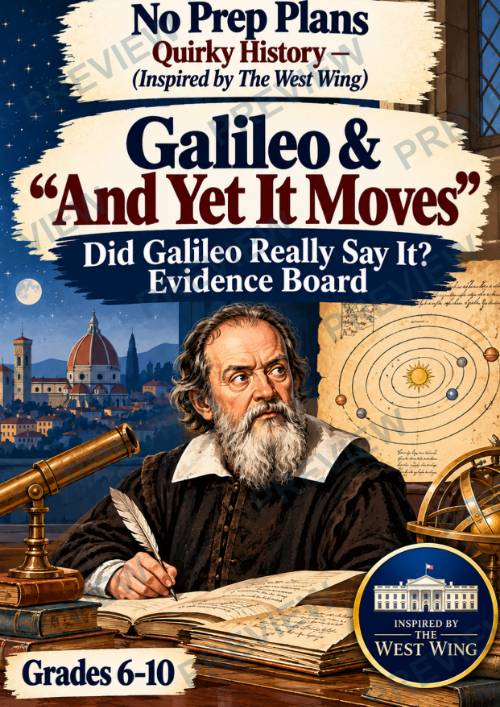
Quirky History: Galileo & “And Yet It Moves”Did Galileo Really Say It?|West Wing
Quirky History: Galileo & “And Yet It Moves”Did Galileo Really Say It? Evidence Board | Inspired by The West Wing | Grades 6–10
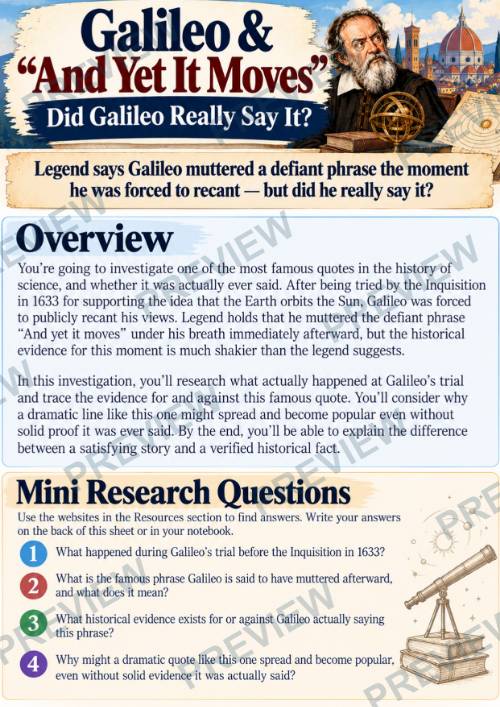
Legend says Galileo muttered a defiant phrase the moment he was forced to recant — but did he really say it?
In this Quirky History investigation, students explore one of the most famous quotations in the history of science. After Galileo’s 1633 trial before the Inquisition, legend claims that he quietly declared “And yet it moves.” Students investigate what actually happened, trace the evidence surrounding the quotation, and consider how a dramatic story can become accepted as historical fact even when the evidence is uncertain.
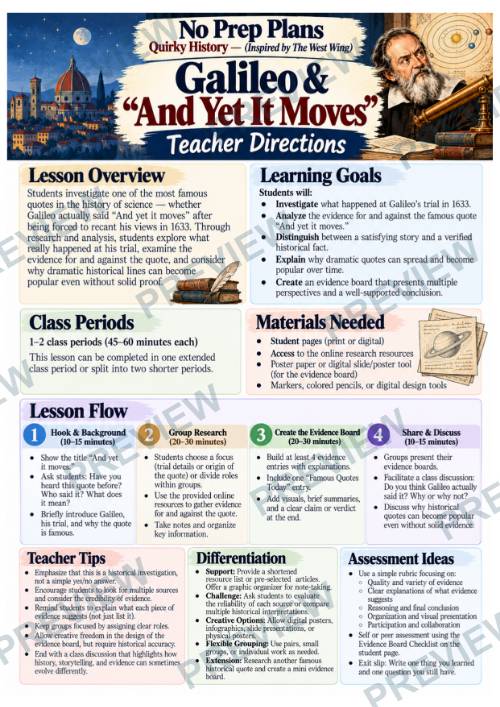
Designed for 1–2 class periods, this No Prep Plan moves students beyond simply researching Galileo. They evaluate evidence, examine the gap between an event and later retellings, explore how famous quotations become legends, and build their own Did Galileo Really Say It? Evidence Board.
What’s Included
- Teacher Directions & Historical Overview
- Mini Research Questions
- 5-Step Group Investigation
- 3 Student Research, Evidence & Planning Pages
- Color + Black & White Versions
- Online Research Resources
- Disclaimers & Credits
Why Teachers Love This
- No prep and ready to use
- Turns a famous historical quote into an engaging mystery
- Builds source evaluation and evidence-analysis skills
- Helps students distinguish historical evidence from popular legend
- Examines how stories change through repetition and retelling
- Encourages students to evaluate what evidence does and does not prove
- Integrates history, science, and media literacy
- Flexible for individual, partner, or small-group use
- Works as a stand-alone lesson, enrichment activity, or sub plan
Perfect For
- World History
- Renaissance & Scientific Revolution
- History of Science
- Galileo Studies
- Historical Research
- Source & Evidence Analysis
- Media Literacy
- Critical Thinking
- Enrichment & Sub Plans
Students culminate their investigation by creating an Evidence Board containing at least four pieces of evidence, explaining what each suggests, and examining another famous historical quotation that may not have been said as commonly believed.
Please Note: This is an independent educational resource inspired by historical topics referenced in The West Wing. It is not affiliated with, endorsed by, or connected to NBC, Warner Bros., or the creators, producers, or distributors of The West Wing.
·
This resource is also part of a bundle with 9 other resources
Questions
No questions yet.
Ask a question
Your question goes to No Prep Plans. Answers show on this page, without your name or email.
Sent. The answer will show on this page.
Reviews
No reviews yet. Buyers can review a resource from their order page.
More from No Prep Plans
Campus Happiness Index
 No Prep Plans
$3.00
Book Labels
No Prep PlansFree
Big Band & Jazz Musicians Poster Set (1930s–1950s)
No Prep Plans$3.50
FREE Geography Learning Stations Signs & Choice Cards--Reusable
No Prep PlansFree
Refugee: Author's Craft, Themes & Evidence Bundle 10 Literary Analysis Lessons
No Prep Plans$29.25
Ancient World Turning Points Bundle | 10 Research + Group Project Lessons | 6-10
No Prep Plans$29.25
Request a quote or purchase order
For schools and districts. Your request goes to No Prep Plans, who will reply to your email with a quote or invoice.
Sent. The seller will reply to your email.
Report this listing
What your notice must include
The address of the listing on Classroom Clearinghouse (for example, the /p/ link).
https://classroomclearinghouse.com/p/tgb5vekf4u
Your name, mailing address, phone number, and email.
How to report
Your name, company, mailing address, phone number, and email.
The address of each listing or store you are reporting.
https://classroomclearinghouse.com/p/tgb5vekf4u
Copyright owners can also use the DMCA notice page.
Thanks. The report is in the review queue.