
Preview: 3 of 16 pages. Scroll sideways to see more.
$3.50
In your cart. View cart
No account needed. You get a download link.
| Grade | 6th Grade to 8th Grade |
|---|---|
| Resource type | Lesson Plans |
| Subject | Science |
| Format | PDF, 16 pages |
| How was this made? | Created by hand, with images from generation tools |
| Updated | 2026-10-26 |
No Prep Plans: Cambridge Year 8 Science Earth & Space — Earth Systems Review
No Prep Plans: Cambridge Year 8 Science Earth & Space — Earth Systems Review
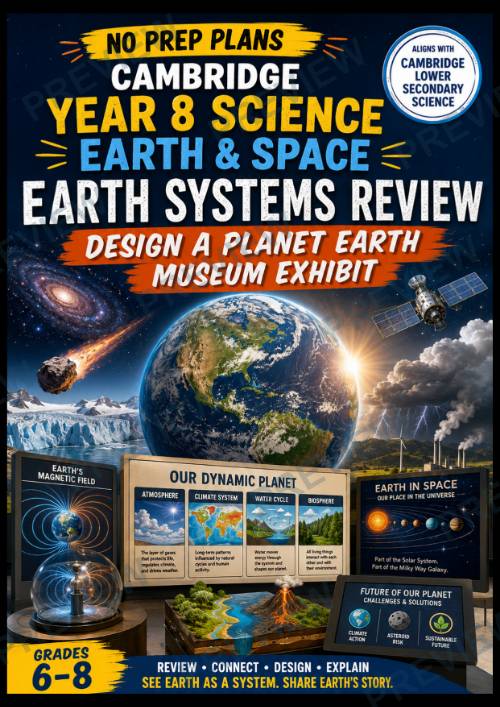
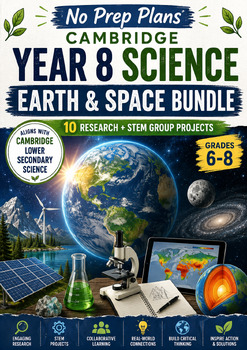
Bring your entire Earth & Space unit together with an engaging Planet Earth Museum Exhibit capstone project! Designed for Cambridge Year 8 Science / US Grade 7 and adaptable for Grades 6–8, this resource challenges students to move beyond studying individual topics and recognize Earth as one interconnected system within a much larger universe.
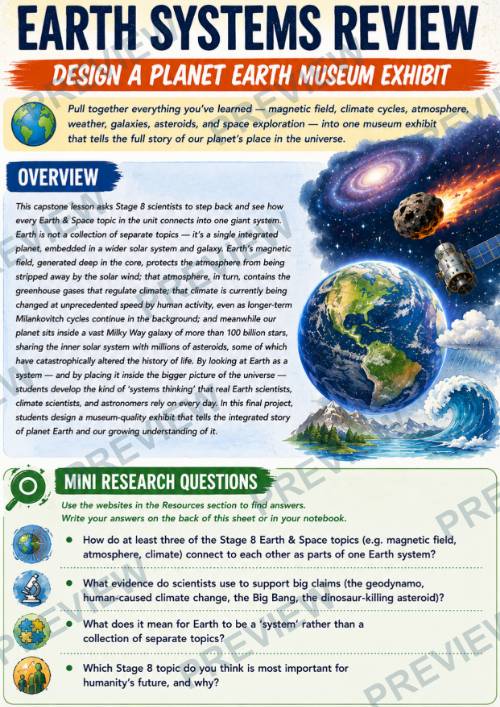
Students review and connect major ideas from across the unit, including Earth’s magnetic field, atmosphere, weather, climate and climate cycles, galaxies, asteroids, and space exploration. They then apply their understanding to design a museum exhibit that combines multiple topics into one clear scientific story.
Students Will:
✓ Connect concepts from across an entire Earth & Space unit
✓ Explain relationships between Earth systems
✓ Apply cause-and-effect thinking to scientific processes
✓ Examine evidence used to support major scientific ideas
✓ Distinguish between natural processes and human influences
✓ Consider Earth at different scales—from its interior to the wider universe
✓ Plan a cohesive museum exhibit around 4+ connected topics
✓ Develop a working model or demonstration
✓ Organize scientific information for a real audience
✓ Synthesize learning into a big-picture understanding of Planet Earth
What’s Included
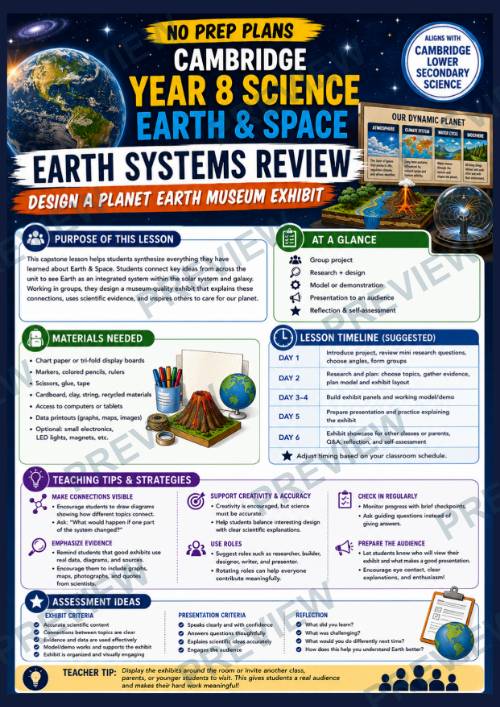
• Teacher Directions
• Earth Systems Review Overview + Mini Research Questions
• 5-Step Planet Earth Museum Exhibit Group Activity
• 3 Student Research, Planning & Deeper Review Pages
• 9-Activity Early Finisher Choice Board
• Color + printer-friendly B&W student pages
Why Teachers Love It
✓ No prep and ready to use
✓ Provides a meaningful review of an entire Earth & Space unit
✓ Moves students through understanding → planning → deeper thinking
✓ Helps students see connections instead of treating science topics in isolation
✓ Combines scientific knowledge with systems thinking
✓ Reinforces evidence, cause and effect, and scientific reasoning
✓ Gives students an authentic purpose and audience for their learning
✓ Encourages collaboration, creativity, and communication
✓ Early finisher board provides meaningful extension and review
✓ Includes both full-color and B&W options
Perfect For
• Cambridge Year 8 Science / US Grade 7
• Grades 6–8 Earth & Space Science
• End-of-unit review
• Earth systems units
• Science exam review
• Capstone projects
• Project-based learning
• Collaborative group work
• Science centers or stations
• End-of-semester activities
• Early finisher activities
• No-prep lessons or substitute plans
Rather than reviewing magnetic fields, climate, weather, galaxies, asteroids, and space exploration as separate lessons, students bring their learning together to answer a much bigger question: How do all of these ideas help us understand Planet Earth and its place in the universe?
Disclaimer
This is an independently created educational resource designed to align with Cambridge Lower Secondary Science. It is not affiliated with, endorsed by, sponsored by, or officially connected with Cambridge University Press & Assessment or Cambridge International Education. Cambridge names and curriculum references are used solely to describe curriculum alignment and intended educational use.
·
This resource is also part of 2 bundles
Questions
No questions yet.
Ask a question
Your question goes to No Prep Plans. Answers show on this page, without your name or email.
Sent. The answer will show on this page.
Reviews
No reviews yet. Buyers can review a resource from their order page.
More from No Prep Plans
Campus Happiness Index
 No Prep Plans
$3.00
Book Labels
No Prep PlansFree

Big Band & Jazz Musicians Poster Set (1930s–1950s)
No Prep Plans$3.50
FREE Geography Learning Stations Signs & Choice Cards--Reusable
No Prep PlansFree
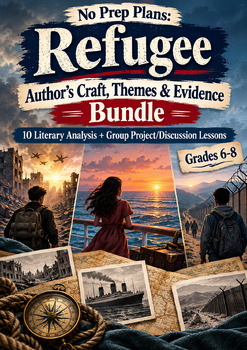
Refugee: Author's Craft, Themes & Evidence Bundle 10 Literary Analysis Lessons
No Prep Plans$29.25
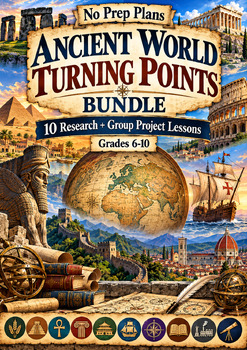
Ancient World Turning Points Bundle | 10 Research + Group Project Lessons | 6-10
No Prep Plans$29.25
Request a quote or purchase order
For schools and districts. Your request goes to No Prep Plans, who will reply to your email with a quote or invoice.
Sent. The seller will reply to your email.
Report this listing
What your notice must include
The address of the listing on Classroom Clearinghouse (for example, the /p/ link).
https://classroomclearinghouse.com/p/tgaary88e8
Your name, mailing address, phone number, and email.
How to report
Your name, company, mailing address, phone number, and email.
The address of each listing or store you are reporting.
https://classroomclearinghouse.com/p/tgaary88e8
Copyright owners can also use the DMCA notice page.
Thanks. The report is in the review queue.