
Preview: 3 of 14 pages. Scroll sideways to see more.
$3.25
In your cart. View cart
No account needed. You get a download link.
| Grade | 6th Grade to 8th Grade |
|---|---|
| Resource type | Projects |
| Subject | History |
| Format | PDF, 14 pages |
| How was this made? | Created by hand, with images from generation tools |
| Updated | 2026-10-26 |
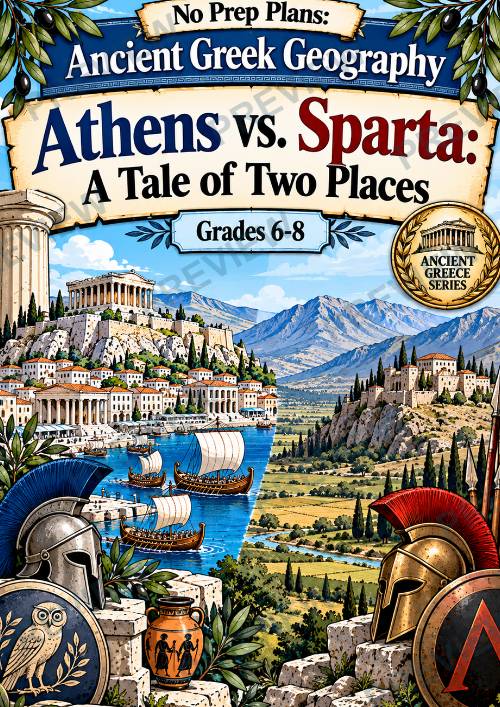
Ancient Greek Geography: Athens vs. Sparta — A Tale of Two Places
Ancient Greek Geography: Athens vs. Sparta — A Tale of Two PlacesGeography Comparison Challenge | Grades 6–8
Why did Athens and Sparta develop so differently even though both were Greek city-states?
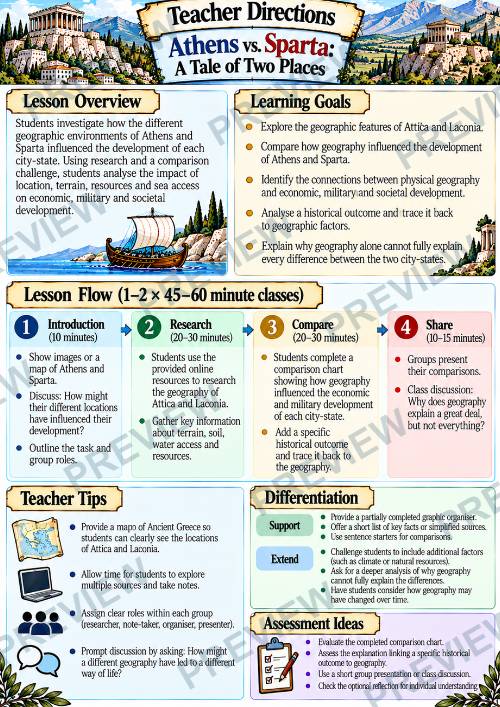
In this Ancient Greek Geography investigation, students compare the contrasting physical environments of Athens in Attica and Sparta in Laconia. They examine how terrain, soil, farmland, coastal access, trade opportunities, and defensive position helped shape each city-state’s economy and military development.
What’s Included
- Teacher Directions
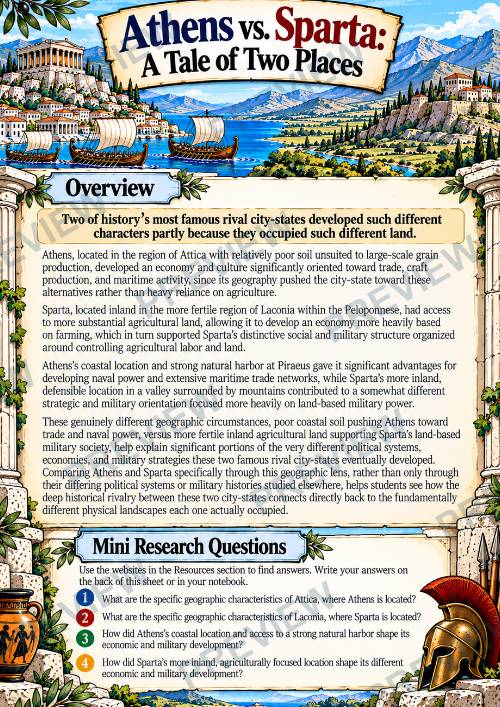
- Overview & mini research questions
- 5-step Geography Comparison Challenge
- Athens & Sparta geographic profiles
- Side-by-side comparison activities
- Cause-and-effect analysis
- Full-color + black-and-white student pages
Students Will
- Compare the geography of Attica and Laconia
- Examine terrain, soil, farmland & sea access
- Identify geographic advantages and limitations
- Connect geography to trade, agriculture & movement
- Trace geographic conditions to economic and military responses
- Explore Athens’ naval power and Sparta’s land-based military power
- Build clear cause-and-effect connections
- Consider how the city-states might have developed differently in another location
- Distinguish what geography can—and cannot—explain
- Support conclusions with geographic evidence
Why Teachers Love This Resource
- No prep and classroom ready
- Designed for 1–2 45–60 minute classes
- Combines geography, history, research & critical thinking
- Moves beyond a basic Athens-vs.-Sparta comparison
- Builds strong comparison and cause-and-effect skills
- Encourages evidence-based reasoning
- Includes engaging hypothetical thinking
- Connects physical geography directly to historical development
- Works for individual, partner or group learning
- Includes color and ink-friendly B&W pages
- Fits easily into an Ancient Greece unit
Rather than simply comparing Athens and Sparta’s governments or societies, this activity asks students to read the landscapes beneath the history. Students discover how two very different places created different opportunities and limitations—and how those geographic circumstances contributed to the distinctive paths Athens and Sparta followed.
·
This resource is also part of a bundle with 9 other resources
Questions
No questions yet.
Ask a question
Your question goes to No Prep Plans. Answers show on this page, without your name or email.
Sent. The answer will show on this page.
Reviews
No reviews yet. Buyers can review a resource from their order page.
More from No Prep Plans
Campus Happiness Index
 No Prep Plans
$3.00
Book Labels
No Prep PlansFree

Big Band & Jazz Musicians Poster Set (1930s–1950s)
No Prep Plans$3.50
FREE Geography Learning Stations Signs & Choice Cards--Reusable
No Prep PlansFree

Refugee: Author's Craft, Themes & Evidence Bundle 10 Literary Analysis Lessons
No Prep Plans$29.25
Ancient World Turning Points Bundle | 10 Research + Group Project Lessons | 6-10
No Prep Plans$29.25
Request a quote or purchase order
For schools and districts. Your request goes to No Prep Plans, who will reply to your email with a quote or invoice.
Sent. The seller will reply to your email.
Report this listing
What your notice must include
The address of the listing on Classroom Clearinghouse (for example, the /p/ link).
https://classroomclearinghouse.com/p/t3ggra7ezk
Your name, mailing address, phone number, and email.
How to report
Your name, company, mailing address, phone number, and email.
The address of each listing or store you are reporting.
https://classroomclearinghouse.com/p/t3ggra7ezk
Copyright owners can also use the DMCA notice page.
Thanks. The report is in the review queue.