
Preview: 3 of 16 pages. Scroll sideways to see more.
$3.50
In your cart. View cart
No account needed. You get a download link.
| Grade | 6th Grade to 8th Grade |
|---|---|
| Resource type | Lesson Plans |
| Subject | Science |
| Format | PDF, 16 pages |
| How was this made? | Created by hand, with images from generation tools |
| Updated | 2026-10-26 |
No Prep Plans: Year 8 Biology – Gas Exchange (Diffusion Demonstration) 6th-8th
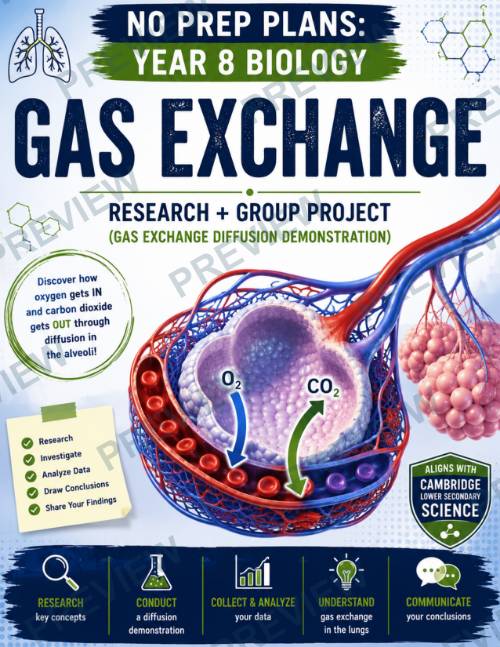
No Prep Plans: Year 8 Biology – Gas Exchange
Research + Group Project: Gas Exchange Diffusion Demonstration
Help students visualize one of the most important processes in biology with this engaging, inquiry-based Gas Exchange Diffusion Demonstration! Through hands-on investigation, scientific observation, and collaborative learning, students explore how oxygen and carbon dioxide move by diffusion and discover why alveoli are perfectly adapted for efficient gas exchange.
Part of the No Prep Plans: Year 8 Biology series, this ready-to-use lesson combines research, practical investigation, and critical thinking while reinforcing key respiratory system concepts.
What's Included
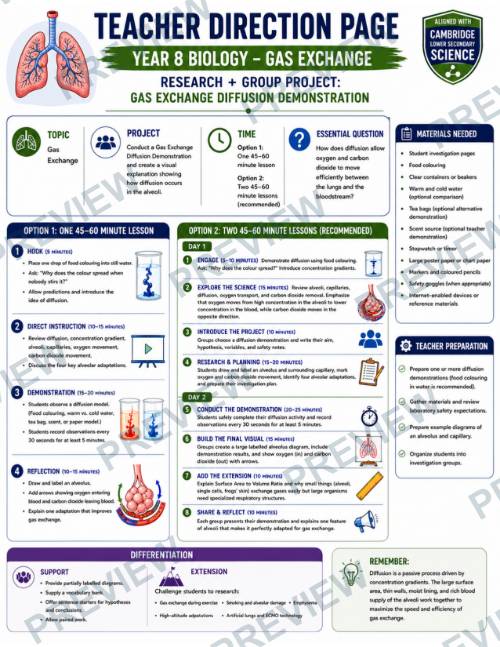
- ✅ Complete Teacher Direction Page with options for one or two 45–60 minute lessons
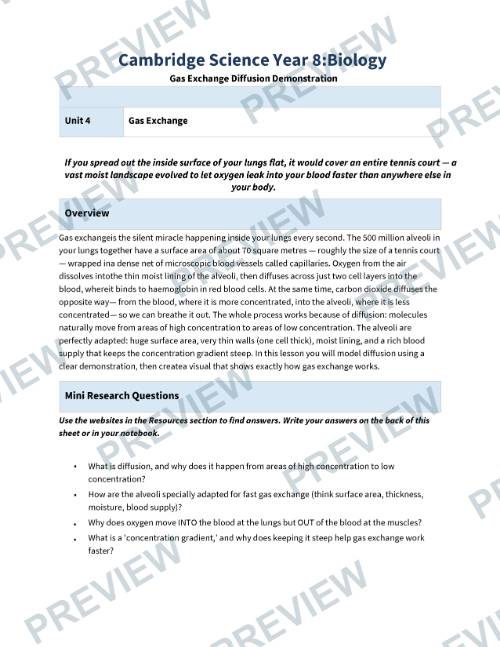
- ✅ Student Research & Planning Page
- ✅ Student Demonstration & Observation Page
- ✅ Student Analysis, Conclusions & Reflection Page
- ✅ Early Finisher Choice Board with 10 meaningful extension activities
- ✅ Full-color printable version
- ✅ Black-and-white printer-friendly version
Students Will:
- Explain diffusion as the movement of particles from areas of high concentration to low concentration.
- Investigate how diffusion models can represent gas exchange in the lungs.
- Identify the structure and function of alveoli and surrounding capillaries.
- Describe the four key adaptations that make alveoli efficient for gas exchange.
- Develop a hypothesis and safely conduct a classroom diffusion demonstration.
- Record systematic observations and interpret experimental evidence.
- Draw and label scientific diagrams showing oxygen and carbon dioxide movement.
- Connect surface area to volume ratio with efficient gas exchange in living organisms.
- Communicate scientific findings through written conclusions and reflection.
Perfect For
- Year 8 Biology/US Grade 7
- Respiratory System units
- Cambridge-style practical investigations
- Inquiry-based science classrooms
- STEM and project-based learning
- Scientific method practice
- Homeschool settings
- Cooperative learning groups
- Early finisher enrichment
- Science centers and extension activities
This investigation encourages students to move beyond memorization by observing diffusion in action and connecting simple classroom demonstrations to the microscopic processes occurring inside the human lungs. The structured activities promote scientific thinking while helping students understand why alveoli are uniquely adapted for rapid and efficient gas exchange.
Cambridge Lower Secondary Science Disclaimer
This resource is an independent educational product created to support classroom instruction and is not affiliated with, endorsed by, sponsored by, or approved by Cambridge University Press & Assessment or Cambridge International Education. References to Cambridge Lower Secondary Science are provided solely to indicate curriculum alignment and compatibility.
·
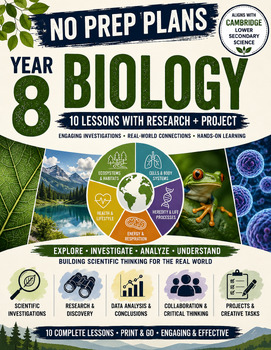
This resource is also part of 2 bundles

Questions
No questions yet.
Ask a question
Your question goes to No Prep Plans. Answers show on this page, without your name or email.
Sent. The answer will show on this page.
Reviews
No reviews yet. Buyers can review a resource from their order page.
More from No Prep Plans
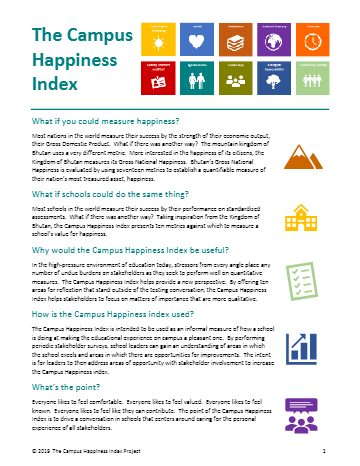
Campus Happiness Index
 No Prep Plans
$3.00

Book Labels
No Prep PlansFree

Big Band & Jazz Musicians Poster Set (1930s–1950s)
No Prep Plans$3.50
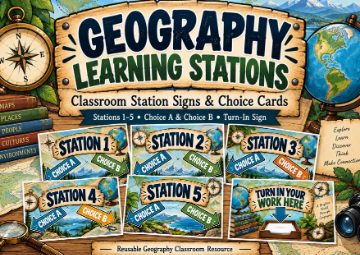
FREE Geography Learning Stations Signs & Choice Cards--Reusable
No Prep PlansFree

Refugee: Author's Craft, Themes & Evidence Bundle 10 Literary Analysis Lessons
No Prep Plans$29.25

Ancient World Turning Points Bundle | 10 Research + Group Project Lessons | 6-10
No Prep Plans$29.25
Request a quote or purchase order
For schools and districts. Your request goes to No Prep Plans, who will reply to your email with a quote or invoice.
Sent. The seller will reply to your email.
Report this listing
What your notice must include
The address of the listing on Classroom Clearinghouse (for example, the /p/ link).
https://classroomclearinghouse.com/p/smehfewdta
Your name, mailing address, phone number, and email.
How to report
Your name, company, mailing address, phone number, and email.
The address of each listing or store you are reporting.
https://classroomclearinghouse.com/p/smehfewdta
Copyright owners can also use the DMCA notice page.
Thanks. The report is in the review queue.