
Preview: 3 of 14 pages. Scroll sideways to see more.
$3.00
In your cart. View cart
No account needed. You get a download link.
| Grade | 6th Grade to 8th Grade |
|---|---|
| Resource type | Projects |
| Subject | History |
| Format | PDF, 14 pages |
| How was this made? | Created by hand, with images from generation tools |
| Updated | 2026-10-26 |
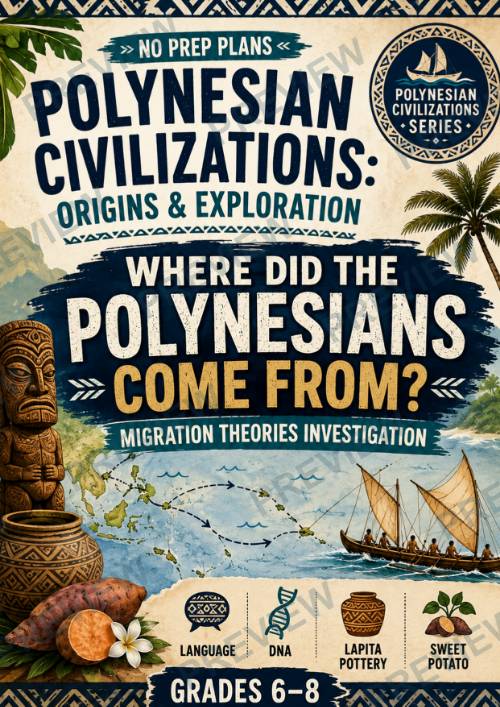
Polynesian Civilizations: Origins-- Where Did the Polynesians Come From?
Polynesian Civilizations: Origins & ExplorationWhere Did the Polynesians Come From? — Migration Theories Investigation Grades 6–8 | No Prep | Inquiry + Research + Evidence Analysis
Turn students into history detectives as they investigate one of the most fascinating questions in Pacific history: Where did the Polynesians come from, and how did they spread across the vast Pacific Ocean?
In this inquiry-based lesson, students examine the evidence researchers use to reconstruct Polynesian origins and migration. They explore connections revealed through language, DNA, Lapita pottery, archaeology, and plant evidence, including the fascinating sweet potato connection between Polynesia and South America.
Rather than simply memorizing a migration route, students learn to weigh evidence, compare explanations, recognize the limitations of individual clues, and build an evidence-based conclusion about Polynesian origins.
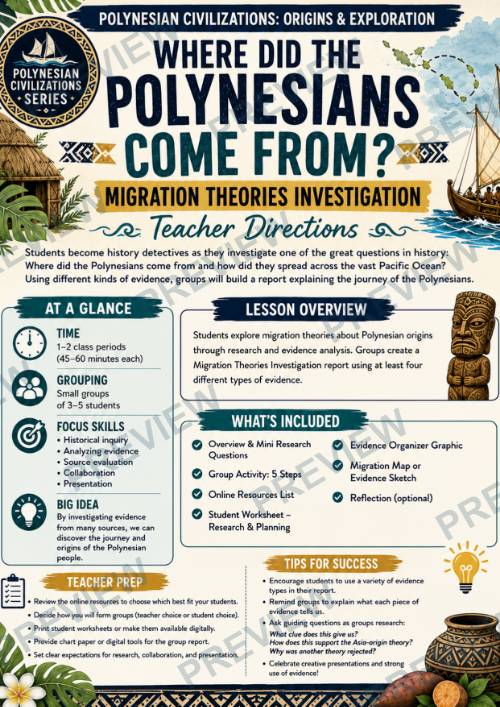
What's Included
- Teacher Directions for 1–2 class periods
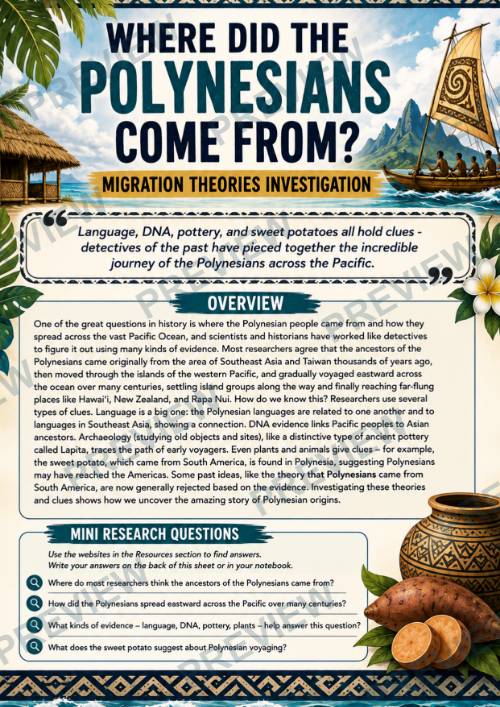
- Polynesian origins overview
- Mini Research Questions
- 5-step Migration Theories Investigation
- Online research resources
- Understanding the Research: Following the Evidence student organizer
- Planning the Investigation student worksheet
- Digging Deeper: Thinking Like a History Detective analysis worksheet
- Full-color student pages
- Printer-friendly black-and-white student pages
Students Investigate
- The Southeast Asia/Taiwan connection to Polynesian origins
- Migration through the western Pacific and eastward across the ocean
- Language evidence
- DNA evidence
- Archaeological evidence and Lapita pottery
- The mysterious sweet potato connection
- How different kinds of evidence can support the same conclusion
- Why historical explanations change when stronger evidence becomes available
- How researchers evaluate competing migration theories
Perfect for
- World History, Geography
- Ancient Civilizations
- Pacific Studies
- Polynesian Civilizations
- inquiry-based learning
- historical thinking
- middle school social studies.
Help students discover that historians don't simply know what happened in the past—they piece together the story from evidence.
·
This resource is also part of a bundle with 9 other resources
Questions
No questions yet.
Ask a question
Your question goes to No Prep Plans. Answers show on this page, without your name or email.
Sent. The answer will show on this page.
Reviews
No reviews yet. Buyers can review a resource from their order page.
More from No Prep Plans
Campus Happiness Index
 No Prep Plans
$3.00
Book Labels
No Prep PlansFree
Big Band & Jazz Musicians Poster Set (1930s–1950s)
No Prep Plans$3.50
FREE Geography Learning Stations Signs & Choice Cards--Reusable
No Prep PlansFree
Refugee: Author's Craft, Themes & Evidence Bundle 10 Literary Analysis Lessons
No Prep Plans$29.25
Ancient World Turning Points Bundle | 10 Research + Group Project Lessons | 6-10
No Prep Plans$29.25
Request a quote or purchase order
For schools and districts. Your request goes to No Prep Plans, who will reply to your email with a quote or invoice.
Sent. The seller will reply to your email.
Report this listing
What your notice must include
The address of the listing on Classroom Clearinghouse (for example, the /p/ link).
https://classroomclearinghouse.com/p/rfm9qzuvq4
Your name, mailing address, phone number, and email.
How to report
Your name, company, mailing address, phone number, and email.
The address of each listing or store you are reporting.
https://classroomclearinghouse.com/p/rfm9qzuvq4
Copyright owners can also use the DMCA notice page.
Thanks. The report is in the review queue.