
Preview: 3 of 14 pages. Scroll sideways to see more.
$3.50
In your cart. View cart
No account needed. You get a download link.
| Grade | 6th Grade to 8th Grade |
|---|---|
| Resource type | Lesson Plans |
| Subject | Science |
| Format | PDF, 14 pages |
| How was this made? | Created by hand, with images from generation tools |
| Updated | 2026-10-26 |
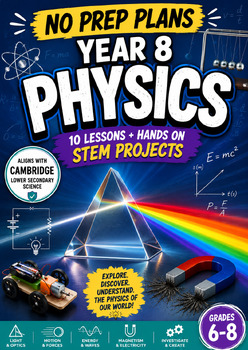
No Prep Plans: Year 8 Physics – Balanced & Unbalanced Forces | Motion Analysis
No Prep Plans: Year 8 Physics – Balanced & Unbalanced Forces | Motion AnalysisHands-On Cambridge Lower Secondary Science Companion
Year 8 / US Grade 7
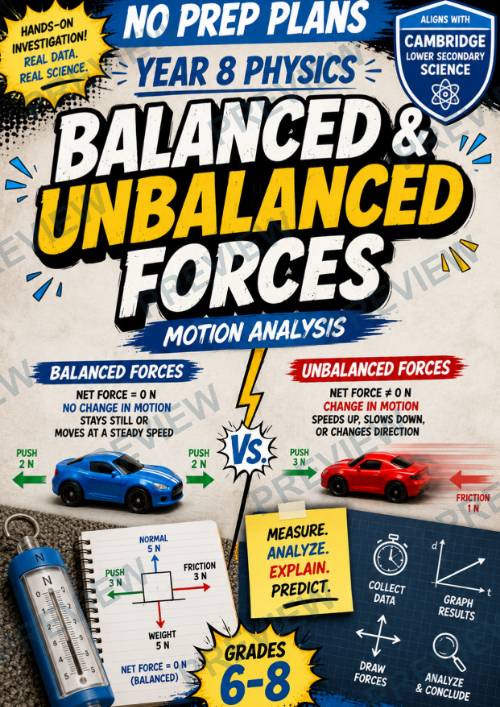
Help students understand how forces change motion through an engaging, hands-on investigation using toy cars, different surfaces, measurements, and force-arrow diagrams.
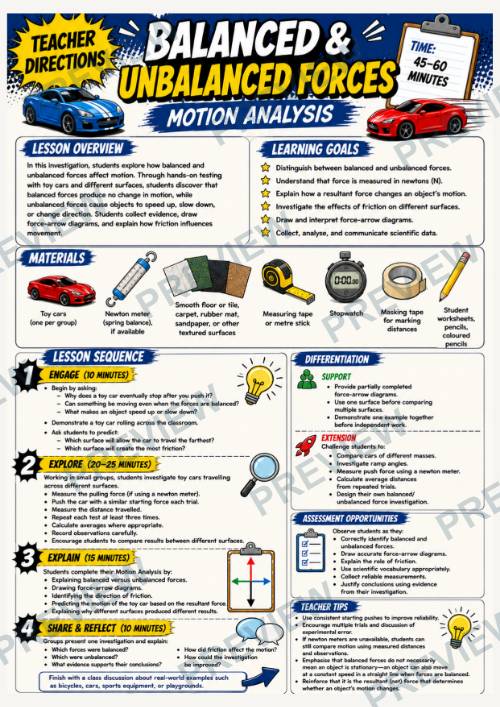
In this lesson, students explore the difference between balanced and unbalanced forces, investigate how friction affects movement, calculate and interpret resultant force, and apply their understanding to real-world motion scenarios. The activity moves beyond simple definitions by asking students to collect evidence, compare surfaces, analyse forces, and explain why objects speed up, slow down, remain still, or continue moving at a steady speed.
What’s Included
- Teacher Directions for a 45–60 minute lesson
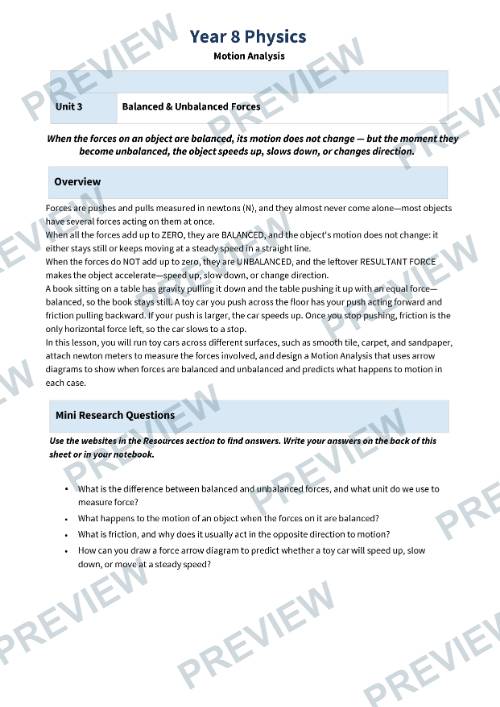
- Research and Investigation Planning page
- Motion Investigation Data Collection page
- Force Detective Motion Analysis page
- Printer-friendly black-and-white versions of all student pages
Students Will Learn To
- Define force as a push or pull
- Understand that force is measured in newtons (N)
- Distinguish between balanced and unbalanced forces
- Explain how resultant force affects motion
- Identify gravity, friction, normal force, applied force, and air resistance
- Investigate how different surfaces affect friction
- Collect and compare repeated measurements
- Draw and label force-arrow diagrams
- Explain whether an object will remain still, move steadily, speed up, slow down, or change direction
- Support conclusions with evidence from an investigation
Student Activities Include
- Comparing balanced and unbalanced forces
- Planning a fair investigation
- Testing toy cars across tile, carpet, sandpaper, and another chosen surface
- Recording push force and distance travelled
- Completing repeated trials and calculating averages
- Identifying which surface creates the most friction
- Analysing everyday force scenarios
- Drawing force diagrams for selected situations
- Writing an evidence-based explanation of motion
Perfect For
- Cambridge Lower Secondary Science
- Year 8 Physics
- US Grade 7 Physical Science
- Forces and motion units
- STEM investigations
- Inquiry-based learning
- Science centres
- Collaborative group work
- Experimental design and data analysis
- Review, enrichment, or assessment
Why Teachers Love It
- Ready to print and teach
- Hands-on and highly visual
- Combines scientific knowledge with practical investigation
- Reinforces fair testing and repeated trials
- Includes large writing and drawing spaces
- Encourages students to explain their reasoning
- Develops science, mathematics, and communication skills
- Engaging comic-style design for middle school learners
- Minimal teacher preparation required
Important Disclaimer
This resource is an independent educational companion designed to support topics commonly taught in Cambridge Lower Secondary Science. It is not affiliated with, endorsed by, or approved by Cambridge University Press & Assessment.
This lesson is intended as a supplementary classroom resource. Teachers should adapt, modify, and integrate the materials to suit their own curriculum, approved resources, school requirements, teaching context, and the individual needs of their students. It is designed to complement—not replace—official curriculum documents and instructional materials.
·
This resource is also part of 2 bundles
Questions
No questions yet.
Ask a question
Your question goes to No Prep Plans. Answers show on this page, without your name or email.
Sent. The answer will show on this page.
Reviews
No reviews yet. Buyers can review a resource from their order page.
More from No Prep Plans
Campus Happiness Index
 No Prep Plans
$3.00
Book Labels
No Prep PlansFree

Big Band & Jazz Musicians Poster Set (1930s–1950s)
No Prep Plans$3.50
FREE Geography Learning Stations Signs & Choice Cards--Reusable
No Prep PlansFree
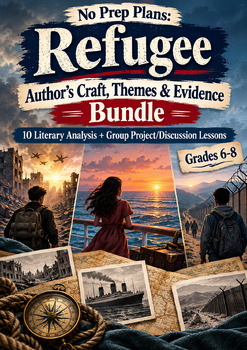
Refugee: Author's Craft, Themes & Evidence Bundle 10 Literary Analysis Lessons
No Prep Plans$29.25
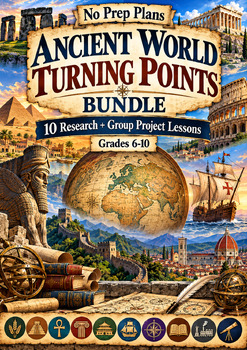
Ancient World Turning Points Bundle | 10 Research + Group Project Lessons | 6-10
No Prep Plans$29.25
Request a quote or purchase order
For schools and districts. Your request goes to No Prep Plans, who will reply to your email with a quote or invoice.
Sent. The seller will reply to your email.
Report this listing
What your notice must include
The address of the listing on Classroom Clearinghouse (for example, the /p/ link).
https://classroomclearinghouse.com/p/ref33yns26
Your name, mailing address, phone number, and email.
How to report
Your name, company, mailing address, phone number, and email.
The address of each listing or store you are reporting.
https://classroomclearinghouse.com/p/ref33yns26
Copyright owners can also use the DMCA notice page.
Thanks. The report is in the review queue.