
Preview: 3 of 14 pages. Scroll sideways to see more.
$3.25
In your cart. View cart
No account needed. You get a download link.
| Grade | 6th Grade to 10th Grade |
|---|---|
| Resource type | Projects |
| Subject | History |
| Format | PDF, 14 pages |
| How was this made? | Created by hand, with images from generation tools |
| Updated | 2026-10-26 |
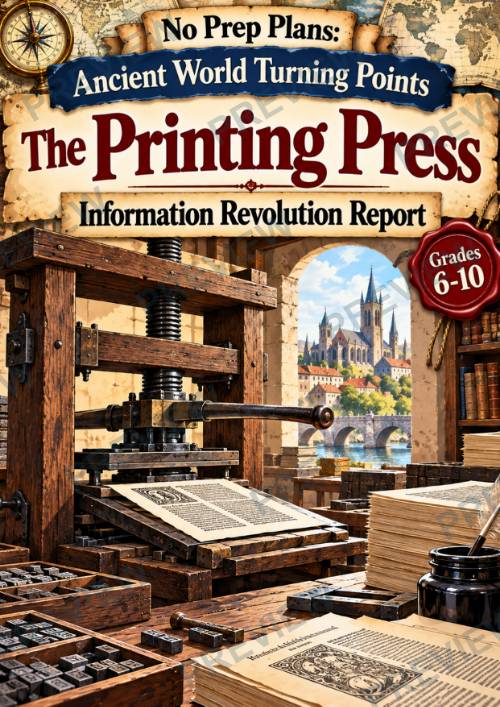
Ancient World Turning Points | The Printing Press |Information Revolution Report
Ancient World Turning Points | The Printing Press | Information Revolution Report | Grades 6–10
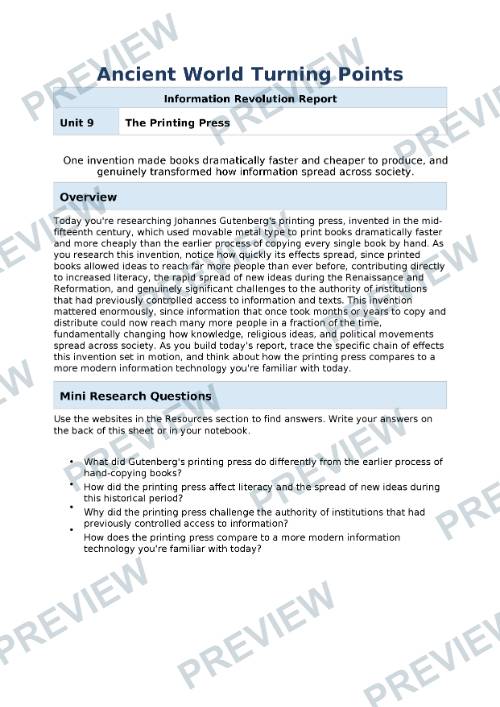
How did one invention revolutionize the spread of information and change the course of history?
In this no-prep Ancient World Turning Points lesson, students investigate Johannes Gutenberg's printing press and explore how the development of movable-type printing in fifteenth-century Europe transformed access to information, education, and the spread of ideas.
Through historical research, critical thinking, cause-and-effect analysis, and collaborative discussion, students examine how printed materials became more widely available, contributed to increased literacy, and challenged institutions that previously controlled access to knowledge.
Students work in groups to create an Information Revolution Report, tracing the chain of historical consequences set in motion by the printing press and comparing its impact to modern information technologies such as the internet and social media.
What's Included
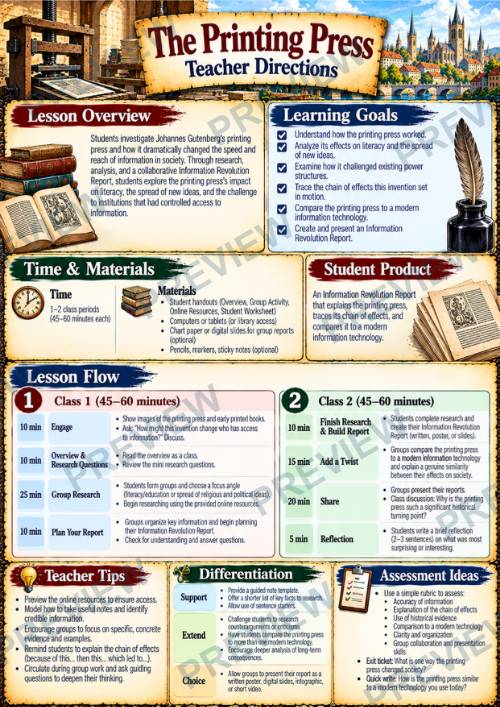
- Teacher Directions (1–2 class periods, 45–60 minutes each)
- Historical Overview and Mini Research Questions
- Five-Step Group Project Instructions
- Suggested Online Research Resources
- 3 Student Worksheets in Color and Black & White:
Students Will
- Investigate the development of Gutenberg's printing press in fifteenth-century Europe.
- Examine how movable metal type transformed the production of books and written materials.
- Compare information production before and after the printing press.
- Analyze how wider access to printed materials influenced literacy and education.
- Investigate the spread of religious, political, and intellectual ideas.
- Examine how printed information challenged established institutions and authority.
- Trace interconnected causes and consequences of technological innovation.
- Evaluate the printing press's influence on the Renaissance and Reformation.
- Compare the historical printing revolution with modern information technologies.
- Construct and present an evidence-based Information Revolution Report.
Perfect For
- World History
- The Renaissance and Reformation
- Johannes Gutenberg and the Printing Press
- History of Technology and Innovation
- Information Revolutions
- Historical Turning Points
- Literacy and Education in History
- Critical Thinking and Research Skills
- Collaborative Group Projects
Help students move beyond memorizing Gutenberg's invention to critically examining how the printing press transformed access to knowledge, accelerated the spread of ideas, challenged established authority, and helped reshape European society—while making meaningful connections to the information revolution we experience today!
·
This resource is also part of a bundle with 9 other resources
Questions
No questions yet.
Ask a question
Your question goes to No Prep Plans. Answers show on this page, without your name or email.
Sent. The answer will show on this page.
Reviews
No reviews yet. Buyers can review a resource from their order page.
More from No Prep Plans
Campus Happiness Index
 No Prep Plans
$3.00
Book Labels
No Prep PlansFree

Big Band & Jazz Musicians Poster Set (1930s–1950s)
No Prep Plans$3.50
FREE Geography Learning Stations Signs & Choice Cards--Reusable
No Prep PlansFree
Refugee: Author's Craft, Themes & Evidence Bundle 10 Literary Analysis Lessons
No Prep Plans$29.25
Ancient World Turning Points Bundle | 10 Research + Group Project Lessons | 6-10
No Prep Plans$29.25
Request a quote or purchase order
For schools and districts. Your request goes to No Prep Plans, who will reply to your email with a quote or invoice.
Sent. The seller will reply to your email.
Report this listing
What your notice must include
The address of the listing on Classroom Clearinghouse (for example, the /p/ link).
https://classroomclearinghouse.com/p/pzfts68ju2
Your name, mailing address, phone number, and email.
How to report
Your name, company, mailing address, phone number, and email.
The address of each listing or store you are reporting.
https://classroomclearinghouse.com/p/pzfts68ju2
Copyright owners can also use the DMCA notice page.
Thanks. The report is in the review queue.