
Preview: 3 of 14 pages. Scroll sideways to see more.
$3.00
In your cart. View cart
No account needed. You get a download link.
| Grade | 6th Grade to 10th Grade |
|---|---|
| Resource type | Projects |
| Subject | Reading |
| Format | PDF, 14 pages |
| How was this made? | Created by hand, with images from generation tools |
| Updated | 2026-10-26 |
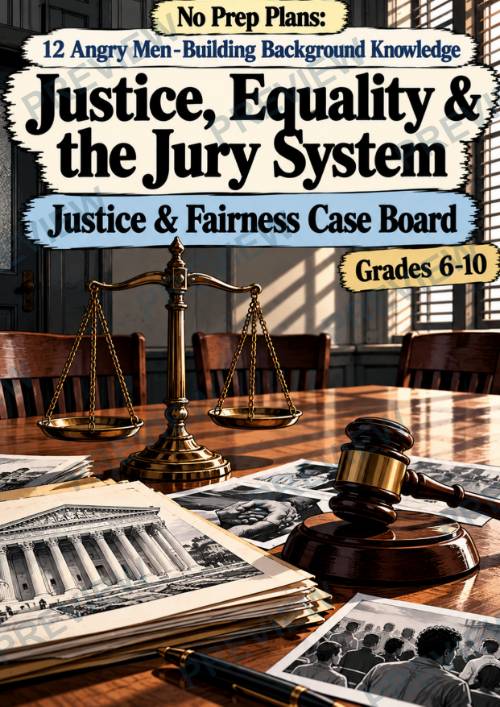
12 Angry Men Building Background Knowledge | Justice, Equality & the Jury System
12 Angry Men Building Background Knowledge | Justice, Equality & the Jury System
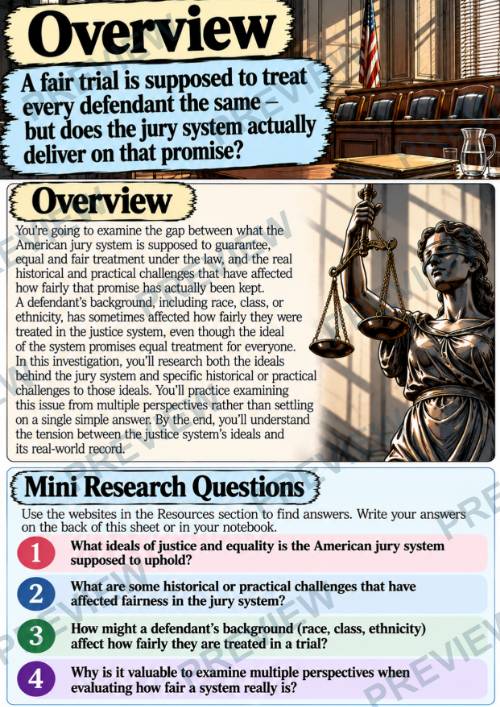
Help students explore the relationship between justice, equality, and the American jury system before reading or studying Twelve Angry Men. This no-prep background knowledge lesson asks students to examine the gap between what the jury system is designed to guarantee—equal and fair treatment under the law—and the historical and practical challenges that can affect whether that ideal is achieved. 09-Justice-Equality-Jury-System
Students investigate the ideals of equal justice, analyze challenges to fairness, consider how different people may view the same issue, and use evidence to examine multiple perspectives. They then apply their research by creating a collaborative Justice & Fairness Case Board.
What’s Included
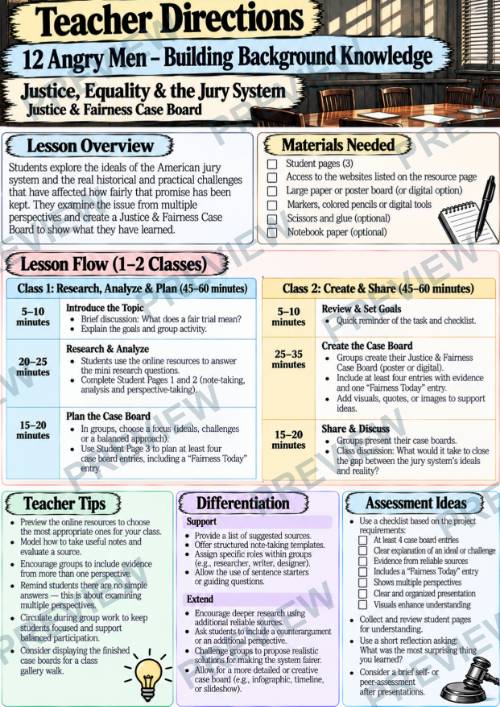
- Teacher Directions
- Overview & mini research questions
- Justice & Fairness Case Board group activity
- 3 research, analysis & planning student pages
- Ideal vs. reality analysis
- Fairness scenarios & perspective analysis
- Evidence evaluation activities
- Fairness Today real-world connection
- Twelve Angry Men connection
- Color & black-and-white student pages
Students Will
- Examine the ideals of justice and equality
- Compare the jury system’s ideals with real-world challenges
- Analyze situations involving fairness and unequal treatment
- Distinguish between simple and more complicated questions of fairness
- Examine an issue from multiple perspectives
- Use evidence to support conclusions
- Consider evidence that could challenge their own thinking
- Connect historical and practical issues to modern conversations about fairness
- Create a Justice & Fairness Case Board
Why Teachers Love This Resource
This lesson moves students beyond simply defining justice, equality, and fairness. Students are asked to investigate the tension between ideal and reality, consider competing perspectives, and support their thinking with evidence. These skills provide meaningful background for understanding the different experiences, assumptions, and perspectives jurors bring into the jury room in Twelve Angry Men.
Perfect for: Pre-reading, ELA, literature studies, civics, social studies, justice & fairness units, argumentation, or interdisciplinary instruction.
Grades 6–10 | 1–2 class periods
This independently created educational resource supports the study of Twelve Angry Men by Reginald Rose. It is not affiliated with or endorsed by the author, publishers, or related rights holders. The play is not included or reproduced.
·
This resource is also part of a bundle with 9 other resources
Questions
No questions yet.
Ask a question
Your question goes to No Prep Plans. Answers show on this page, without your name or email.
Sent. The answer will show on this page.
Reviews
No reviews yet. Buyers can review a resource from their order page.
More from No Prep Plans
Campus Happiness Index
 No Prep Plans
$3.00
Book Labels
No Prep PlansFree
Big Band & Jazz Musicians Poster Set (1930s–1950s)
No Prep Plans$3.50
FREE Geography Learning Stations Signs & Choice Cards--Reusable
No Prep PlansFree
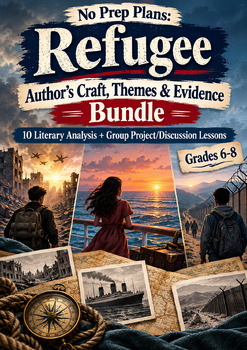
Refugee: Author's Craft, Themes & Evidence Bundle 10 Literary Analysis Lessons
No Prep Plans$29.25
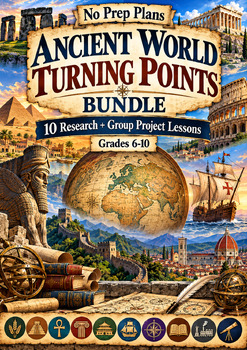
Ancient World Turning Points Bundle | 10 Research + Group Project Lessons | 6-10
No Prep Plans$29.25
Request a quote or purchase order
For schools and districts. Your request goes to No Prep Plans, who will reply to your email with a quote or invoice.
Sent. The seller will reply to your email.
Report this listing
What your notice must include
The address of the listing on Classroom Clearinghouse (for example, the /p/ link).
https://classroomclearinghouse.com/p/prjk96ctga
Your name, mailing address, phone number, and email.
How to report
Your name, company, mailing address, phone number, and email.
The address of each listing or store you are reporting.
https://classroomclearinghouse.com/p/prjk96ctga
Copyright owners can also use the DMCA notice page.
Thanks. The report is in the review queue.