
Preview: 3 of 14 pages. Scroll sideways to see more.
$3.50
In your cart. View cart
No account needed. You get a download link.
| Grade | 6th Grade to 8th Grade |
|---|---|
| Resource type | Lesson Plans |
| Subject | Science |
| Format | PDF, 14 pages |
| How was this made? | Created by hand, with images from generation tools |
| Updated | 2026-10-26 |
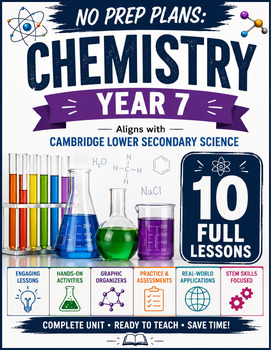
No Prep Plans: Gas Tests Year 7/Grade 6 Chemistry (Cambridge Lower Sec. Aligned)
No Prep Plans: Gas Tests
Aligned to Cambridge Lower Secondary Science
Year 7 Chemistry Investigation
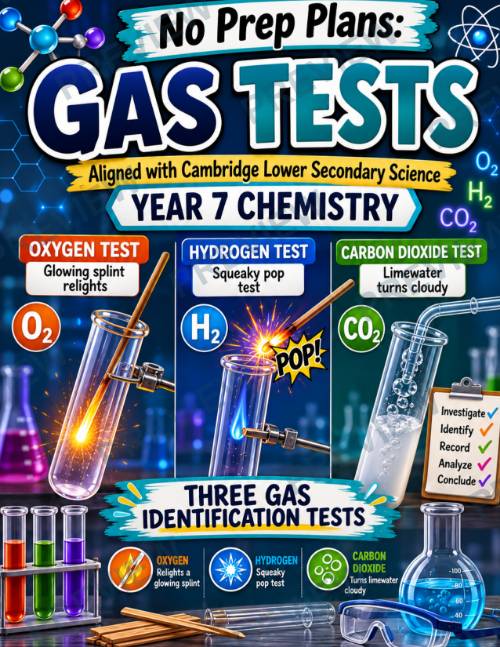
Help students become young forensic chemists as they learn how scientists identify invisible gases using three classic laboratory tests. In this engaging investigation, students explore the tests for oxygen, hydrogen, and carbon dioxide while developing research, observation, and scientific reasoning skills.
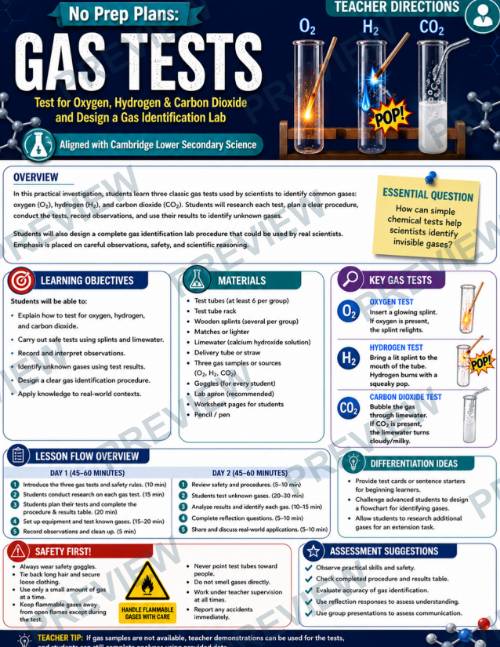
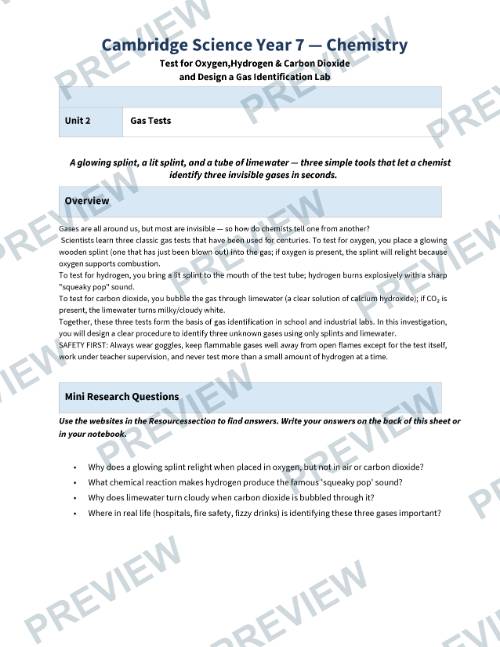
Students investigate how a glowing splint can identify oxygen, how hydrogen produces a distinctive "squeaky pop," and how carbon dioxide turns limewater cloudy. They then apply their learning by designing their own gas identification lab, recording observations, analyzing results, and connecting gas testing to real-world applications.
Designed to support Cambridge Lower Secondary Science learning objectives, this ready-to-use resource combines scientific inquiry, laboratory planning, data analysis, and real-world problem solving in an engaging and accessible format.
Students Will:
- Learn how scientists identify oxygen, hydrogen, and carbon dioxide
- Understand why different gases require different tests
- Investigate the glowing splint, squeaky pop, and limewater tests
- Design a gas identification laboratory procedure
- Record observations and interpret scientific evidence
- Develop laboratory safety awareness
- Apply chemistry concepts to real-world situations
- Communicate findings using scientific vocabulary
What's Included:
✔ Teacher Directions
✔ Student Research & Planning Activities
✔ Gas Identification Lab Design Activities
✔ Diagram, Reflection, and Real-World Connection Activities
✔ Full-Color Student Pages
✔ Black & White Student Pages
Topics Covered:
- Oxygen (O₂)
- Hydrogen (H₂)
- Carbon Dioxide (CO₂)
- Gas identification tests
- Scientific observation
- Laboratory safety
- Experimental design
- Data collection and analysis
- Real-world applications of chemistry
Perfect For:
- Cambridge Lower Secondary Science
- Year 7/US Grade 6 Chemistry
- Inquiry-Based Learning
- Science Investigations
- Laboratory Preparation Activities
- STEM Lessons
- Emergency Sub Plans
- Independent Learning
- Small Group Collaboration
Teacher Preparation:
Simply print and teach. Teachers may choose to demonstrate the gas tests, provide laboratory equipment, or use teacher-approved resources to support student research and investigation. Activities can be adapted to suit available materials and classroom safety requirements.
Important Note:
This resource is an independent educational product created to support classroom instruction. It is not affiliated with, endorsed by, or officially connected to Cambridge International Education or the Cambridge Lower Secondary programme. References to Cambridge Lower Secondary Science are provided solely to indicate curriculum alignment and topic relevance.
Teachers should use their own curriculum resources, laboratory materials, safety procedures, and professional judgment when conducting practical investigations. Activities may be adapted to suit available equipment, student needs, local safety requirements, and school laboratory policies.
·
This resource is also part of 2 bundles
Questions
No questions yet.
Ask a question
Your question goes to No Prep Plans. Answers show on this page, without your name or email.
Sent. The answer will show on this page.
Reviews
No reviews yet. Buyers can review a resource from their order page.
More from No Prep Plans
Campus Happiness Index
 No Prep Plans
$3.00
Book Labels
No Prep PlansFree

Big Band & Jazz Musicians Poster Set (1930s–1950s)
No Prep Plans$3.50
FREE Geography Learning Stations Signs & Choice Cards--Reusable
No Prep PlansFree
Refugee: Author's Craft, Themes & Evidence Bundle 10 Literary Analysis Lessons
No Prep Plans$29.25
Ancient World Turning Points Bundle | 10 Research + Group Project Lessons | 6-10
No Prep Plans$29.25
Request a quote or purchase order
For schools and districts. Your request goes to No Prep Plans, who will reply to your email with a quote or invoice.
Sent. The seller will reply to your email.
Report this listing
What your notice must include
The address of the listing on Classroom Clearinghouse (for example, the /p/ link).
https://classroomclearinghouse.com/p/p9c2ew6wj5
Your name, mailing address, phone number, and email.
How to report
Your name, company, mailing address, phone number, and email.
The address of each listing or store you are reporting.
https://classroomclearinghouse.com/p/p9c2ew6wj5
Copyright owners can also use the DMCA notice page.
Thanks. The report is in the review queue.