
Preview: 3 of 16 pages. Scroll sideways to see more.
$3.50
In your cart. View cart
No account needed. You get a download link.
| Grade | 6th Grade to 8th Grade |
|---|---|
| Resource type | Lesson Plans |
| Subject | Science |
| Format | PDF, 16 pages |
| How was this made? | Created by hand, with images from generation tools |
| Updated | 2026-10-26 |
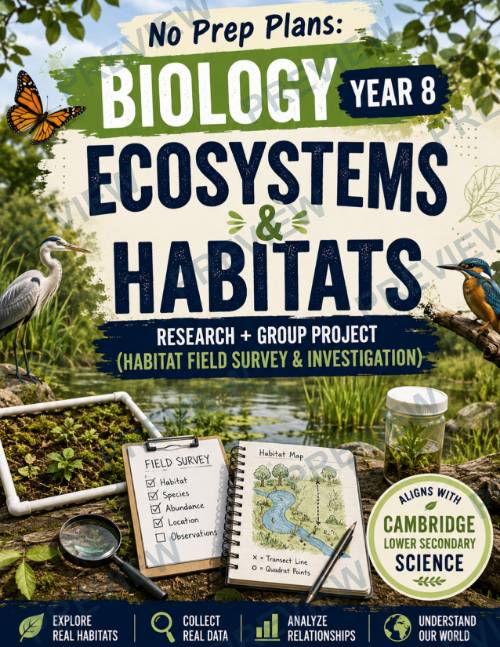
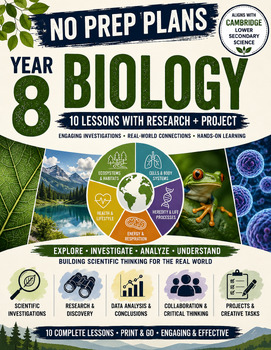
No Prep Plans: Biology Year 8 – Ecosystems & Habitats (Habitat Field Survey)
No Prep Plans: Biology Year 8 – Ecosystems & Habitats
Research + Group Project: Habitat Field Survey & Ecosystem Investigation
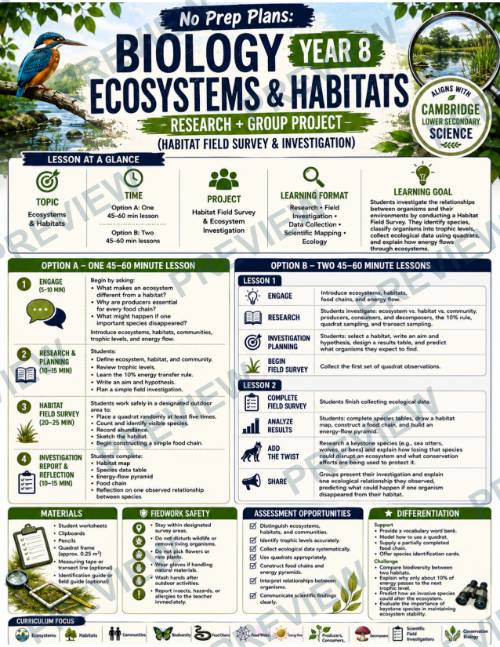
Take biology beyond the classroom with this engaging fieldwork investigation that allows students to explore real ecosystems while developing practical scientific skills. Students investigate habitats, collect ecological data using quadrats, classify organisms into trophic levels, analyze energy flow, and create a scientific investigation report based on their own observations.
Designed to align with Cambridge Lower Secondary Science, this lesson combines ecological concepts with authentic fieldwork, encouraging students to think and work like real field biologists.
What's Included
- ✅ Complete Teacher Direction Page (options for one or two 45–60 minute lessons)
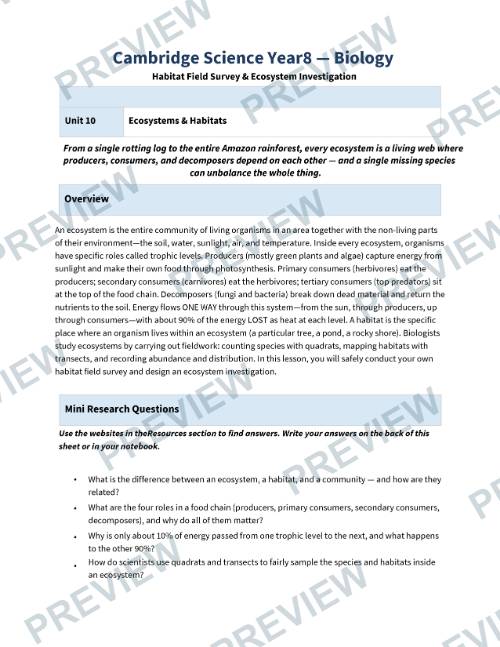
- ✅ Student Research & Investigation Planning Worksheet
- ✅ Student Habitat Field Survey Data Collection Worksheet
- ✅ Student Analysis & Explanation Worksheet
- ✅ Early Finisher Choice Board
- ✅ Full-color version
- ✅ Black-and-white printer-friendly version
Students Will:
- Differentiate between ecosystems, habitats, communities, and populations.
- Explain the roles of producers, consumers, and decomposers.
- Investigate energy transfer through trophic levels.
- Plan and conduct a habitat field survey.
- Use quadrats to collect ecological data.
- Record species abundance and habitat conditions.
- Construct food chains and energy pyramids.
- Investigate the importance of keystone species.
- Analyze ecological relationships using real field data.
- Communicate scientific findings using diagrams, tables, and written conclusions.
Perfect For
- ✅ Year 8 Biology
- ✅ US Grade 7 Life Science
- ✅ Cambridge Lower Secondary Science
- ✅ Ecology & Ecosystems Units
- ✅ Habitats & Biodiversity
- ✅ Food Chains & Food Webs
- ✅ Outdoor Learning
- ✅ STEM Activities
- ✅ Project-Based Learning (PBL)
- ✅ Homeschool Science
Why Teachers Love This Resource
Students love getting outdoors and collecting authentic scientific data. This investigation transforms abstract ecology concepts into meaningful, hands-on learning by allowing students to observe real habitats, identify organisms, and analyze ecological relationships firsthand. The structured worksheets guide learners through every stage of the investigation while encouraging scientific thinking, observation, and evidence-based conclusions.
Skills Developed
- Scientific inquiry
- Field investigation techniques
- Observation skills
- Data collection and analysis
- Ecological reasoning
- Scientific drawing and mapping
- Critical thinking
- Collaboration
- Scientific communication
- Problem solving
Part of the No Prep Plans: Biology Year 8 series
This resource is part of the No Prep Plans: Biology Year 8 series, designed to help students explore key biology concepts through research, investigations, collaboration, and project-based learning. Each lesson includes teacher guidance, structured student worksheets, engaging group activities, and extension tasks that require minimal teacher preparation while maximizing student engagement.
Cambridge Lower Secondary Science Disclaimer
This resource is an independent educational product created to support classroom instruction and is not affiliated with, endorsed by, sponsored by, or approved by Cambridge University Press & Assessment or Cambridge International Education. References to Cambridge Lower Secondary Science are provided solely to indicate curriculum alignment and compatibility.
·
This resource is also part of 2 bundles
Questions
No questions yet.
Ask a question
Your question goes to No Prep Plans. Answers show on this page, without your name or email.
Sent. The answer will show on this page.
Reviews
No reviews yet. Buyers can review a resource from their order page.
More from No Prep Plans
Campus Happiness Index
 No Prep Plans
$3.00
Book Labels
No Prep PlansFree

Big Band & Jazz Musicians Poster Set (1930s–1950s)
No Prep Plans$3.50
FREE Geography Learning Stations Signs & Choice Cards--Reusable
No Prep PlansFree
Refugee: Author's Craft, Themes & Evidence Bundle 10 Literary Analysis Lessons
No Prep Plans$29.25
Ancient World Turning Points Bundle | 10 Research + Group Project Lessons | 6-10
No Prep Plans$29.25
Request a quote or purchase order
For schools and districts. Your request goes to No Prep Plans, who will reply to your email with a quote or invoice.
Sent. The seller will reply to your email.
Report this listing
What your notice must include
The address of the listing on Classroom Clearinghouse (for example, the /p/ link).
https://classroomclearinghouse.com/p/km9pk8wuzk
Your name, mailing address, phone number, and email.
How to report
Your name, company, mailing address, phone number, and email.
The address of each listing or store you are reporting.
https://classroomclearinghouse.com/p/km9pk8wuzk
Copyright owners can also use the DMCA notice page.
Thanks. The report is in the review queue.