
Preview: 3 of 14 pages. Scroll sideways to see more.
$3.25
In your cart. View cart
No account needed. You get a download link.
| Grade | 6th Grade to 8th Grade |
|---|---|
| Resource type | Projects |
| Subject | History |
| Format | PDF, 14 pages |
| How was this made? | Created by hand, with images from generation tools |
| Updated | 2026-10-26 |
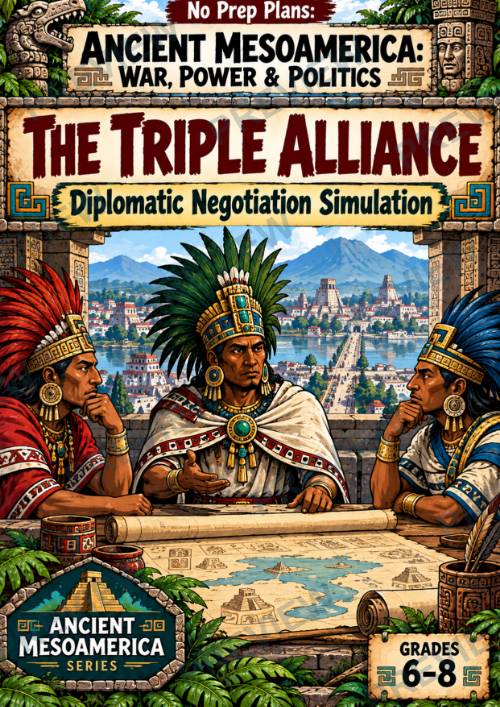
Ancient Mesoamerica: War, Power & Politics — The Triple Alliance
Ancient Mesoamerica: War, Power & Politics — The Triple Alliance Diplomatic Negotiation Simulation | Grades 6–8
Bring the politics of the Aztec Empire to life with this no-prep research and diplomatic negotiation simulation from the Ancient Mesoamerica: War, Power & Politics series!
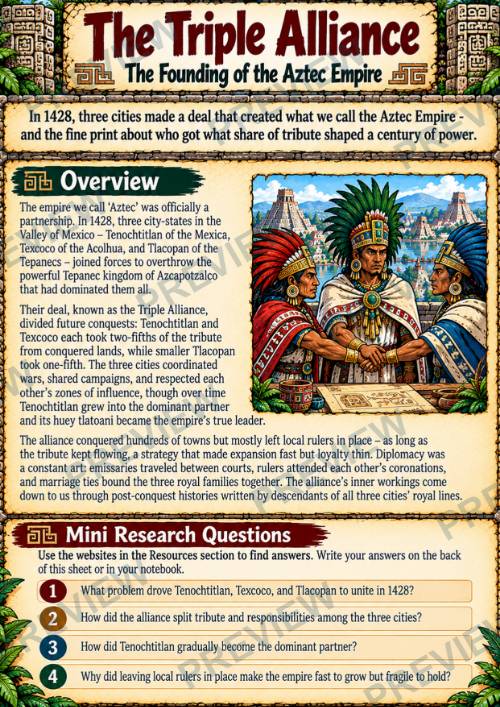
In 1428, Tenochtitlan, Texcoco, and Tlacopan joined forces to overthrow Azcapotzalco and formed the partnership known as the Triple Alliance. Their agreement divided tribute, coordinated warfare, and established zones of influence—but the three partners did not share power equally forever. Over time, Tenochtitlan emerged as the dominant member of the alliance.
In this interactive lesson, students investigate the interests and political leverage of the three city-states before stepping into the role of negotiators. They decide what their city wants, what it can offer, where it can compromise, and what terms will create a workable alliance. After negotiating their own treaty, students compare their decisions with the real 1428 agreement.
What’s Included
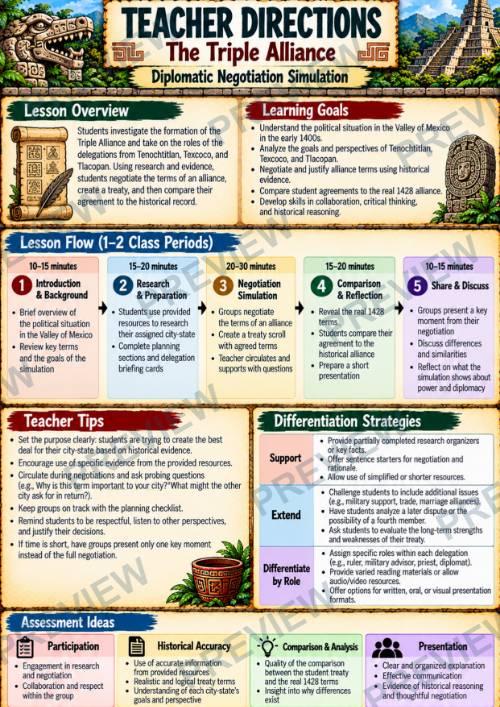
- Teacher directions and lesson flow
- Background overview + mini research questions
- 5-step Diplomatic Negotiation Simulation
- Curated research resources
- City-state political profiles
- Goals, leverage, and compromise planner
- Color + black-and-white student pages
Students Will
Students investigate the circumstances that brought the three city-states together and analyze the goals, strengths, needs, and bargaining power of each partner. They then use their research to develop and defend a negotiating position.
During the simulation, students negotiate tribute shares, war duties, political authority, and zones of influence while balancing their city's interests against the need to reach an agreement. They ultimately create their own treaty and compare their decisions with the historical Triple Alliance.
Why Teachers Love It
Instead of simply reading about the Triple Alliance, students explore the political decision-making behind the alliance. The lesson combines historical research with perspective-taking, argumentation, negotiation, collaboration, and evidence-based reasoning.
Structured student pages provide support throughout the process while still requiring students to make meaningful decisions, negotiate compromises, and defend their choices with evidence.
Designed for approximately 1–2 45–60 minute class periods, this lesson works well with units on Ancient Mesoamerica, the Aztec Empire, Ancient Civilizations, World History, diplomacy, warfare, government, and political power.
·
This resource is also part of a bundle with 9 other resources
Questions
No questions yet.
Ask a question
Your question goes to No Prep Plans. Answers show on this page, without your name or email.
Sent. The answer will show on this page.
Reviews
No reviews yet. Buyers can review a resource from their order page.
More from No Prep Plans
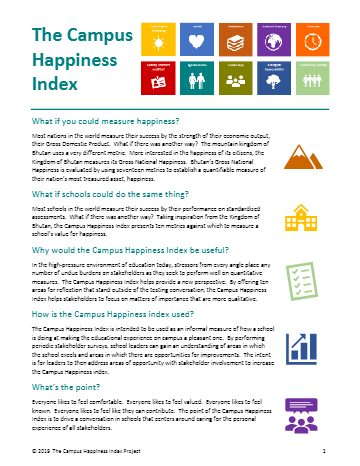
Campus Happiness Index
 No Prep Plans
$3.00
Book Labels
No Prep PlansFree
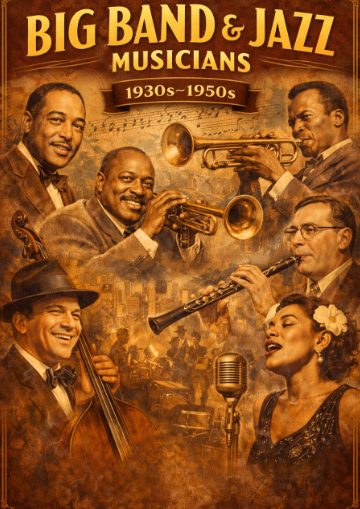
Big Band & Jazz Musicians Poster Set (1930s–1950s)
No Prep Plans$3.50
FREE Geography Learning Stations Signs & Choice Cards--Reusable
No Prep PlansFree
Refugee: Author's Craft, Themes & Evidence Bundle 10 Literary Analysis Lessons
No Prep Plans$29.25
Ancient World Turning Points Bundle | 10 Research + Group Project Lessons | 6-10
No Prep Plans$29.25
Request a quote or purchase order
For schools and districts. Your request goes to No Prep Plans, who will reply to your email with a quote or invoice.
Sent. The seller will reply to your email.
Report this listing
What your notice must include
The address of the listing on Classroom Clearinghouse (for example, the /p/ link).
https://classroomclearinghouse.com/p/hh3gc5artv
Your name, mailing address, phone number, and email.
How to report
Your name, company, mailing address, phone number, and email.
The address of each listing or store you are reporting.
https://classroomclearinghouse.com/p/hh3gc5artv
Copyright owners can also use the DMCA notice page.
Thanks. The report is in the review queue.