
Preview: 3 of 14 pages. Scroll sideways to see more.
$3.00
In your cart. View cart
No account needed. You get a download link.
| Grade | 9th Grade to 12th Grade |
|---|---|
| Resource type | Lesson Plans |
| Subject | Science |
| Format | PDF, 14 pages |
| How was this made? | Created by hand, with images from generation tools |
| Updated | 2026-10-26 |
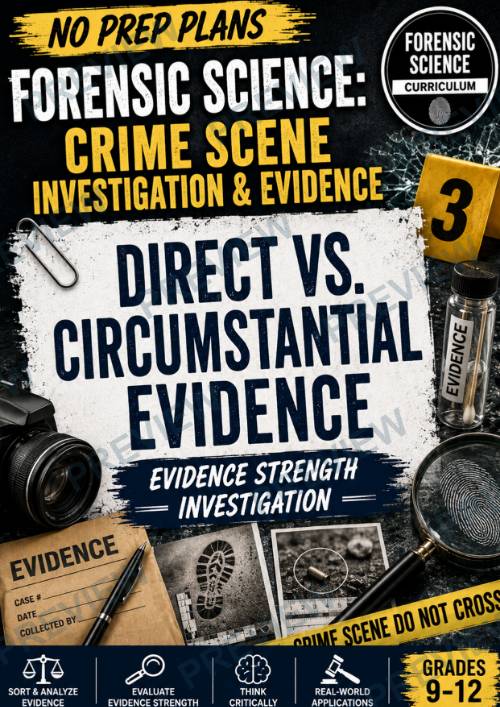
No Prep Plans Forensic Science: Direct vs. Circumstantial Evidence
No Prep Plans Forensic Science: Direct vs. Circumstantial Evidence
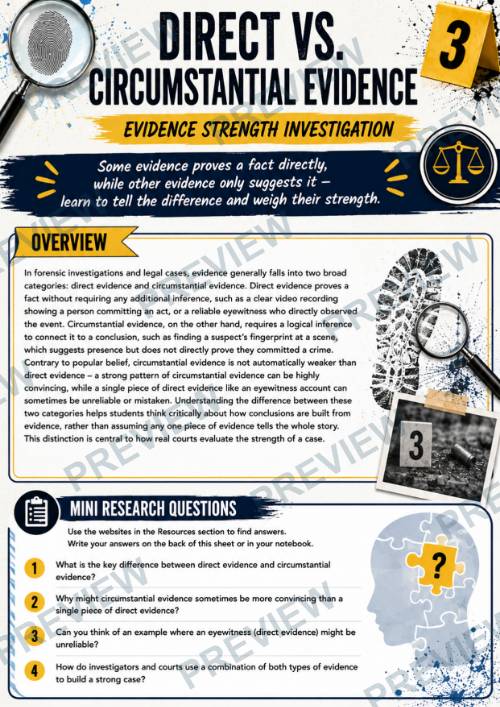
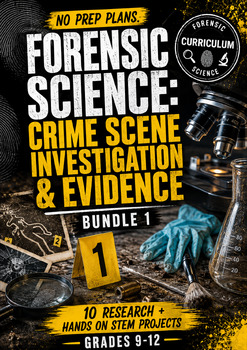
Help students move beyond simply identifying evidence and start thinking like evidence analysts with this engaging No Prep Forensic Science lesson for Grades 9–12. Students explore the difference between direct and circumstantial evidence, investigate how reliability and context affect evidence strength, and discover why circumstantial evidence is not automatically weaker than direct evidence.
Students classify realistic evidence, examine the inferences investigators make, evaluate the strength and reliability of individual clues, and ultimately determine how convincing an overall case is based on the combination of evidence available.
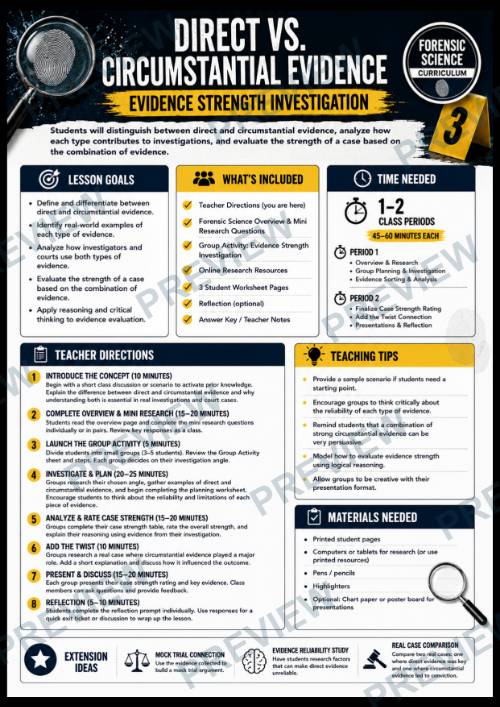
What's Included
- Teacher Directions
- Forensic Science Overview + Mini Research
- Evidence Strength Investigation Group Activity
- 3 Student Activity Pages
- Online Research Resources
- Color + Black-and-White Student Pages
Students Will Explore
- Direct vs. circumstantial evidence
- How investigators distinguish between facts and inferences
- Examples of both evidence types
- Reliability and limitations of evidence
- Factors that strengthen or weaken a piece of evidence
- Why direct evidence is not automatically strong
- Why circumstantial evidence is not automatically weak
- How multiple clues can work together to support a conclusion
- How investigators evaluate the strength of an overall case
- The role of circumstantial evidence in real-world cases
Why Teachers Love This Lesson
- No prep and ready to use
- Designed for 1–2 class periods
- Goes beyond basic evidence vocabulary and classification
- Emphasizes critical thinking, inference, and evidence evaluation
- Uses realistic scenarios students can analyze and debate
- Challenges the misconception that direct evidence is always stronger
- Encourages students to justify conclusions with evidence
- Includes individual research, analysis, and collaborative learning
- Works as a stand-alone lesson or as part of a larger Crime Scene Investigation & Evidence unit
- Includes full-color and printer-friendly black-and-white student pages
Great For
- Forensic Science & CSI
- Direct vs. Circumstantial Evidence
- Evidence Analysis & Evaluation
- Criminal Justice
- High School Science
- Grades 9–12
Time: 1–2 class periods, approximately 45–60 minutes each
·
This resource is also part of 2 bundles
Questions
No questions yet.
Ask a question
Your question goes to No Prep Plans. Answers show on this page, without your name or email.
Sent. The answer will show on this page.
Reviews
No reviews yet. Buyers can review a resource from their order page.
More from No Prep Plans
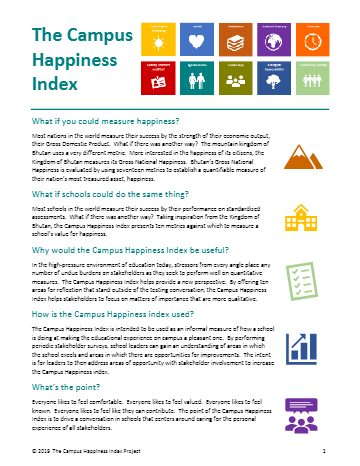
Campus Happiness Index
 No Prep Plans
$3.00
Book Labels
No Prep PlansFree

Big Band & Jazz Musicians Poster Set (1930s–1950s)
No Prep Plans$3.50
FREE Geography Learning Stations Signs & Choice Cards--Reusable
No Prep PlansFree
Refugee: Author's Craft, Themes & Evidence Bundle 10 Literary Analysis Lessons
No Prep Plans$29.25

Ancient World Turning Points Bundle | 10 Research + Group Project Lessons | 6-10
No Prep Plans$29.25
Request a quote or purchase order
For schools and districts. Your request goes to No Prep Plans, who will reply to your email with a quote or invoice.
Sent. The seller will reply to your email.
Report this listing
What your notice must include
The address of the listing on Classroom Clearinghouse (for example, the /p/ link).
https://classroomclearinghouse.com/p/h4yta36gka
Your name, mailing address, phone number, and email.
How to report
Your name, company, mailing address, phone number, and email.
The address of each listing or store you are reporting.
https://classroomclearinghouse.com/p/h4yta36gka
Copyright owners can also use the DMCA notice page.
Thanks. The report is in the review queue.