
Preview: 3 of 14 pages. Scroll sideways to see more.
$3.50
In your cart. View cart
No account needed. You get a download link.
| Grade | 6th Grade to 8th Grade |
|---|---|
| Resource type | Projects |
| Subject | History |
| Format | PDF, 14 pages |
| How was this made? | Created by hand, with images from generation tools |
| Updated | 2026-10-26 |
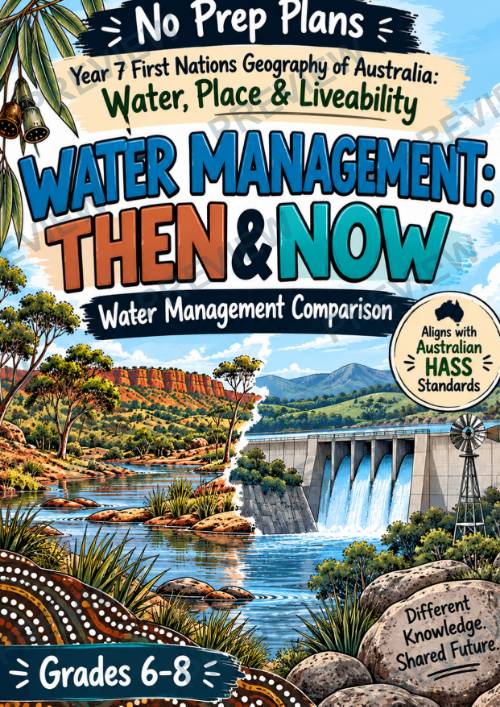
Year 7 First Nations Geography: Water Management Then & Now | HASS Aligned
No Prep Plans | Year 7 First Nations Geography: Water Management Then & Now | HASS Aligned
Explore First Nations Geography of Australia through a balanced investigation of traditional Aboriginal water management approaches and modern Australian water management systems.
Students research how different approaches use knowledge, observation, technology, infrastructure, regulation, and environmental understanding to manage water. Rather than deciding which approach is simply “better,” students examine their different contexts, strengths, scales, and purposes before investigating how contemporary Australian water management is increasingly incorporating traditional ecological knowledge alongside modern approaches.
WHAT’S INCLUDED
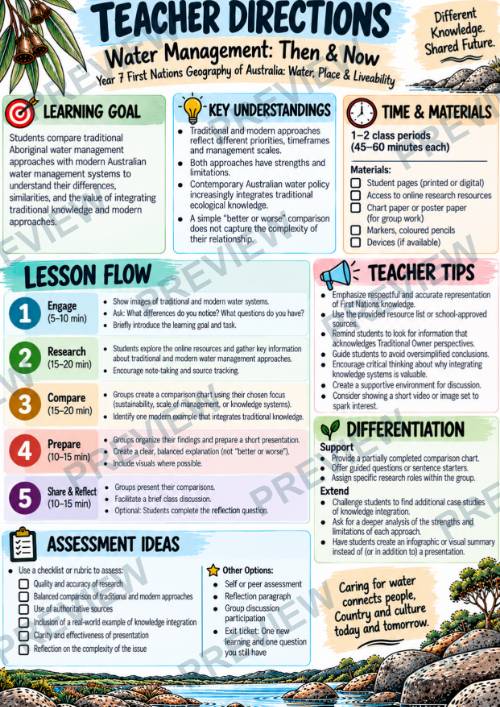
- Teacher Directions
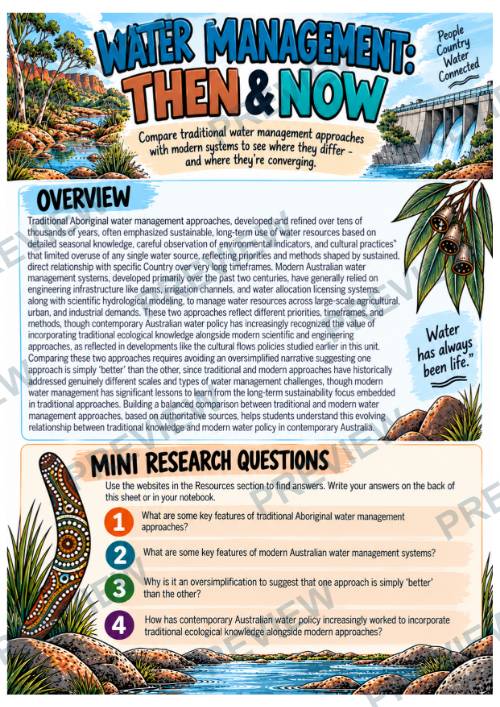
- Overview + Mini Research Questions
- Water Management Comparison Group Activity
- 3 Research, Analysis & Planning Pages
- Colour + Black-and-White Student Versions
- Online Research Resources
STUDENTS WILL
- Investigate traditional Aboriginal water management approaches
- Examine modern Australian water management systems
- Compare sustainability, scale, decision-making, technology, and water use
- Analyse similarities and meaningful differences
- Consider the different challenges each approach has historically addressed
- Evaluate evidence from authoritative sources
- Explain why a simple “better or worse” comparison is inadequate
- Research a contemporary example of traditional ecological knowledge being incorporated into modern water management
- Develop evidence-based conclusions
- Create a Water Management Comparison
WHY TEACHERS LOVE THIS
- No prep and ready to use
- Designed for 1–2 class periods of approximately 45–60 minutes
- Moves beyond surface-level compare-and-contrast
- Builds research, source evaluation, and critical-thinking skills
- Encourages balanced, evidence-based analysis
- Connects traditional knowledge with contemporary Australian water management
- Colour and printer-friendly versions included
PERFECT FOR
- Year 7 HASS Geography
- First Nations Geography of Australia
- Water in the World
- Place & Liveability
- Aboriginal and Torres Strait Islander Histories and Cultures
- Traditional ecological knowledge
- Water management and sustainability
- Human-environment relationships
- Geography inquiry and research
- Grades 6–8
AUSTRALIAN CURRICULUM / HASS ALIGNMENT DISCLAIMER
This independently created resource is designed to align with and support learning within the Australian Curriculum: Humanities and Social Sciences (HASS), including Geography. References to the Australian Curriculum, HASS, curriculum content, or related terminology are provided for alignment and descriptive purposes only. This resource is not produced, endorsed, approved, sponsored, or affiliated with the Australian Curriculum, Assessment and Reporting Authority (ACARA). The Australian Curriculum and associated curriculum materials remain the intellectual property of their respective rights holders. Teachers should consult the current official Australian Curriculum when determining curriculum requirements for their school, state, territory, or context.
FOLLOW & SAVE 10%
·
This resource is also part of a bundle with 9 other resources
Questions
No questions yet.
Ask a question
Your question goes to No Prep Plans. Answers show on this page, without your name or email.
Sent. The answer will show on this page.
Reviews
No reviews yet. Buyers can review a resource from their order page.
More from No Prep Plans
Campus Happiness Index
 No Prep Plans
$3.00
Book Labels
No Prep PlansFree

Big Band & Jazz Musicians Poster Set (1930s–1950s)
No Prep Plans$3.50
FREE Geography Learning Stations Signs & Choice Cards--Reusable
No Prep PlansFree
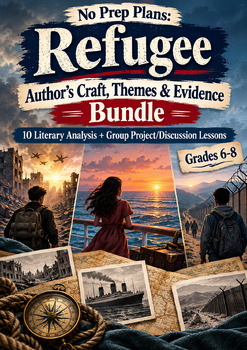
Refugee: Author's Craft, Themes & Evidence Bundle 10 Literary Analysis Lessons
No Prep Plans$29.25
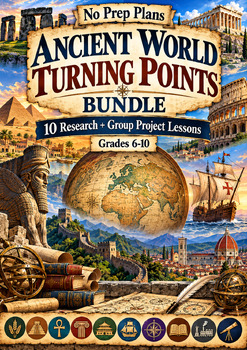
Ancient World Turning Points Bundle | 10 Research + Group Project Lessons | 6-10
No Prep Plans$29.25
Request a quote or purchase order
For schools and districts. Your request goes to No Prep Plans, who will reply to your email with a quote or invoice.
Sent. The seller will reply to your email.
Report this listing
What your notice must include
The address of the listing on Classroom Clearinghouse (for example, the /p/ link).
https://classroomclearinghouse.com/p/gkqcf963d6
Your name, mailing address, phone number, and email.
How to report
Your name, company, mailing address, phone number, and email.
The address of each listing or store you are reporting.
https://classroomclearinghouse.com/p/gkqcf963d6
Copyright owners can also use the DMCA notice page.
Thanks. The report is in the review queue.