
Preview: 3 of 14 pages. Scroll sideways to see more.
$3.50
In your cart. View cart
No account needed. You get a download link.
| Grade | 6th Grade to 8th Grade |
|---|---|
| Resource type | Lesson Plans |
| Subject | Science |
| Format | PDF, 14 pages |
| How was this made? | Created by hand, with images from generation tools |
| Updated | 2026-10-26 |
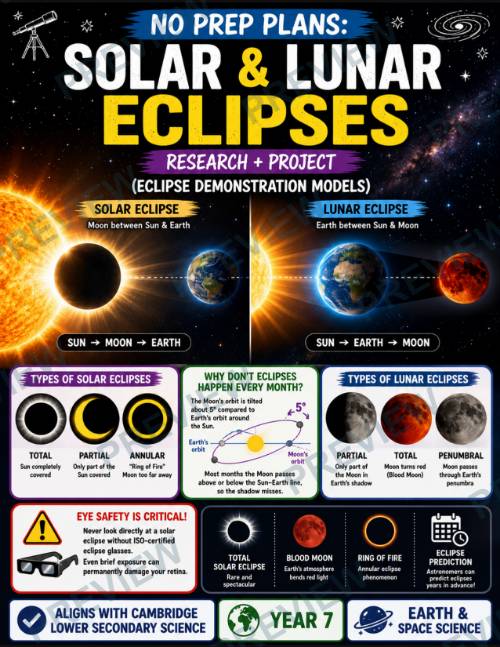
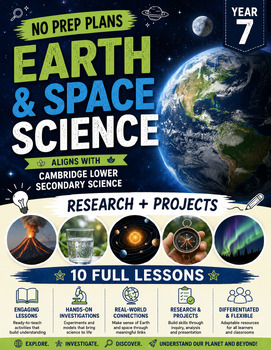
No Prep Plans: Solar & Lunar Eclipses Year 7 Earth & Space Science
No Prep Plans: Solar & Lunar Eclipses
Research + Project (Eclipse Demonstration Models)
Aligns with Cambridge Lower Secondary Science
Year 7 Earth & Space Science
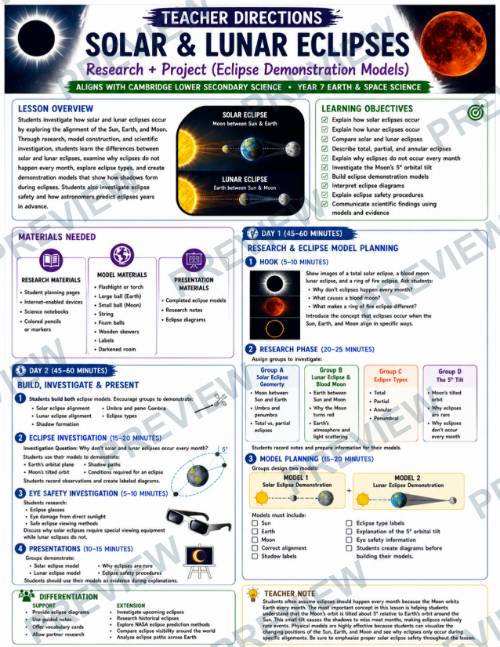
Bring one of astronomy's most spectacular phenomena into your classroom with this engaging research, modeling, and investigation project. Students explore how solar and lunar eclipses occur, investigate why eclipses do not happen every month, and build demonstration models that show the alignment of the Sun, Earth, and Moon during eclipse events.
Through research, scientific modeling, eclipse investigations, and evidence-based explanations, students develop a deeper understanding of shadows, orbital motion, eclipse geometry, and the role of the Moon's tilted orbit in creating these rare celestial events.
What's Included
✅ Teacher Direction Page
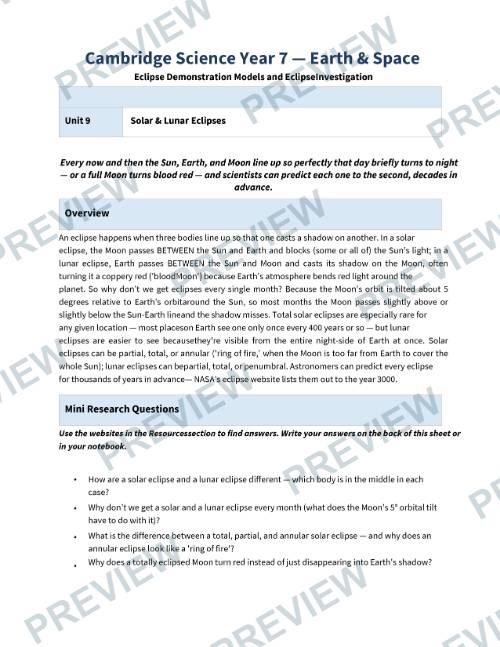
✅ Student Research & Planning Page
✅ Student Eclipse Demonstration Models Design & Construction Plan Page
✅ Student Eclipse Investigation Page
✅ Online Resources Page
✅ Color and Black & White Versions of All Student and Teacher Pages
Students Will
- Explain how solar eclipses occur
- Explain how lunar eclipses occur
- Compare solar and lunar eclipses
- Identify the positions of the Sun, Earth, and Moon during different eclipse events
- Define and apply key eclipse vocabulary
- Investigate total, partial, annular, and penumbral eclipses
- Explore why eclipses do not occur every month
- Examine the Moon's 5° orbital tilt
- Design and build solar and lunar eclipse demonstration models
- Investigate eclipse shadows, including the umbra and penumbra
- Explain safe solar eclipse viewing practices
- Communicate scientific understanding using Claim-Evidence-Reasoning (CER)
Skills Developed
- Scientific Research
- Scientific Inquiry
- Scientific Modeling
- STEM Design
- Observation Skills
- Critical Thinking
- Data Analysis
- Cause-and-Effect Reasoning
- Scientific Communication
- Visual Modeling
- Claim-Evidence-Reasoning (CER)
- Earth & Space Science Literacy
Perfect For
- Cambridge Lower Secondary Science
- Year 7 Earth & Space Science/US Grade 6
- Astronomy Units
- Sun-Earth-Moon System Lessons
- Eclipse Studies
- STEM Activities
- Inquiry-Based Learning
- Project-Based Learning
- Independent Research Projects
- Science Centers
- Sub Plans
Teacher Note
This resource is an independent educational product created to support classroom instruction and project-based learning. It is designed to align with topics commonly taught in Cambridge Lower Secondary Science Year 7; however, it is not an official Cambridge resource and is not affiliated with, endorsed by, approved by, or produced by Cambridge University Press & Assessment or Cambridge International Education.
The activities are intended to supplement teacher instruction and provide students with opportunities to investigate scientific concepts, build and analyze models, examine evidence, and communicate scientific understanding through research and inquiry. Teachers are encouraged to adapt materials, expectations, and resources to best meet the needs of their students and local curriculum requirements.
No Prep Plans resources are designed to provide meaningful, ready-to-use learning experiences that combine research, critical thinking, scientific inquiry, creativity, and communication skills while minimizing teacher preparation time.
·
This resource is also part of 2 bundles
Questions
No questions yet.
Ask a question
Your question goes to No Prep Plans. Answers show on this page, without your name or email.
Sent. The answer will show on this page.
Reviews
No reviews yet. Buyers can review a resource from their order page.
More from No Prep Plans
Campus Happiness Index
 No Prep Plans
$3.00
Book Labels
No Prep PlansFree

Big Band & Jazz Musicians Poster Set (1930s–1950s)
No Prep Plans$3.50
FREE Geography Learning Stations Signs & Choice Cards--Reusable
No Prep PlansFree
Refugee: Author's Craft, Themes & Evidence Bundle 10 Literary Analysis Lessons
No Prep Plans$29.25
Ancient World Turning Points Bundle | 10 Research + Group Project Lessons | 6-10
No Prep Plans$29.25
Request a quote or purchase order
For schools and districts. Your request goes to No Prep Plans, who will reply to your email with a quote or invoice.
Sent. The seller will reply to your email.
Report this listing
What your notice must include
The address of the listing on Classroom Clearinghouse (for example, the /p/ link).
https://classroomclearinghouse.com/p/avrv8zd3yh
Your name, mailing address, phone number, and email.
How to report
Your name, company, mailing address, phone number, and email.
The address of each listing or store you are reporting.
https://classroomclearinghouse.com/p/avrv8zd3yh
Copyright owners can also use the DMCA notice page.
Thanks. The report is in the review queue.