
Preview: 3 of 14 pages. Scroll sideways to see more.
$3.25
In your cart. View cart
No account needed. You get a download link.
| Grade | 6th Grade to 10th Grade |
|---|---|
| Resource type | Projects |
| Subject | History |
| Format | PDF, 14 pages |
| How was this made? | Created by hand, with images from generation tools |
| Updated | 2026-10-26 |
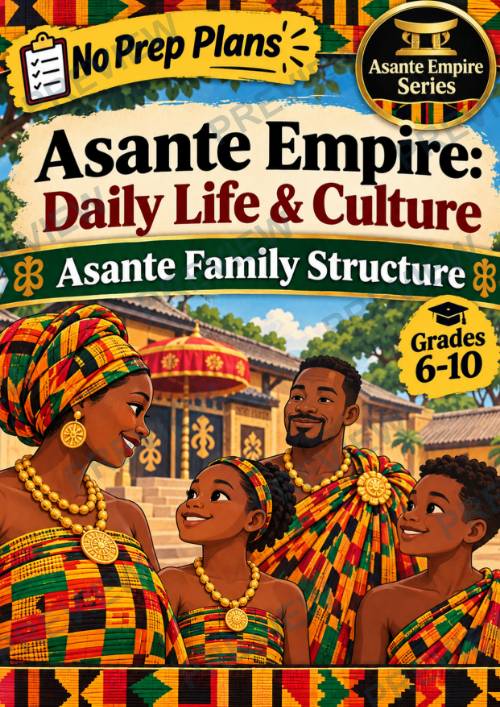
Asante Empire: Daily Life & Culture — Asante Family Structure
Asante Empire: Daily Life & Culture — Asante Family Structure
No Prep Plans | Grades 6–10
Help students explore family, identity, inheritance, and clan relationships in Asante society with this ready-to-use research and group project lesson.
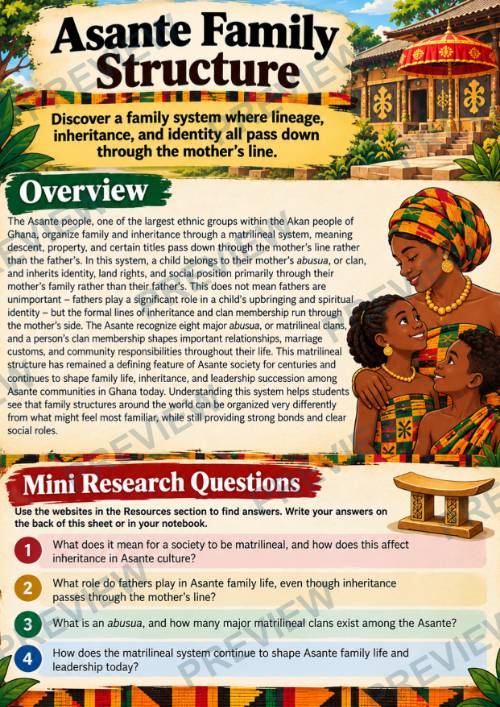
Students investigate the Asante matrilineal family system, discovering how lineage, inheritance, and clan identity pass through the mother’s line. They examine the abusua clan system, consider the important roles of both mothers and fathers, trace family relationships, and explore how matrilineal organization influences identity, responsibilities, and leadership.
Students then apply their research by creating an Asante Family Structure Illustrated Guide that visually explains how the system works. The group challenge asks students to create a sample family tree, demonstrate how clan membership and inheritance pass through the mother's line, and respectfully compare matrilineal and patrilineal family structures.
What's Included
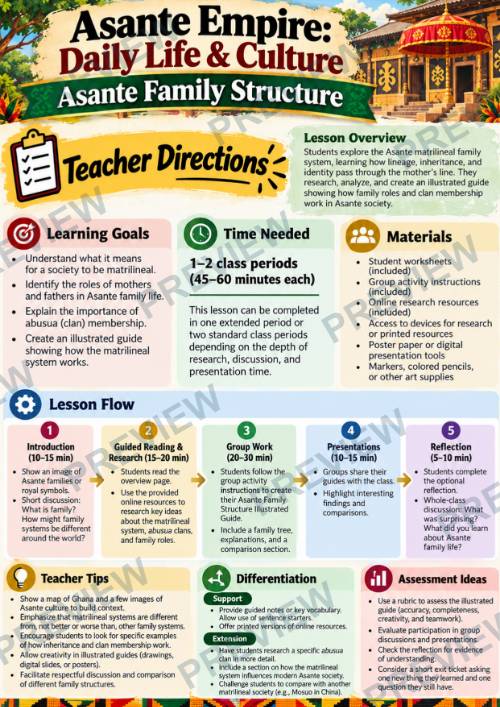
- Teacher Directions + lesson flow
- Overview + Mini Research Questions
- 5-Step Group Activity
- 3 student research, analysis, and planning pages
- Illustrated Guide + Evidence Planner
- Online research resources
- Color + black-and-white student pages
Why Teachers Love This
- No prep and ready to print
- Moves beyond basic fact-finding into analysis and application
- Builds research and critical-thinking skills
- Encourages collaboration and visual learning
- Explores family structures from a global perspective
- Culminates in a meaningful collaborative product
- Flexible for multiple Social Studies courses
Perfect For
- Grades 6–10
- World History
- African History
- World Cultures
- Research Projects
- Group Work
- Sub Plans
- Enrichment
Students don't just learn that Asante society was matrilineal—they investigate how that system shaped family relationships, inheritance, identity, and community life.
·
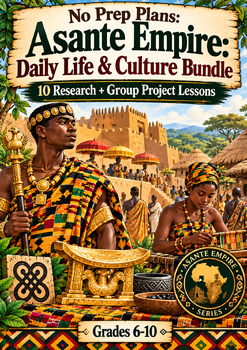
This resource is also part of a bundle with 9 other resources
Questions
No questions yet.
Ask a question
Your question goes to No Prep Plans. Answers show on this page, without your name or email.
Sent. The answer will show on this page.
Reviews
No reviews yet. Buyers can review a resource from their order page.
More from No Prep Plans
Campus Happiness Index
 No Prep Plans
$3.00
Book Labels
No Prep PlansFree

Big Band & Jazz Musicians Poster Set (1930s–1950s)
No Prep Plans$3.50
FREE Geography Learning Stations Signs & Choice Cards--Reusable
No Prep PlansFree
Refugee: Author's Craft, Themes & Evidence Bundle 10 Literary Analysis Lessons
No Prep Plans$29.25
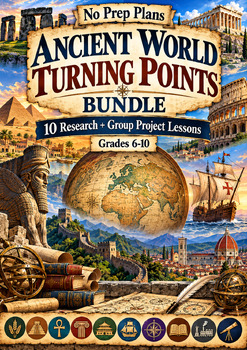
Ancient World Turning Points Bundle | 10 Research + Group Project Lessons | 6-10
No Prep Plans$29.25
Request a quote or purchase order
For schools and districts. Your request goes to No Prep Plans, who will reply to your email with a quote or invoice.
Sent. The seller will reply to your email.
Report this listing
What your notice must include
The address of the listing on Classroom Clearinghouse (for example, the /p/ link).
https://classroomclearinghouse.com/p/acxxjcgvsc
Your name, mailing address, phone number, and email.
How to report
Your name, company, mailing address, phone number, and email.
The address of each listing or store you are reporting.
https://classroomclearinghouse.com/p/acxxjcgvsc
Copyright owners can also use the DMCA notice page.
Thanks. The report is in the review queue.