
Preview: 3 of 14 pages. Scroll sideways to see more.
$3.00
In your cart. View cart
No account needed. You get a download link.
| Grade | 6th Grade to 8th Grade |
|---|---|
| Resource type | Lesson Plans |
| Subject | Geography |
| Format | PDF, 14 pages |
| How was this made? | Created by hand, with images from generation tools |
| Updated | 2026-10-26 |
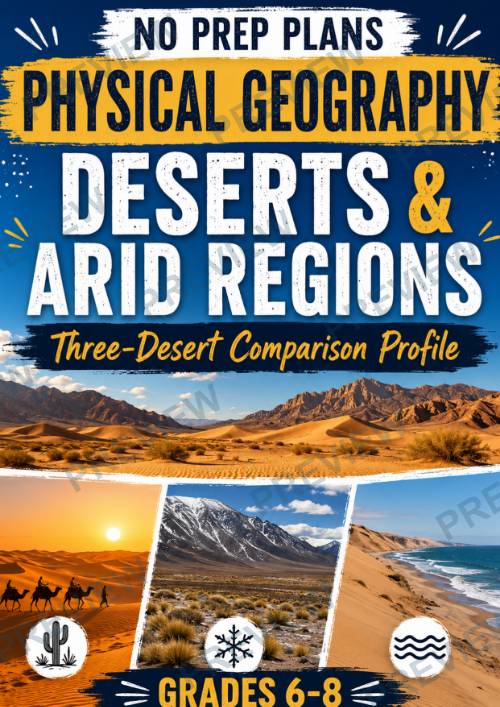
No Prep Plans: Physical Geography – Deserts & Arid Regions
No Prep Plans: Physical Geography – Deserts & Arid Regions-Three-Desert Comparison Profile | Grades 6–8
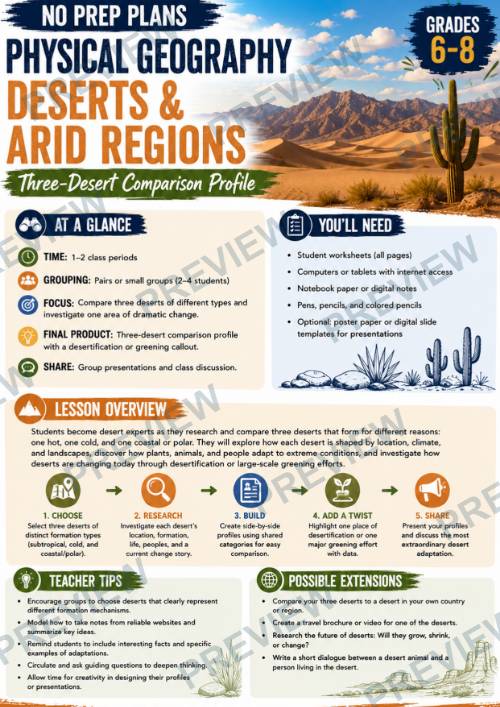
Take students beyond the stereotype of hot, sandy deserts with this engaging geography lesson that explores the incredible diversity of Earth's driest environments. Students investigate three different desert types—one hot, one cold, and one coastal or polar—while discovering how deserts form, how plants, animals, and people adapt to extreme conditions, and how these fragile environments are changing today.
Designed for Grades 6–8, this inquiry-based resource develops research, comparison, critical thinking, and geographic analysis skills through structured activities and collaborative learning. Students examine topics such as desertification, climate change, conservation, and human adaptation while creating a detailed comparison profile.
Perfect for individual work, partners, or collaborative learning, this lesson requires minimal teacher preparation and can easily be adapted to fit your own curriculum and classroom needs.
This Resource Includes
- Teacher Directions
- Student Overview & Background Reading
- Group Research Activity
- Student Research Organizer
- Project Planning Page
- Digging Deeper Reflection & Critical Thinking Page
Students Will Explore
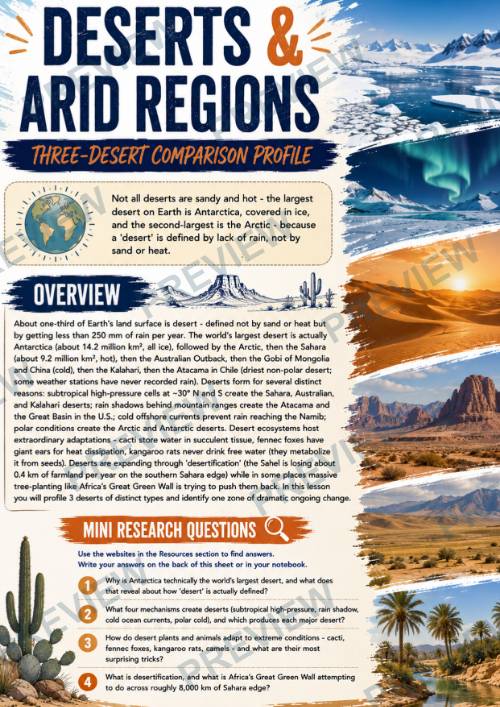
- What defines a desert and why deserts are not always hot or sandy
- The characteristics of hot, cold, coastal, and polar deserts
- How deserts form through different geographic and climatic processes
- Plant and animal adaptations for surviving extreme environments
- Human cultures and life in desert regions
- Desertification and environmental change
- Conservation efforts and sustainable management of arid regions
- Geographic comparison and evidence-based decision making
Perfect For
- Physical Geography
- Earth Science
- Middle School Geography
- Biomes & Ecosystems Units
- Landforms & Climate Studies
- Inquiry-Based Learning
- Research Projects
- Cooperative Learning
- Early Finishers
- Substitute Plans
- Homeschool Learning
Teachers are encouraged to adapt and modify this resource to best meet the needs of their curriculum, students, and classroom learning goals.
·
This resource is also part of a bundle with 9 other resources
Questions
No questions yet.
Ask a question
Your question goes to No Prep Plans. Answers show on this page, without your name or email.
Sent. The answer will show on this page.
Reviews
No reviews yet. Buyers can review a resource from their order page.
More from No Prep Plans
Campus Happiness Index
 No Prep Plans
$3.00
Book Labels
No Prep PlansFree

Big Band & Jazz Musicians Poster Set (1930s–1950s)
No Prep Plans$3.50
FREE Geography Learning Stations Signs & Choice Cards--Reusable
No Prep PlansFree
Refugee: Author's Craft, Themes & Evidence Bundle 10 Literary Analysis Lessons
No Prep Plans$29.25
Ancient World Turning Points Bundle | 10 Research + Group Project Lessons | 6-10
No Prep Plans$29.25
Request a quote or purchase order
For schools and districts. Your request goes to No Prep Plans, who will reply to your email with a quote or invoice.
Sent. The seller will reply to your email.
Report this listing
What your notice must include
The address of the listing on Classroom Clearinghouse (for example, the /p/ link).
https://classroomclearinghouse.com/p/a8t9hxbc2n
Your name, mailing address, phone number, and email.
How to report
Your name, company, mailing address, phone number, and email.
The address of each listing or store you are reporting.
https://classroomclearinghouse.com/p/a8t9hxbc2n
Copyright owners can also use the DMCA notice page.
Thanks. The report is in the review queue.