
Preview: 3 of 17 pages. Scroll sideways to see more.
$3.50
In your cart. View cart
No account needed. You get a download link.
| Grade | 9th Grade to 12th Grade |
|---|---|
| Resource type | Projects |
| Subject | Science |
| Format | PDF, 17 pages |
| How was this made? | Created by hand, with images from generation tools |
| Updated | 2026-10-26 |
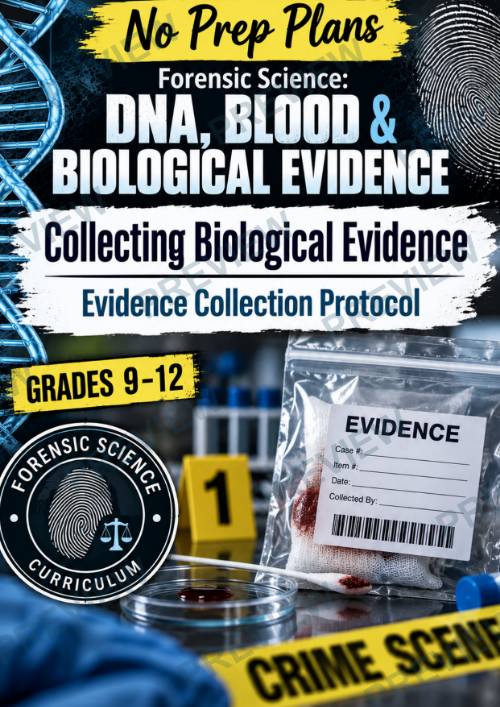
Forensic Science: DNA, Blood & Biological Evidence | Collecting Biologicals
Forensic Science: DNA, Blood & Biological Evidence | Collecting Biological Evidence | Evidence Collection Protocol | Grades 9–12
Teach students that finding biological evidence is only the beginning! In this no-prep Evidence Collection Protocol investigation, students explore how blood, saliva, hair with root, and skin cells must be properly collected, documented, packaged, and preserved to protect their value as forensic evidence.
Students take on the role of crime scene technicians as they research collection procedures, build a step-by-step protocol, identify contamination and degradation risks, and analyze what happens when evidence collection goes wrong. Designed for Grades 9–12 and approximately 1–2 class periods.
What’s Included
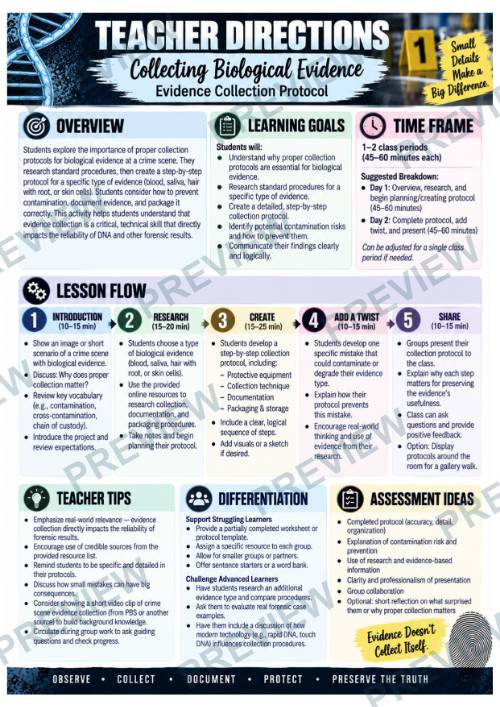
- Teacher Directions
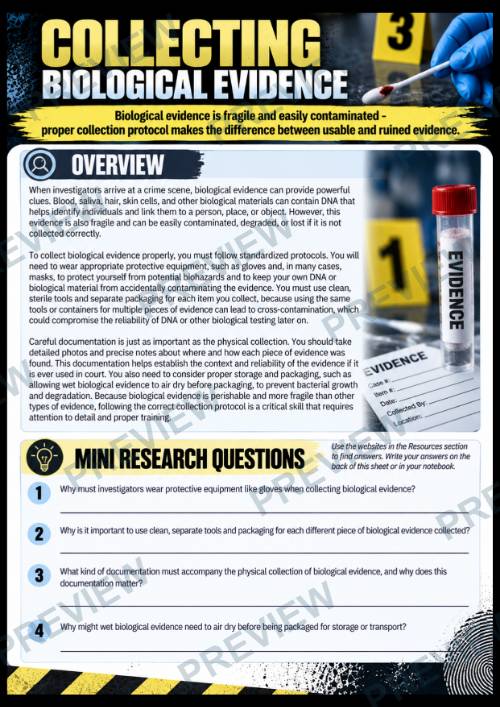
- Student-Friendly Overview
- Mini Research Questions
- Online Resources
- Group Activity: Evidence Collection Protocol
- 3 Student Investigation Pages- Before You Collect: Analyze the Evidence
- Build Your Evidence Collection Protocol
- When Collection Goes Wrong
- Black-and-white versions of student pages
- 2 Teacher Reference Guides- Blood & Saliva Collection Protocols
- Hair with Root & Skin Cells (Touch DNA) Collection Protocols
Students Will
- Compare collection needs for blood, saliva, hair with root, and skin cells
- Examine what technicians must consider before, during, and after collection
- Identify contamination and degradation risks
- Select appropriate PPE, collection tools, and packaging
- Develop a step-by-step biological evidence collection protocol
- Practice documentation and evidence-labeling procedures
- Analyze realistic collection errors and determine how they should be corrected
- Distinguish between contamination, degradation, and loss of context
- Explain why careful collection protects the reliability of later forensic analysis
Good For
High School Forensic Science • DNA, Blood & Biological Evidence Units • Criminalistics • CSI Units • Crime Scene Investigation • Criminal Justice • Law & Public Safety/CTE • STEM Electives • Homeschool • Sub Plans • Small-Group Activities
Why Teachers Love This Resource
- No-prep and classroom ready
- Designed for 1–2 class periods
- Moves beyond vocabulary into practical evidence-handling decisions
- Covers four major types of biological evidence
- Connects collection mistakes to real consequences for forensic analysis
- Emphasizes contamination prevention, documentation, packaging, and preservation
- Includes detailed teacher reference guides
- Includes printer-friendly black-and-white student pages
⭐ Follow & Save!
Disclaimer
This is an independent educational resource created for classroom instruction. It is not affiliated with or endorsed by any law enforcement agency, forensic laboratory, government organization, or other organization referenced within the resource.
Forensic science may involve sensitive topics including crime, violence, blood, DNA, bodily fluids, injuries, death, and other biological evidence. Teachers should preview materials and determine their appropriateness for their students and school community. All forensic scenarios, biological evidence, collection protocols, and investigative activities are provided for educational purposes only and are not intended as professional forensic, medical, or legal training.
·
This resource is also part of a bundle with 9 other resources
Questions
No questions yet.
Ask a question
Your question goes to No Prep Plans. Answers show on this page, without your name or email.
Sent. The answer will show on this page.
Reviews
No reviews yet. Buyers can review a resource from their order page.
More from No Prep Plans
Campus Happiness Index
 No Prep Plans
$3.00
Book Labels
No Prep PlansFree
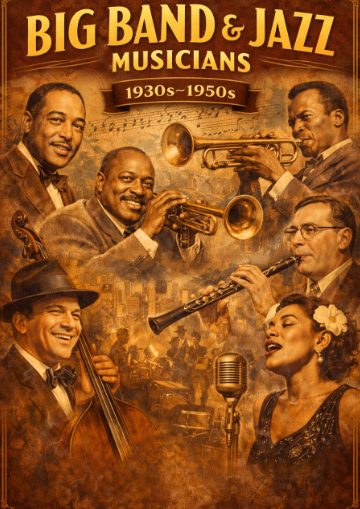
Big Band & Jazz Musicians Poster Set (1930s–1950s)
No Prep Plans$3.50
FREE Geography Learning Stations Signs & Choice Cards--Reusable
No Prep PlansFree
Refugee: Author's Craft, Themes & Evidence Bundle 10 Literary Analysis Lessons
No Prep Plans$29.25
Ancient World Turning Points Bundle | 10 Research + Group Project Lessons | 6-10
No Prep Plans$29.25
Request a quote or purchase order
For schools and districts. Your request goes to No Prep Plans, who will reply to your email with a quote or invoice.
Sent. The seller will reply to your email.
Report this listing
What your notice must include
The address of the listing on Classroom Clearinghouse (for example, the /p/ link).
https://classroomclearinghouse.com/p/9ymzte6fmr
Your name, mailing address, phone number, and email.
How to report
Your name, company, mailing address, phone number, and email.
The address of each listing or store you are reporting.
https://classroomclearinghouse.com/p/9ymzte6fmr
Copyright owners can also use the DMCA notice page.
Thanks. The report is in the review queue.