
Preview: 3 of 14 pages. Scroll sideways to see more.
$3.00
In your cart. View cart
No account needed. You get a download link.
| Grade | 6th Grade to 8th Grade |
|---|---|
| Resource type | Lesson Plans |
| Subject | History |
| Format | PDF, 14 pages |
| How was this made? | Created by hand, with images from generation tools |
| Updated | 2026-10-26 |
No Prep Plans: Ancient Greece Science, Trade & Exploration – Hellenistic Culture
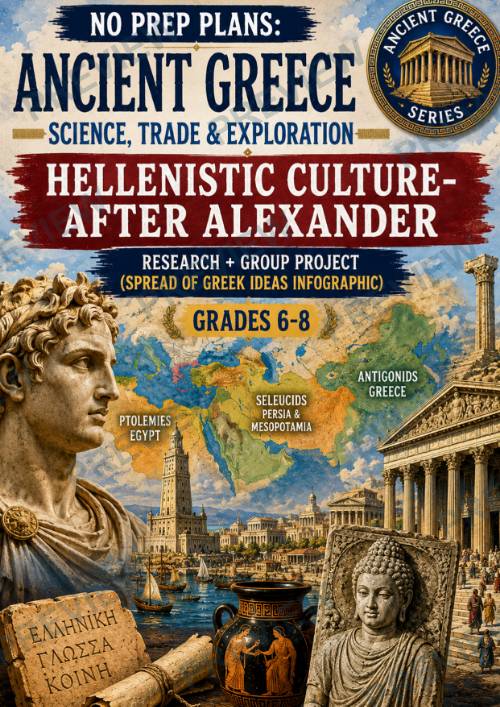
No Prep Plans: Ancient Greece Science, Trade & Exploration – Hellenistic Culture After Alexander Research + Group Project (Spread of Greek Ideas Infographic) | Grades 6–8
Help students discover how Alexander the Great's empire transformed the ancient world long after his death! In this engaging research and project-based lesson, students investigate the rise of the Hellenistic world, exploring how Greek language, art, science, architecture, and ideas spread across three continents and blended with local cultures. Students then apply their learning by designing a Spread of Greek Ideas Infographic that illustrates one of history's greatest examples of cultural diffusion.
Designed for Grades 6–8, this ready-to-use lesson integrates history, geography, art, and critical thinking while requiring minimal teacher preparation.
This resource is part of the Ancient Greece Series and is also included in the Ancient Greece Science, Trade & Exploration Bundle.
What's Included
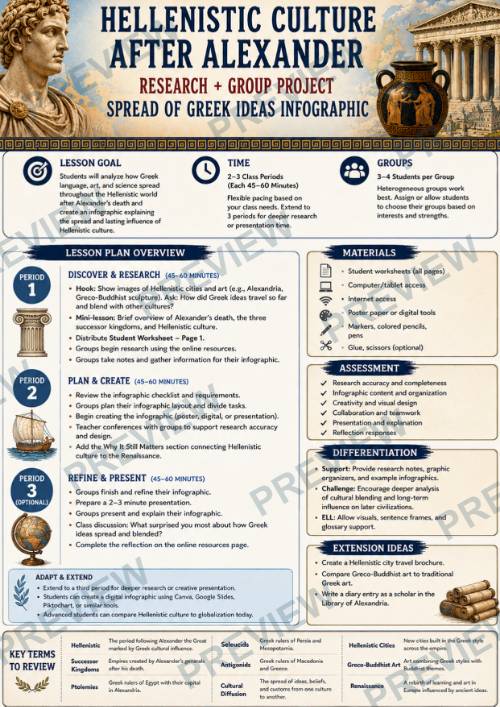
- Teacher directions with options for two or three 45–60 minute lessons
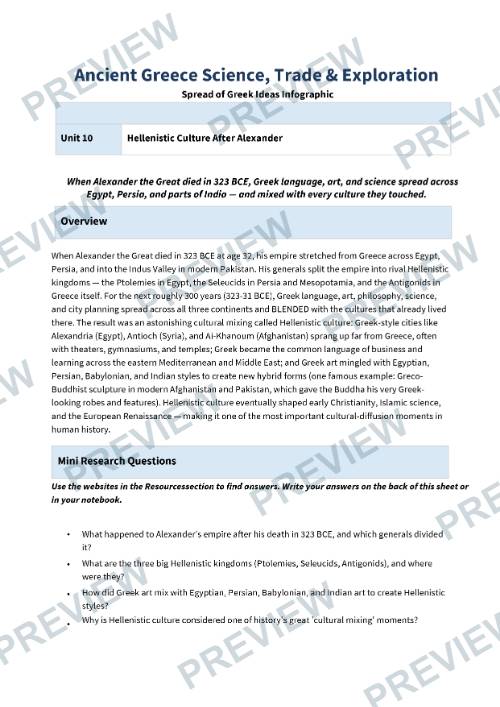
- Historical overview with mini research questions
- Collaborative project planning activity
- Online research resources page
- Student Hellenistic World Research Journal worksheet
- Student Spread of Greek Ideas Infographic planning worksheet
- Student The Greek World Expands reflection worksheet
- Black-and-white versions of all student worksheets for economical printing
Students Will Learn About
- What happened to Alexander the Great's empire after his death
- The three successor kingdoms: the Ptolemies, Seleucids, and Antigonids
- The meaning of the Hellenistic period
- How Greek culture blended with Egyptian, Persian, Babylonian, and Indian traditions
- Major Hellenistic cities including Alexandria, Antioch, and Ai-Khanoum
- Koine Greek as the common language of trade and learning
- Cultural diffusion and the spread of ideas across Europe, Asia, and Africa
- The lasting influence of Hellenistic culture on later civilizations
Skills Developed
- Historical research
- Geographic literacy
- Map interpretation
- Understanding cultural diffusion
- Comparing civilizations
- Critical thinking
- Collaboration and communication
- Infographic design
- Evidence-based writing
Perfect For
- Ancient Greece units
- World History
- Ancient Civilizations
- Geography
- Cultural diffusion lessons
- History of Art
- Research lessons
- Project-Based Learning (PBL)
- Independent or cooperative learning
- Early finishers and enrichment
Part of the Ancient Greece Series
This lesson is one title in the growing Ancient Greece Series, which explores the people, achievements, innovations, culture, and lasting influence of one of history's most remarkable civilizations.
It is also included in the Ancient Greece Science, Trade & Exploration Bundle, where students investigate the discoveries, inventions, technologies, engineering, trade networks, navigation, scientific achievements, and mathematical innovations that helped Ancient Greece shape the ancient and modern world.
Low prep. High engagement. Simply print, research, collaborate, and let students trace the remarkable spread of Greek ideas across three continents, discovering how the Hellenistic world became one of history's greatest examples of cultural exchange and why its influence can still be seen in language, art, science, and learning today.
·
This resource is also part of a bundle with 9 other resources
Questions
No questions yet.
Ask a question
Your question goes to No Prep Plans. Answers show on this page, without your name or email.
Sent. The answer will show on this page.
Reviews
No reviews yet. Buyers can review a resource from their order page.
More from No Prep Plans
Campus Happiness Index
 No Prep Plans
$3.00
Book Labels
No Prep PlansFree
Big Band & Jazz Musicians Poster Set (1930s–1950s)
No Prep Plans$3.50
FREE Geography Learning Stations Signs & Choice Cards--Reusable
No Prep PlansFree
Refugee: Author's Craft, Themes & Evidence Bundle 10 Literary Analysis Lessons
No Prep Plans$29.25
Ancient World Turning Points Bundle | 10 Research + Group Project Lessons | 6-10
No Prep Plans$29.25
Request a quote or purchase order
For schools and districts. Your request goes to No Prep Plans, who will reply to your email with a quote or invoice.
Sent. The seller will reply to your email.
Report this listing
What your notice must include
The address of the listing on Classroom Clearinghouse (for example, the /p/ link).
https://classroomclearinghouse.com/p/9qn7nffpvx
Your name, mailing address, phone number, and email.
How to report
Your name, company, mailing address, phone number, and email.
The address of each listing or store you are reporting.
https://classroomclearinghouse.com/p/9qn7nffpvx
Copyright owners can also use the DMCA notice page.
Thanks. The report is in the review queue.