
Preview: 3 of 15 pages. Scroll sideways to see more.
$4.00
In your cart. View cart
No account needed. You get a download link.
| Grade | 9th Grade to 12th Grade |
|---|---|
| Subject | Science |
| Format | PDF, 15 pages |
| How was this made? | Created by hand, with images from generation tools |
| Updated | 2026-10-26 |
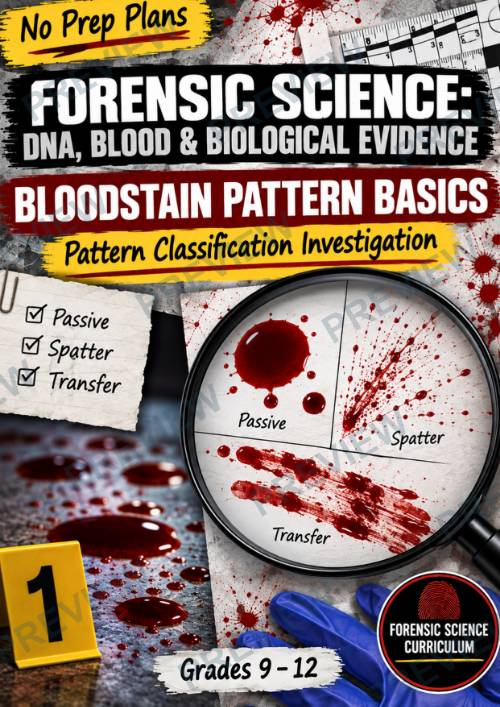
Forensic Science: DNA, Blood & Biological Evidence | Bloodstain Pattern Basics
Forensic Science: DNA, Blood & Biological Evidence | Bloodstain Pattern Basics | Pattern Classification Investigation | Grades 9–12
Introduce students to the fundamentals of bloodstain pattern analysis with this no-prep forensic science investigation for Grades 9–12. Students learn to recognize and distinguish three foundational bloodstain pattern categories—passive, spatter, and transfer—before applying their knowledge to a Pattern Classification Investigation.
Students begin by researching the characteristics of each pattern type and organizing their findings. They then step into the role of bloodstain pattern analysts as they examine six hypothetical evidence scenarios, classify the patterns, identify observations that support their decisions, and evaluate their confidence.
The lesson moves beyond simple classification by asking students to consider ambiguous evidence, limitations of interpretation, and what bloodstain patterns can and cannot reveal. Students finish by considering the additional questions an analyst would need to investigate before attempting a more detailed reconstruction.
What's Included
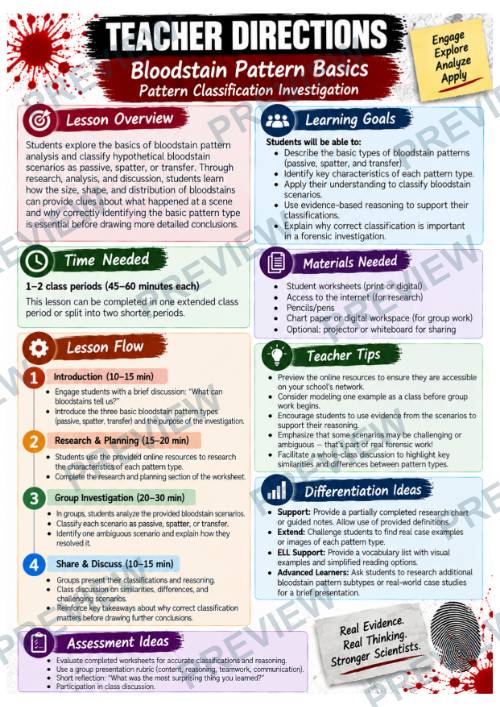
- Teacher Directions with lesson flow, teacher tips, differentiation, and assessment ideas
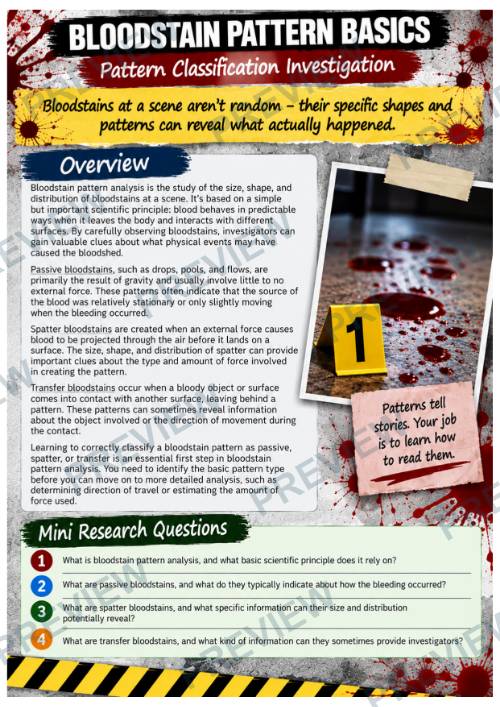
- Student-friendly Bloodstain Pattern Basics Overview
- Mini Research Questions
- Online Resources reference page
- Group Activity directions
- Understand the Patterns student research/analysis page
- Pattern Classification Case File featuring six hypothetical evidence scenarios
- Dig Deeper: From Pattern to Interpretation student analysis page
- Teacher Answer Key with classifications, supporting evidence, and possible/model responses
- Full-color student pages
- Printer-friendly black-and-white versions of student activity pages
Students Will
- Describe the characteristics of passive, spatter, and transfer bloodstain patterns
- Explain how gravity, external force, and contact contribute to different patterns
- Identify visual characteristics useful for distinguishing pattern categories
- Analyze hypothetical bloodstain evidence
- Classify evidence as passive, spatter, or transfer
- Support classifications with observable evidence
- Evaluate their confidence in forensic conclusions
- Recognize when evidence may be ambiguous
- Explain the risks of drawing conclusions beyond what the evidence supports
- Compare different examples within the same pattern category
- Develop questions for more detailed bloodstain analysis
- Practice observation, research, scientific reasoning, collaboration, and evidence-based argumentation
Perfect For:
- High School Forensic Science
- Forensic Biology
- Crime Scene Investigation
- Biology enrichment
- STEM electives
- Homeschool forensic science
- Sub plans
Why Teachers Love This Resource
- No prep and ready for classroom use
- Fits into 1–2 class periods
- Engaging forensic case-file format
- Includes six hypothetical evidence scenarios
- Moves students from research → classification → analysis → interpretation
- Emphasizes evidence-based reasoning, not memorization
- Encourages students to recognize the limitations and ambiguity of forensic evidence
- Includes structured activities while still requiring independent thinking
- Works for individuals, partners, or groups
- Includes color and printer-friendly black-and-white versions
- Includes a teacher answer key with possible/model responses
- Creates a strong foundation for more advanced bloodstain pattern analysis lessons
⭐ Follow & Save!
Disclaimer
This is an independent educational resource created for classroom instruction. It is not affiliated with or endorsed by any law enforcement agency, forensic laboratory, government organization, or other organization referenced within the resource.
Forensic science may involve sensitive topics including crime, violence, blood, DNA, bodily fluids, injuries, death, and other biological evidence. Teachers should preview materials and determine their appropriateness for their students and school community. All forensic scenarios, DNA profiles, bloodstain patterns, and investigative activities are provided for educational purposes only and are not intended as professional forensic, medical, or legal training.
·
This resource is also part of a bundle with 9 other resources
Questions
No questions yet.
Ask a question
Your question goes to No Prep Plans. Answers show on this page, without your name or email.
Sent. The answer will show on this page.
Reviews
No reviews yet. Buyers can review a resource from their order page.
More from No Prep Plans
Campus Happiness Index
 No Prep Plans
$3.00
Book Labels
No Prep PlansFree

Big Band & Jazz Musicians Poster Set (1930s–1950s)
No Prep Plans$3.50
FREE Geography Learning Stations Signs & Choice Cards--Reusable
No Prep PlansFree

Refugee: Author's Craft, Themes & Evidence Bundle 10 Literary Analysis Lessons
No Prep Plans$29.25

Ancient World Turning Points Bundle | 10 Research + Group Project Lessons | 6-10
No Prep Plans$29.25
Request a quote or purchase order
For schools and districts. Your request goes to No Prep Plans, who will reply to your email with a quote or invoice.
Sent. The seller will reply to your email.
Report this listing
What your notice must include
The address of the listing on Classroom Clearinghouse (for example, the /p/ link).
https://classroomclearinghouse.com/p/7w7hncmbkx
Your name, mailing address, phone number, and email.
How to report
Your name, company, mailing address, phone number, and email.
The address of each listing or store you are reporting.
https://classroomclearinghouse.com/p/7w7hncmbkx
Copyright owners can also use the DMCA notice page.
Thanks. The report is in the review queue.