
Preview: 3 of 14 pages. Scroll sideways to see more.
$3.50
In your cart. View cart
No account needed. You get a download link.
| Grade | 9th Grade to 12th Grade |
|---|---|
| Resource type | Lesson Plans |
| Subject | Science |
| Format | PDF, 14 pages |
| How was this made? | Created by hand, with images from generation tools |
| Updated | 2026-10-26 |
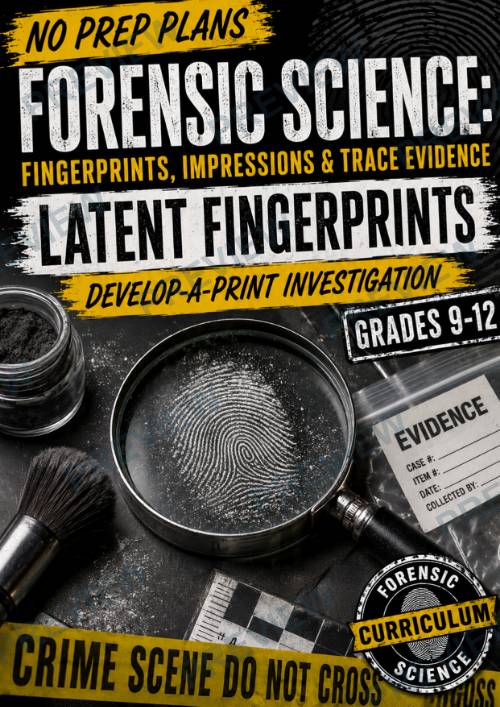
No Prep Plans | Forensic Science: Latent Fingerprints
No Prep Plans | Forensic Science: Latent Fingerprints | Develop-a-Print Investigation Latent Fingerprint Development Research + Crime Scene Investigation | Grades 9–12
Turn invisible evidence into an engaging forensic investigation! In this no-prep forensic science lesson, students investigate how latent fingerprints are created, developed, and preserved while exploring why forensic examiners must select development techniques based on the surface containing the print.
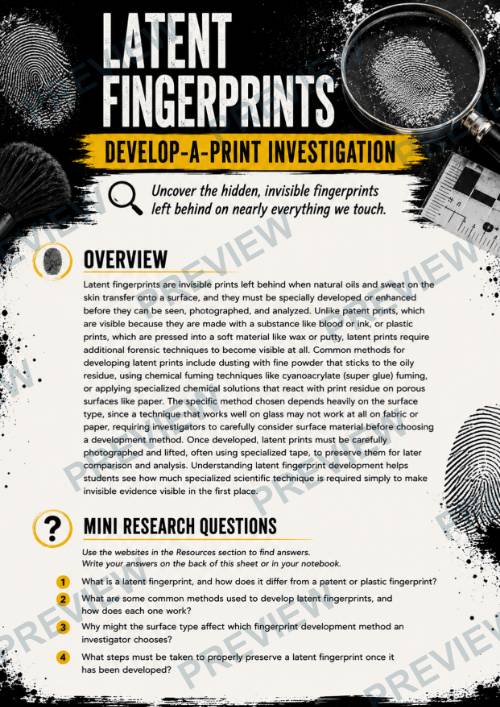
Students compare latent, patent, and plastic fingerprints, explore techniques such as powder dusting, cyanoacrylate fuming, and chemical development, and apply their research in a Develop-a-Print Investigation. Groups determine the best development methods for different crime scene surfaces and defend their forensic decisions.
WHAT’S INCLUDED
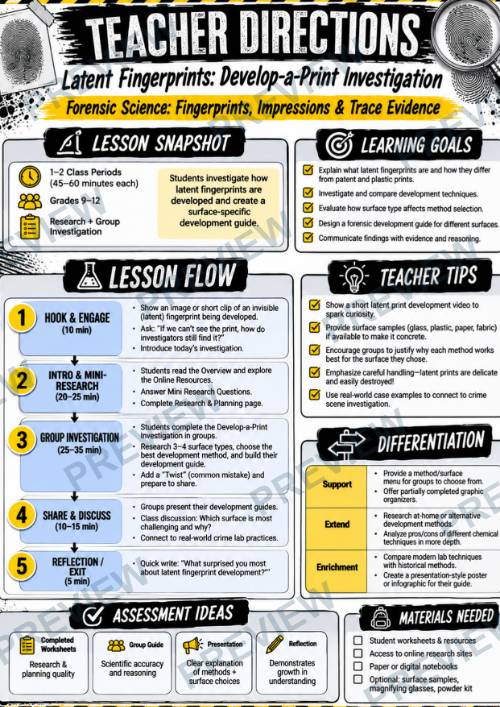
- Teacher directions + lesson overview
- Develop-a-Print group investigation
- Research resources + mini research questions
- Student research, analysis + planning pages
STUDENTS WILL
- Distinguish latent, patent, and plastic fingerprints
- Investigate common latent print development methods
- Compare porous and nonporous surfaces
- Match development techniques to different surfaces
- Analyze mistakes that could damage or destroy evidence
- Examine how developed prints are preserved
- Create and defend a surface-specific development guide
WHY TEACHERS LOVE THIS
- No prep and ready to use
- Designed for 1–2 class periods of approximately 45–60 minutes
- Connects fingerprint science to realistic forensic decisions
- Moves beyond simple vocabulary and identification
- Builds research, analysis, and evidence-based reasoning
- Combines individual thinking with collaborative investigation
PERFECT FOR
- High School Forensic Science
- Latent Fingerprint Lessons
- Fingerprints, Impressions & Trace Evidence
- Crime Scene Investigation Units
- Evidence Collection & Preservation
- Forensic Science Electives
- Group Investigations
- Sub Plans or Enrichment
QUICK SETUP
Provide students with the investigation materials and access to the included research resources. Students investigate latent print development, compare techniques and surfaces, evaluate potential mistakes, and create a development guide showing how forensic examiners can reveal and preserve otherwise invisible evidence.
FOLLOW & SAVE 10%
·
This resource is also part of 2 bundles

Questions
No questions yet.
Ask a question
Your question goes to No Prep Plans. Answers show on this page, without your name or email.
Sent. The answer will show on this page.
Reviews
No reviews yet. Buyers can review a resource from their order page.
More from No Prep Plans
Campus Happiness Index
 No Prep Plans
$3.00
Book Labels
No Prep PlansFree

Big Band & Jazz Musicians Poster Set (1930s–1950s)
No Prep Plans$3.50

FREE Geography Learning Stations Signs & Choice Cards--Reusable
No Prep PlansFree

Refugee: Author's Craft, Themes & Evidence Bundle 10 Literary Analysis Lessons
No Prep Plans$29.25

Ancient World Turning Points Bundle | 10 Research + Group Project Lessons | 6-10
No Prep Plans$29.25
Request a quote or purchase order
For schools and districts. Your request goes to No Prep Plans, who will reply to your email with a quote or invoice.
Sent. The seller will reply to your email.
Report this listing
What your notice must include
The address of the listing on Classroom Clearinghouse (for example, the /p/ link).
https://classroomclearinghouse.com/p/6ry7hacdm2
Your name, mailing address, phone number, and email.
How to report
Your name, company, mailing address, phone number, and email.
The address of each listing or store you are reporting.
https://classroomclearinghouse.com/p/6ry7hacdm2
Copyright owners can also use the DMCA notice page.
Thanks. The report is in the review queue.