
Preview: 3 of 14 pages. Scroll sideways to see more.
$3.00
In your cart. View cart
No account needed. You get a download link.
| Grade | 5th Grade to 8th Grade |
|---|---|
| Subject | Music |
| Format | PDF, 14 pages |
| How was this made? | Created by hand, with images from generation tools |
| Updated | 2026-10-26 |
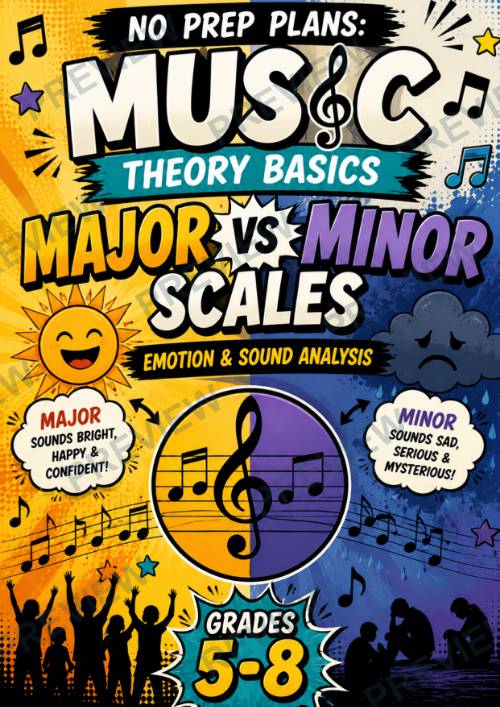
Music Theory Basics: Major vs Minor ScalesEmotion & Sound Analysis | Grades 5–8
Music Theory Basics: Major vs Minor ScalesEmotion & Sound Analysis | Grades 5–8
Help students discover how music shapes emotion with this engaging No Prep Plans lesson on Major vs Minor Scales. Students investigate how different scales create different moods, compare songs in major and minor keys, and explore how composers use musical choices to influence the way audiences feel. They finish by creating an Emotion & Sound Analysis Poster that demonstrates their understanding through examples, comparisons, and creative thinking.
Designed for upper elementary and middle school music classrooms, this lesson combines music theory, listening skills, research, and visual communication in a creative, hands-on project that requires minimal teacher preparation.
What's Included
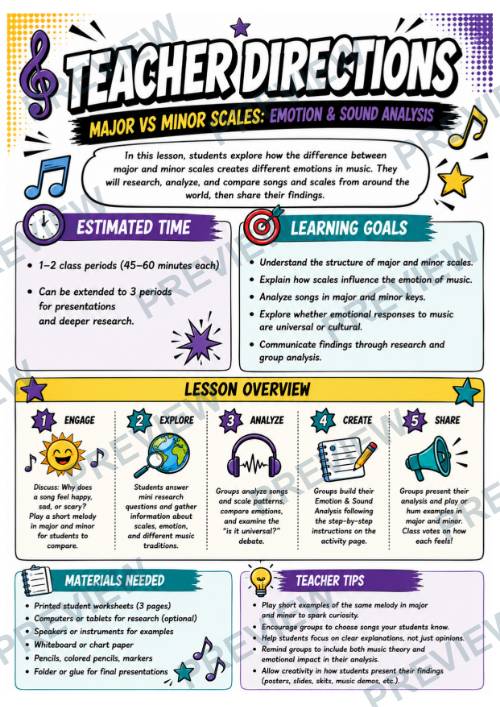
- Teacher Directions (1–2 class periods)
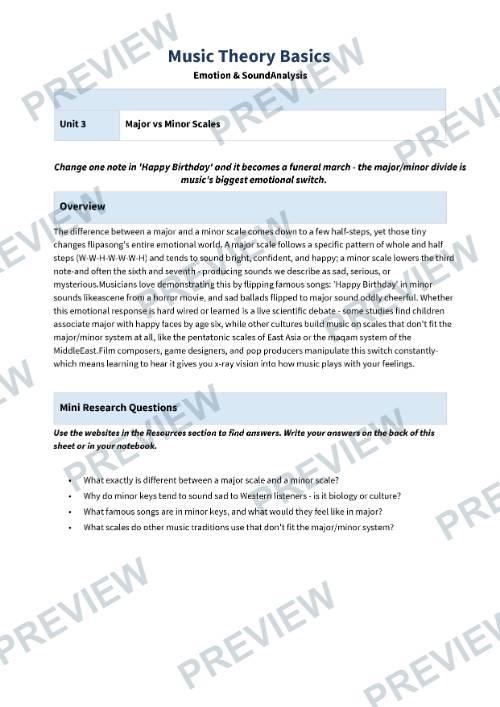
- Student Research Organizer
- Poster Planning Page
- Final Emotion & Sound Analysis Poster
- Full-color student pages
- Printer-friendly black-and-white versions
Students Will Learn About
- The differences between major and minor scales
- How scales influence emotion and mood
- Common emotional associations with major and minor music
- Listening critically to musical examples
- Comparing songs in different keys
- Music from cultures beyond the major/minor system
- How composers use music to support storytelling
- Presenting musical ideas through an engaging poster
Perfect For
- General Music
- Music Theory
- Band
- Choir
- Orchestra
- Music Appreciation
- Listening activities
- Independent research
- Early finisher activities
- Sub plans
- Project-based learning
Why Teachers Love It
- Print-and-go lesson requiring minimal preparation
- Connects music theory with real-world listening experiences
- Encourages critical thinking and musical analysis
- Builds research, discussion, and presentation skills
- Promotes creativity through an authentic final product
- Includes both color and printer-friendly versions
- Large writing and drawing spaces designed for Grades 5–8 learners
This resource is part of the No Prep Plans: Music Theory Basics series, where students explore essential music concepts through engaging research and hands-on creative projects that build musical understanding, confidence, and creativity.
·
This resource is also part of a bundle with 9 other resources
Questions
No questions yet.
Ask a question
Your question goes to No Prep Plans. Answers show on this page, without your name or email.
Sent. The answer will show on this page.
Reviews
No reviews yet. Buyers can review a resource from their order page.
More from No Prep Plans
Campus Happiness Index
 No Prep Plans
$3.00
Book Labels
No Prep PlansFree

Big Band & Jazz Musicians Poster Set (1930s–1950s)
No Prep Plans$3.50
FREE Geography Learning Stations Signs & Choice Cards--Reusable
No Prep PlansFree

Refugee: Author's Craft, Themes & Evidence Bundle 10 Literary Analysis Lessons
No Prep Plans$29.25
Ancient World Turning Points Bundle | 10 Research + Group Project Lessons | 6-10
No Prep Plans$29.25
Request a quote or purchase order
For schools and districts. Your request goes to No Prep Plans, who will reply to your email with a quote or invoice.
Sent. The seller will reply to your email.
Report this listing
What your notice must include
The address of the listing on Classroom Clearinghouse (for example, the /p/ link).
https://classroomclearinghouse.com/p/56geagq4jd
Your name, mailing address, phone number, and email.
How to report
Your name, company, mailing address, phone number, and email.
The address of each listing or store you are reporting.
https://classroomclearinghouse.com/p/56geagq4jd
Copyright owners can also use the DMCA notice page.
Thanks. The report is in the review queue.