
Preview: 3 of 14 pages. Scroll sideways to see more.
$3.00
In your cart. View cart
No account needed. You get a download link.
| Grade | 5th Grade to 8th Grade |
|---|---|
| Resource type | Projects |
| Subject | Reading |
| Format | PDF, 14 pages |
| How was this made? | Created by hand, with images from generation tools |
| Updated | 2026-10-26 |
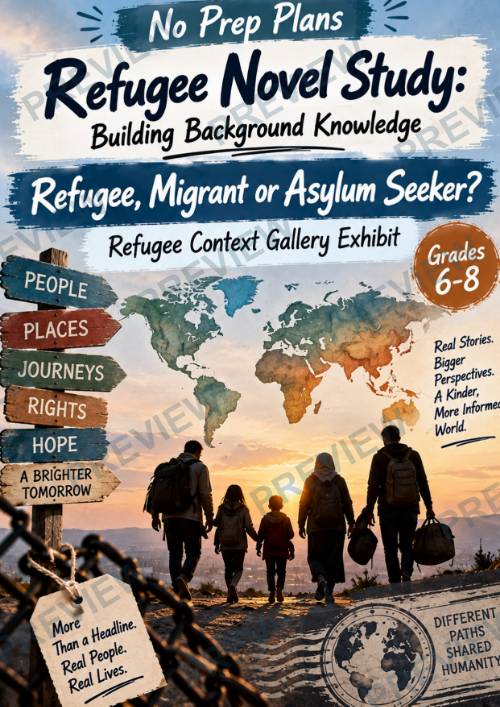
Refugee Novel Study | Refugee, Migrant or Asylum Seeker? Background Knowledge
Refugee Novel Study | Refugee, Migrant or Asylum Seeker? Background Knowledge
Help students better understand Refugee by Alan Gratz while learning the important differences between the terms refugee, migrant, asylum seeker, and internally displaced person.
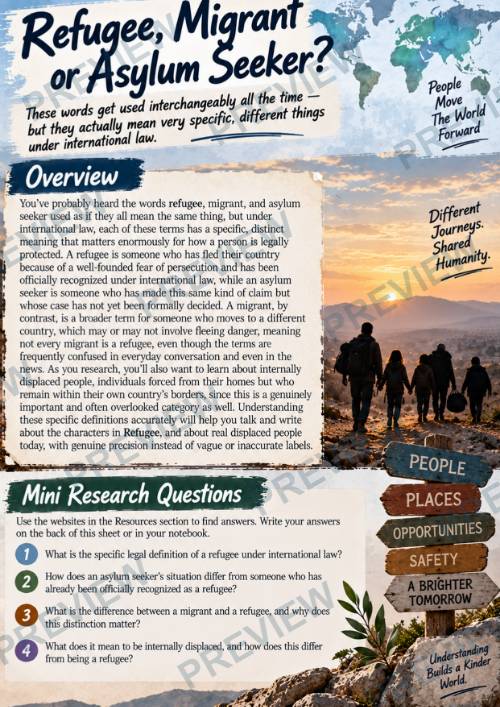
This no-prep Refugee novel study background knowledge activity helps students move beyond using these terms interchangeably. Students research their specific meanings, examine how a person’s circumstances and status can change during a journey, and practice selecting the most accurate terminology based on evidence.
Students then apply their understanding directly to Josef, Isabel, or Mahmoud, analyzing a specific point in the character’s journey before collaborating to create a Refugee Context Gallery Exhibit.
Students Will:
- Distinguish between refugee, migrant, asylum seeker, and internally displaced person
- Apply terminology to realistic scenarios
- Identify the details that determine which term is most accurate
- Examine how circumstances and status can change during a journey
- Apply terminology to Josef, Isabel, or Mahmoud
- Support classifications with evidence
- Explain why accurate terminology matters
- Evaluate the reliability of research sources
- Collaborate to create a Gallery Walk presentation
What’s Included:
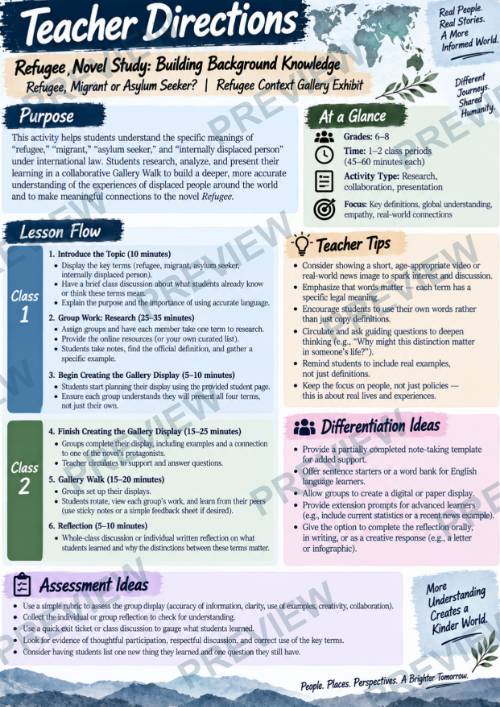
- Teacher Directions & lesson overview
- Mini research questions & reliable resources
- Group Gallery Walk activity
- 3 student research, application & planning pages
- Novel connection activities
- Gallery Exhibit planner & checklist
- Color and black-and-white student pages
Group Activity: Refugee Context Gallery Exhibit
Students work in groups to become experts on refugee, migrant, asylum seeker, and internally displaced person. They research the terminology using authoritative sources and create a Gallery Walk display that clearly distinguishes the four terms using specific examples.
As an added challenge, students identify which term applies to one of the novel’s three protagonists at a specific point in the story and explain their reasoning using evidence.
Perfect For:
- Refugee by Alan Gratz novel studies
- Pre-reading & background knowledge
- Middle school ELA
- Social Studies & Humanities
- Refugee and migration studies
- Cross-curricular ELA & Social Studies
- Sub plans
Why Teachers Love It:
- No prep and ready to use
- Builds important background knowledge for Refugee
- Goes beyond memorizing definitions
- Gives students practice applying terminology to real situations
- Encourages evidence-based reasoning
- Helps students understand that circumstances can change during a journey
- Makes meaningful connections to Josef, Isabel, and Mahmoud
- Reinforces respectful and precise language when discussing displaced people
- Develops research, collaboration, analysis, and presentation skills
Students finish the lesson understanding not only what these commonly confused terms mean, but also why choosing the right word matters when discussing the experiences of real people and the characters in Refugee.
·
This resource is also part of a bundle with 9 other resources
Questions
No questions yet.
Ask a question
Your question goes to No Prep Plans. Answers show on this page, without your name or email.
Sent. The answer will show on this page.
Reviews
No reviews yet. Buyers can review a resource from their order page.
More from No Prep Plans
Campus Happiness Index
 No Prep Plans
$3.00
Book Labels
No Prep PlansFree

Big Band & Jazz Musicians Poster Set (1930s–1950s)
No Prep Plans$3.50
FREE Geography Learning Stations Signs & Choice Cards--Reusable
No Prep PlansFree
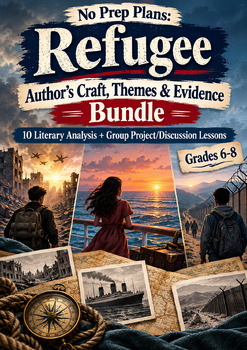
Refugee: Author's Craft, Themes & Evidence Bundle 10 Literary Analysis Lessons
No Prep Plans$29.25
Ancient World Turning Points Bundle | 10 Research + Group Project Lessons | 6-10
No Prep Plans$29.25
Request a quote or purchase order
For schools and districts. Your request goes to No Prep Plans, who will reply to your email with a quote or invoice.
Sent. The seller will reply to your email.
Report this listing
What your notice must include
The address of the listing on Classroom Clearinghouse (for example, the /p/ link).
https://classroomclearinghouse.com/p/549t5ga7dx
Your name, mailing address, phone number, and email.
How to report
Your name, company, mailing address, phone number, and email.
The address of each listing or store you are reporting.
https://classroomclearinghouse.com/p/549t5ga7dx
Copyright owners can also use the DMCA notice page.
Thanks. The report is in the review queue.