
Preview: 3 of 20 pages. Scroll sideways to see more.
$4.50
In your cart. View cart
No account needed. You get a download link.
| Grade | 9th Grade to 12th Grade |
|---|---|
| Resource type | Projects |
| Subject | Science |
| Format | PDF, 20 pages |
| How was this made? | Created by hand, with images from generation tools |
| Updated | 2026-10-26 |
Forensic Science: DNA, Blood & Biological Evidence | Forensic Anthropology
Forensic Science: DNA, Blood & Biological Evidence | Forensic Anthropology | Skeletal Evidence Analysis | Grades 9–12
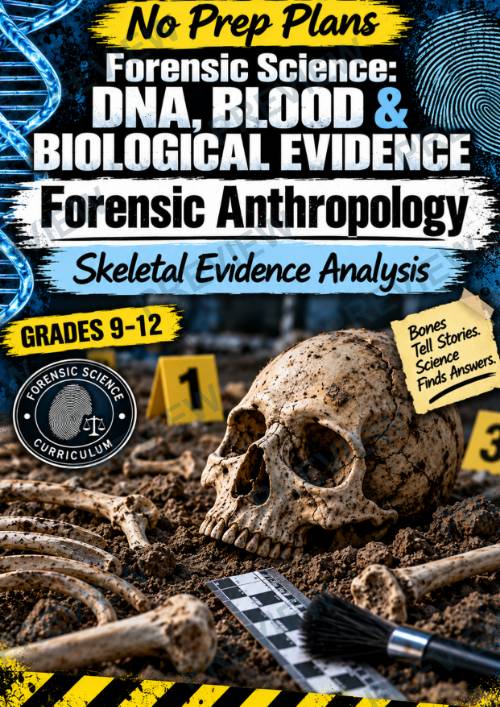
Bring forensic anthropology into your classroom with this no-prep Skeletal Evidence Analysis investigation! Students explore how forensic anthropologists examine skeletal remains to develop a biological profile, including estimates of age, biological sex, ancestry/population affinity, and stature. Students then apply their understanding to a hypothetical case, analyze specific skeletal evidence, examine trauma, and consider both the value and limitations of skeletal evidence.
What’s Included
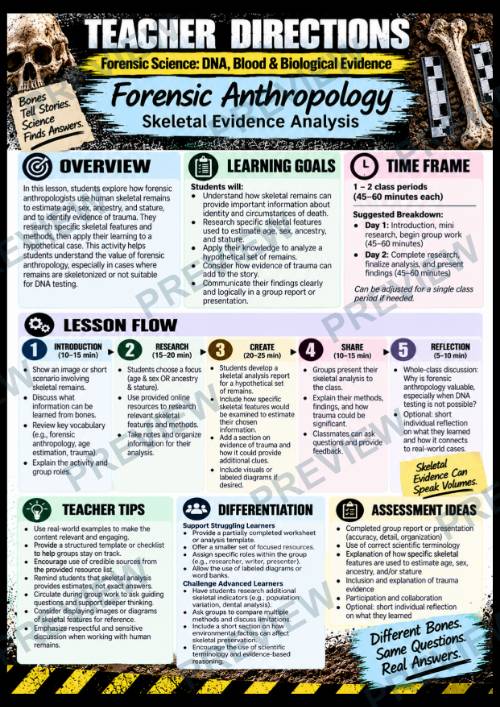
- Teacher Directions
- Student-Friendly Forensic Anthropology Overview
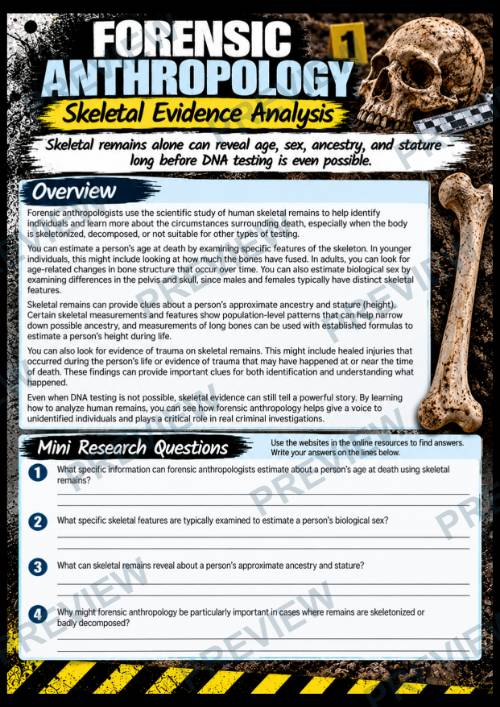
- Mini Research Questions
- Group Activity: Skeletal Evidence Analysis
- 3 Student Investigation Pages- Understand the Evidence: Reading the Skeleton
- Case File: Build the Biological Profile
- Dig Deeper: Trauma, Limits & the Story in the Bones
- 3 Teacher Reference Pages- Age & Biological Sex Indicators
- Ancestry, Stature & Skeletal Measurements
- Labeled Human Skeleton Reference
- 2 Teacher Answer Key Pages- Reading the Skeleton & Building the Biological Profile
- Trauma, Limits & Final Report
- Color and printer-friendly black-and-white student pages
Students Will
- Examine skeletal features used in forensic anthropology
- Analyze age-related skeletal indicators
- Compare pelvic and skull traits used to estimate biological sex
- Explore ancestry/population-affinity indicators and their limitations
- Use long-bone measurements to estimate stature
- Build an evidence-supported biological profile
- Distinguish between antemortem and possible perimortem trauma
- Analyze healed, unhealed, and ambiguous skeletal features
- Explain what skeletal evidence can—and cannot—establish
- Evaluate how skeletal evidence can assist an investigation when DNA is unavailable
- Write a concise forensic anthropologist report using appropriate scientific language
Good For
High School Forensic Science • Forensic Anthropology • DNA, Blood & Biological Evidence Units • Criminalistics • CSI Units • Human Anatomy Connections • Criminal Justice • Law & Public Safety/CTE • STEM Electives • Homeschool • Sub Plans • Small-Group Investigations
Why Teachers Love This Resource
- No prep and classroom ready
- Designed for 1–2 class periods
- Uses one consistent hypothetical case
- Moves from research → evidence analysis → interpretation
- Includes supplied skeletal evidence rather than requiring students to invent a case
- Encourages cautious, evidence-based forensic conclusions
- Addresses the limitations and uncertainty of skeletal analysis
⭐ Follow & Save!
Disclaimer
This is an independent educational resource created for classroom instruction. It is not affiliated with or endorsed by any law enforcement agency, forensic laboratory, government organization, or other organization referenced within the resource.
Forensic science may involve sensitive topics including crime, violence, blood, DNA, bodily fluids, injuries, death, human remains, and other biological evidence. Teachers should preview materials and determine their appropriateness for their students and school community.
All forensic scenarios, skeletal evidence, biological profiles, trauma observations, measurements, and investigative activities are provided for educational purposes only and are not intended as professional forensic, medical, or legal training.
·
This resource is also part of a bundle with 9 other resources
Questions
No questions yet.
Ask a question
Your question goes to No Prep Plans. Answers show on this page, without your name or email.
Sent. The answer will show on this page.
Reviews
No reviews yet. Buyers can review a resource from their order page.
More from No Prep Plans
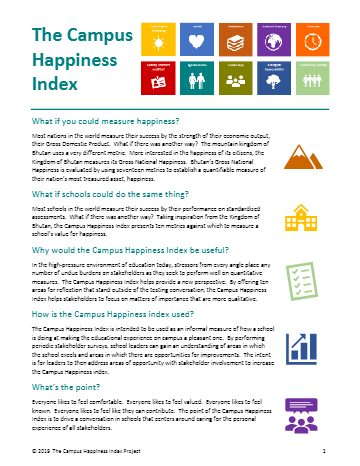
Campus Happiness Index
 No Prep Plans
$3.00
Book Labels
No Prep PlansFree
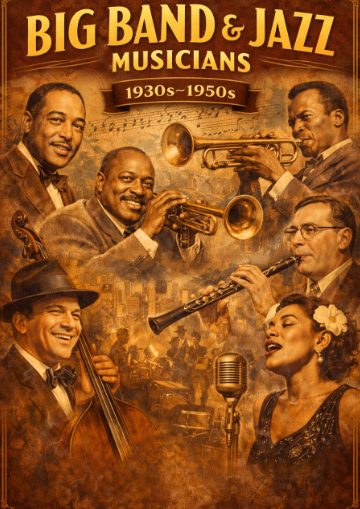
Big Band & Jazz Musicians Poster Set (1930s–1950s)
No Prep Plans$3.50
FREE Geography Learning Stations Signs & Choice Cards--Reusable
No Prep PlansFree

Refugee: Author's Craft, Themes & Evidence Bundle 10 Literary Analysis Lessons
No Prep Plans$29.25
Ancient World Turning Points Bundle | 10 Research + Group Project Lessons | 6-10
No Prep Plans$29.25
Request a quote or purchase order
For schools and districts. Your request goes to No Prep Plans, who will reply to your email with a quote or invoice.
Sent. The seller will reply to your email.
Report this listing
What your notice must include
The address of the listing on Classroom Clearinghouse (for example, the /p/ link).
https://classroomclearinghouse.com/p/4v4qzsszu2
Your name, mailing address, phone number, and email.
How to report
Your name, company, mailing address, phone number, and email.
The address of each listing or store you are reporting.
https://classroomclearinghouse.com/p/4v4qzsszu2
Copyright owners can also use the DMCA notice page.
Thanks. The report is in the review queue.